Florence Wright
By Marv Goldberg
© 2026 by Marv Goldberg
Florence Wright was another of those singers with a nice voice and a short career.
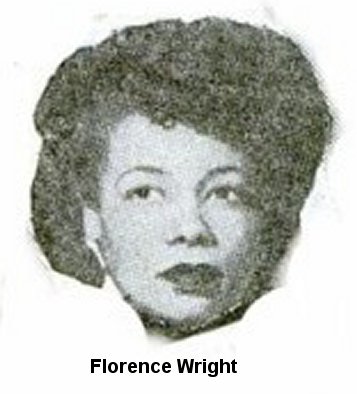
NOTE: there's only one known photo of Florence Wright, first appearing in 1949.
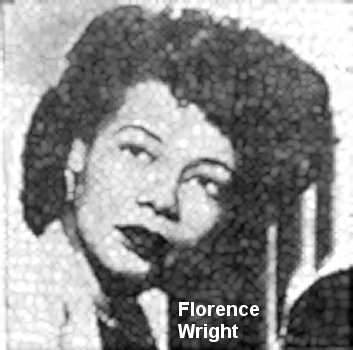
Florence Wright was born Florence "Flossie" Barnett on August 11, 1928, in Orange, New Jersey. Her father was Clifford Barnett and her mother was Mary Bird Stembridge (although it's wrongly seen as "Sternbridge"). Clifford and Mary had married in Crawford County, Georgia in 1907.
In the 1920 census (Houston County, Georgia), the family consisted of 5 children, in addition to Clifford (a farmer) and Mary: James L. (6), John A. (5), Clifford (3), Willie (2), and Hewitt (1 month). Both Clifford, Jr and Hewitt would die prior to the 1930 census.
By 1930, the family had relocated to Orange, New Jersey (by way of Washington, D.C.). Clifford was now a plasterer and the new additions to the family were: Mattie Pearl (8; born in D.C.), Dora (4; born in NJ), and Flossie (1; born in NJ).
While Clifford and Mary were still together in the 1932 Orange City Directory, by 1940, when they were living in East Orange, Clifford (now a mason) was married to Hettie. His children, John, William, Dora, and Flossy, were still with him.
In 1946, sometime after June, Florence Barnett married Willie Wright (she wasn't named in his June 1946 military registration). Over the years, they'd have five children: Willie A., Candice, Vanessa, Kim, and Carla. They set up housekeeping in Newark, although they'd eventually move back to Orange.
Since you're probably pretty tired of her family by now, the September 6, 1949 Washington Afro-American reported that Florence Wright had signed with National Records:
NEWARK, NJ. National Records announces the signing of an exclusive five-year contract with Florence Wright, sensational new song stylist from Newark, NJ.
Florence, who is 22 years old and looks as pretty as she sounds, was visiting Station WAAT in Newark while Bill Cook (disc jockey) was on the air. A. B Green, National prexy, and Sylvia Langler were there at the time. visiting with Bill and they heard Florence humming a tune that was being aired over WAAT.
Later, Florence was introduced to Count Basie at one of the Count's rehearsals, and his carefully considered verdict was: "I've given her every kind of test and hers is one of the finest new voices I've heard in years."
Florence has an adaptable voice that lends itself equally well to ballad, blues and novelty tunes. She will cut her first National sides within the next few weeks.
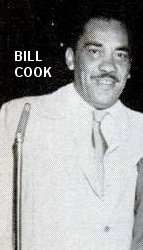 You can forget Green and Langler, it was Bill Cook who took credit for discovering her.
On September 30, 1949, in New York City, Florence had her first National session: "Deal Me A Hand (I'll Play the Game Anyway)", "Farewell to Arms", "Moody Music", and "(Nobody Wins In) The Game Of Broken Hearts". The musicians on the session were Howard Biggs (piano), Mundell Lowe (guitar), Stan Webb (tenor sax), Teddy Charles (vibes), and Al Hall (bass).
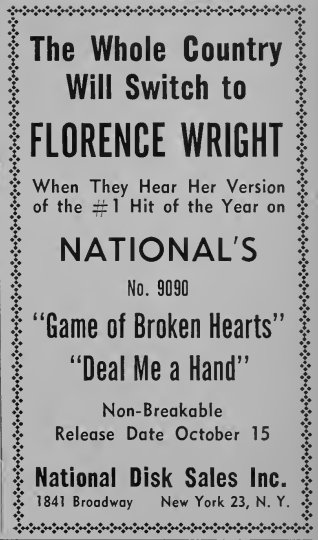
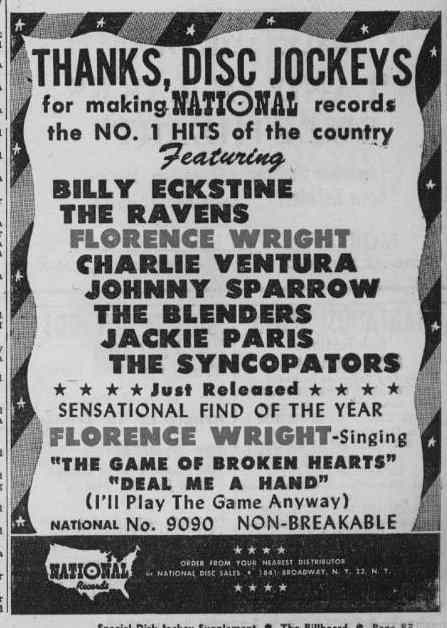
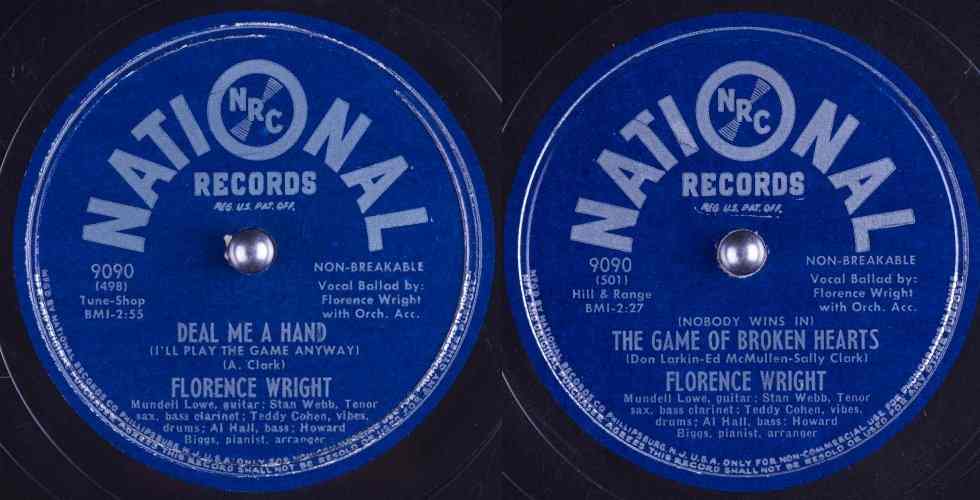 In October 1949 (an ad said that the release date was October 15), National released "Deal Me A Hand (I'll Play The Game Anyway)", backed with "(Nobody Wins In) The Game Of Broken Hearts". A very popular song, "The Game Of Broken Hearts" was originally done by Sally and Marvin Clark (in September), the Magichords (in October), the 3 Suns (in October), Doris Day (in October), Patti Page (in November), and Kay Starr, with the Jubilaires (in December).
Another article appeared in the October 16, 1949 Washington Afro-American:
Twenty-one-year-old Orange-born Florence Wright is being hailed by disc jockeys as the year's new singing sensation, and the cutest little package to come out of that part of Jersey in a long time.
She was 'discovered' by A. B. Green, head of National Records, who heard her humming in the background during a disc jockey session being conducted by Bill Cook on a Newark station.The next day Florence had a five-year contract with the recording firm and already has cut two sides: "Deal Me a Hand (I'll Play The Game Anyway)", and "Nobody Wins In the Game of Broken Hearts", due for an early release.
Florence's mother was a missionary and her work took her to different parts of the country. Little Florence, just 12 years of age, sang spirituals while her mother played the guitar.
During one of these trips Florence heard of an amateur contest being held nearby and decided to try her luck. She borrowed her older sister's clothes, used a faint touch of lipstick and went to the theatre. Her uninhibited voice and her enthusiasm won her the coveted first prize. From then on, Florence dreamed of being in the spotlight.Much later, during the war days. she entertained troops stationed nearby in Jersey. Her heart was so completely in this work that she wrote and dedicated a poem to the Orange Honor Roll of War Veterans. She was commended by Ralph Giordano, commissioner of public works in Orange. This letter of commendation still hangs in the Orange City Hall.
Her voice is described as "one that can lend itself equally as well to ballads as it can to blues and novelty numbers."
I have no idea how much of that was invented by a press agent.
The National release was reviewed in the October 29, 1949 issues of Billboard and Cash Box:
The Game Of Broken Hearts (BB; 77): Bluesy thrush and star jazz men do a pleasing turn on the sleeper ballad that first showed signs as a hillbilly.
Deal Me A Hand (BB; 71): It's game time at National. Gal's style is a cross between D. Washington and S. Vaughan. Middlin' stuff.
Cash Box (Award O' The Week): New chirp makes her bow on National wax and steps out in a blaze of glory to notch this featured spot via a smash disking if there ever was one. It's Florence Wright, a lass who certainly has a bright future if this first platter is any indication. Wax, titled "The Game of Broken Hearts" and "Deal Me A Hand", shows the thrush's pipes off to excellent advantage. Her sincere vocal strains spoon the lyrics of the top deck in a ton of meaningful tones that satisfy. Ditty is essentially a tender one, well loaded with pathos and sorrow. Miss Wright's recording of this tune, currently causing loads of attention in the music business, is top drawer material from start to finish. The flip, "Deal Me A Hand", spills in slow blues tempo and has the canary turning in another wonderful performance. Both sides of this platter should reap harvest for music ops, with "The Game Of Broken Hearts" leading the way!
The Newark Star Ledger of November 20 said:
Florence Wright seems to be putting her hometown of Orange on the map through her National Records waxing of "Deal Me A Hand (I'll Play The Game Anyway)" and "Nobody Wins In The Game Of Broken Hearts". The disc jockeys not only rave about Florence, but play and play and play her records.
However, "Game" never became a hit, probably because it was competing with so many other versions. As far as I can tell, none of them became a hit.
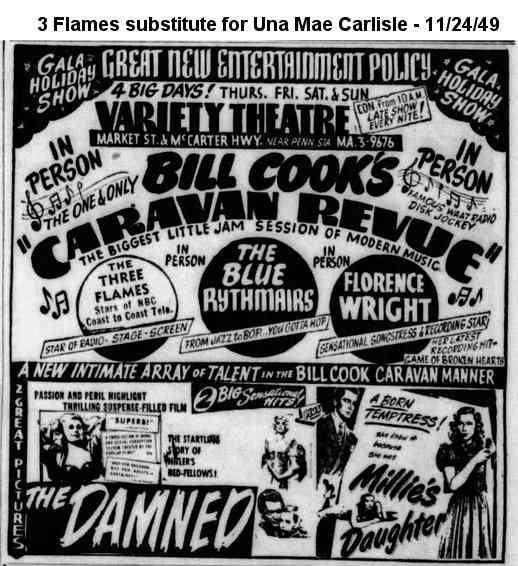
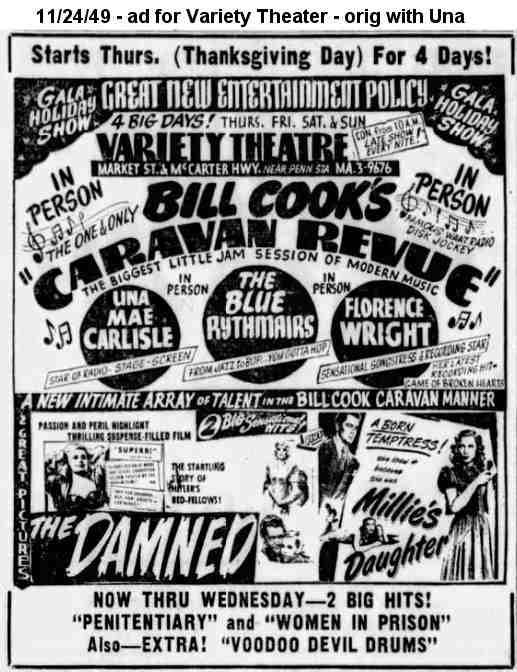 Florence's first known appearance was when she played Newark's Variety Theater from November 24-27, 1949. The show was Bill Cook's "Caravan Revue", starring Una Mae Carlisle, the Blue Rhythmaires, and Florence. However, Una was stricken with pleurisy right before the show and Tiger Haynes & the 3 Flames were quickly rushed in to replace her.
In Cash Box's annual music poll for 1949, Florence didn't do all that well in the Best Female Vocalist Of 1949, coming in 15th out of 18. However, since she was completely unknown for most of the year, that isn't surprising. The winner was Doris Day (38,426 points), beating out Margaret Whiting, Evelyn Knight, Jo Stafford, Kay Starr, Dinah Shore, Fran Warren, Peggy Lee, Sarah Vaughan, Connie Haines, Ella Fitzgerald, Mindy Carson, Patti Page, and Rosemary Clooney.
The December 9, 1949 New York Daily News said: "A new night club called National Jazz Festival opens on the site of the former Click Club, Dec. 15. All this jazz joint has to offer is Max Kaminsky and group, Hot Lips Paige, Lester Young and group, the Stan Gets [sic; should be "Getz"] trio, the Lennie Tristano group, the Charlie Parker ensemble, and individual solos by Harry Belafonte and Florence Wright. Nothing else." Actually, the club wasn't called "National Jazz Festival" at all. That was the name of the first show put on when Birdland opened on that date. (Keep in mind that, years before his Calypso hits, Belafonte was a straight pop/jazz singer.)
I can't imagine why, but "The Game Of Broken Hearts" was #1 on Bill Cook's WAAT show the week of December 17 (I lied; yes I can). It was also #4 on Hal Jackson's WLIB show that week. "Deal Me A Hand" was #5 in Philadelphia on December 31.
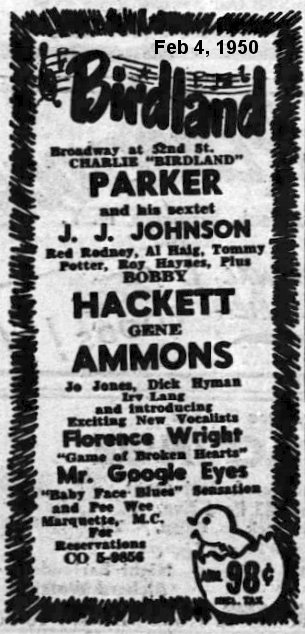 Florence was still at Birdland in February 1950, along with Charlie Parker, Bobby Hackett, Gene Ammons, and Mr. Google Eyes.
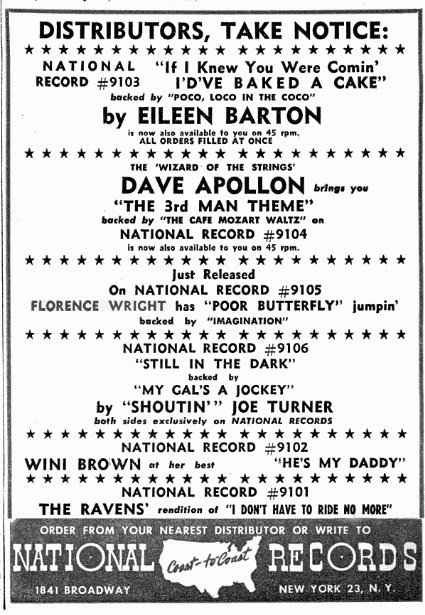
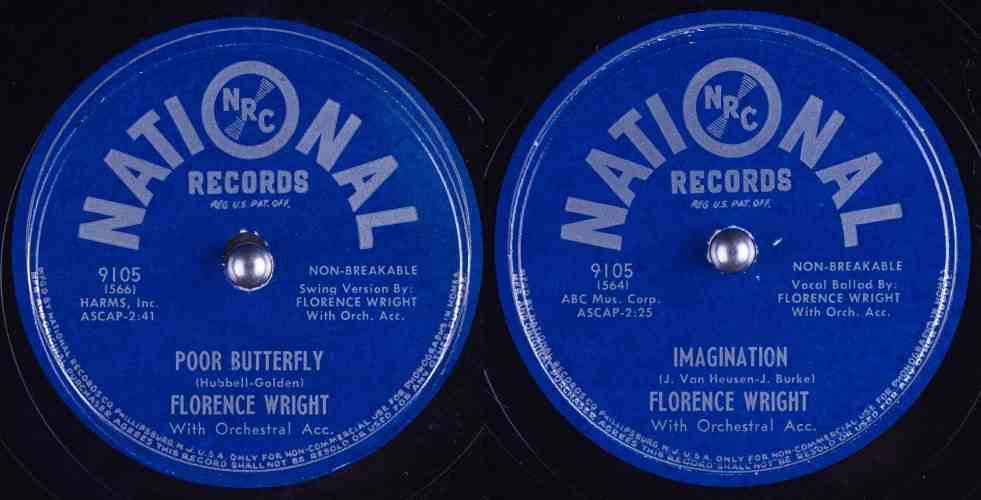 Florence had another National session on February 11, 1950. At it, she recorded "I'll Never Let A Day Pass By", "Imagination", "Billy", and "Poor Butterfly". In March, National released "Imagination", coupled with "Poor Butterfly" (which is jazzy, with a male chorus). Both were standards. They were reviewed in the April 1 Billboard:
Imagination (68): Miss Wright works out some [Sarah] Vaughan-isms in a pleasant albeit not exciting reading of the Burke-Van Heusen standard.
Poor Butterfly (73): Attractive swing arrangement of the standard with ensemble vocalizing and a Wright obligato. Her singing is forced and cold when she's on her own. A biting tenor sax contributes a winning bit.
In the 1950 census, she and Willie Wright, and their son, Willie A., were living in Newark with her husband's parents. Her occupation was "Other". (I have to state that, with all the genealogical research I do, censuses become less informative as the decades go by.)
 In early April 1950, Florence was one of the acts at the Carnival in Pittsburgh. She was advertised as "Illinois Jacquet's singing star" (although she was never before mentioned with him) and "Featured In 'Carmen Jones'" (certainly not any of the Broadway productions up to this point). By mid-April, she was at the Rumpus Room in Pittsburgh. Billy Rowe's column in the April 15 Pittsburgh Courier repeated the "Carmen Jones" story. With a lot more digging, I found out there was another singer named Florence Wright, from Pittsburgh, who had been in some production of "Carmen Jones" in 1946.
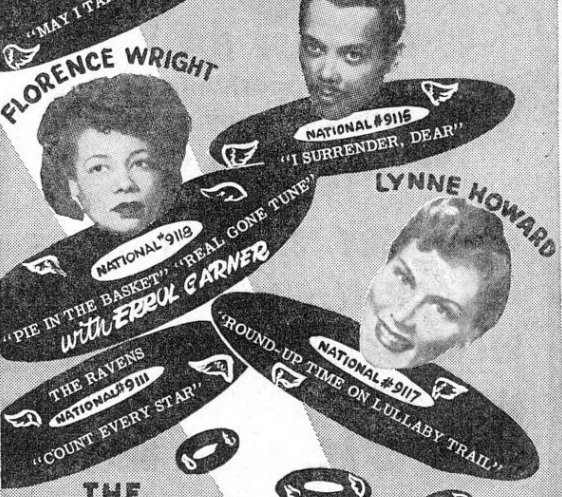
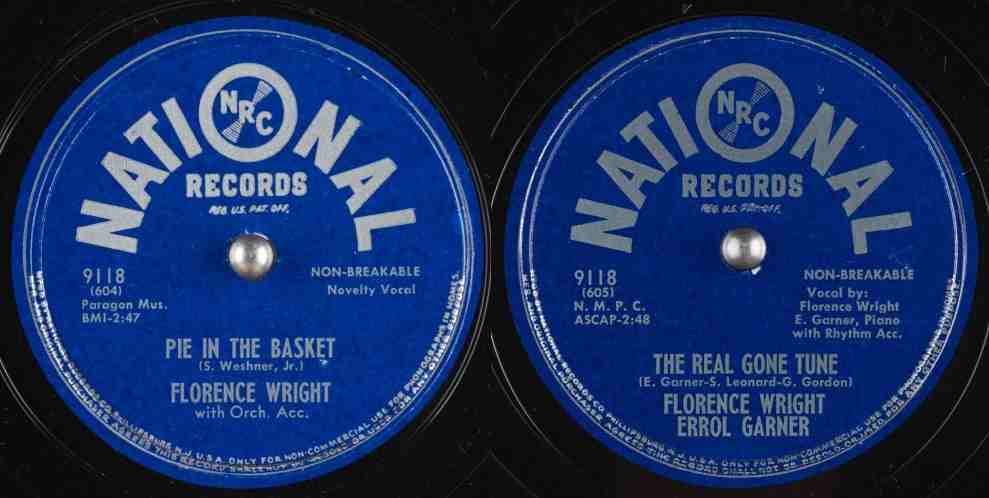 Another National session, held on May 24, 1950, produced "(Roll 'Em) I'm Gonna Fade You With The Blues", "Pie In The Basket", "The Real Gone Tune", and "You And Me". In June, they released "Pie In The Basket", backed with "The Real Gone Tune" (which featured Erroll Garner on piano).
On June 29, 1950 Bill Cook started his own television show on WATV: "Stairway To Stardom". Florence was on that first show.
The July 5 Variety had this to say about "Pie In The Basket":
Florence Wright for National Records and Thelma Carpenter for Columbia are ok on "Pie In The Basket", a tune based on the folk song, "Barbara Allen". The original lyrics are better. [Sorry, but I don't see this being anything like "Barbara Allen".]
The disc was reviewed in the July 15, 1950 issues of Billboard and Cash Box, and the August 11 issue of Down Beat:
Pie In The Basket (BB; 83): The nursery jingle is furbished with suggestive extra material, adding commercially. Thrush gives an "A" performance - voice, quality, beat, inflections are all tops.
The Real Gone Tune (BB: 67): Curious, off-the-track ditty is based on a typical Garner phrase. Lyric is slight. Miss Wright does what she can with it. More for "hippies" than general r. and b. market.
Cash Box (no ratings): "Pie" is the "Award"-winning novelty that gets a tricky intro here in cross conversation twixt the ork and the thrush. Florence Wright gives a rhythm vocal chorus in her chirping. Bottom was penned by Erroll Garner and features the maestro's fine piano stylization. Wright turns in a satisfying vocal offering on this and ops might listen.
The Real Gone Tune (DB: 3 stars): Miss Wright is aided by Erroll Garner, a pianist of some repute. His aid is major, since the lag beat peculiar to Garner's playing gives Miss Wright a substantial background against which to phrase.
Pie In The Basket (DB; 3 stars): Pie is an interesting combination of folk tune, blue implications, A-Tisket, A-Tasket, and rock beat. It should be a commercial hit.
The July 16 Asbury Park Press said:
National comes thru with a successor to such novelty hits as "Bake A Cake", "Candy And Cake", and "Sunshine Cake" with a number called "Pie In The Basket". Florence Wright clicks with some cute lyrics. Miss Wright is joined on the plattermate, "Real Gone Tune", by the talented pianist, Erroll Garner. A jazz tune all the way.
But not all was sweetness and light. The article in the July 29 Billboard was titled: "'Pie In Basket' Gets New Crust":
NEW YORK, July 22.- National Records is editing the introductory lines out of its Florence Wright etching of Pie In The Basket, in an unusual bid to render the etching suitable for air play. Tune, a nursery type ditty, is getting heavy disk coverage, and National, encouraged by the response, is taking the blue material out in the hopes of keeping out in front.
The cutting of the introductory lines - special material of an ambiguous nature - is being made only for a fresh batch of disk jockey copies. The juke and retail records will remain as is. Some jockeys have informed the diskery they have been spinning the disk, but putting needle to groove after the dubious four-bar opening.
I've listened to both versions (Florence's and Thelma Carpenter's) and they're both quite racy. Thelma's has more lyrics, but removing the intro from Florence's doesn't really clean it up if anyone cared to listen closely.
The October 14 New York Age said: "Florence 'Spoogie' Wright ringsided at the Baby Grand last week - her first time out in ages." It says she was in the audience, not performing, but is it her? The nickname "Spoogie" was never applied to her in any other context. Dunno.
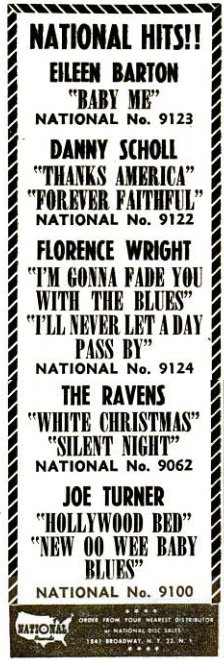
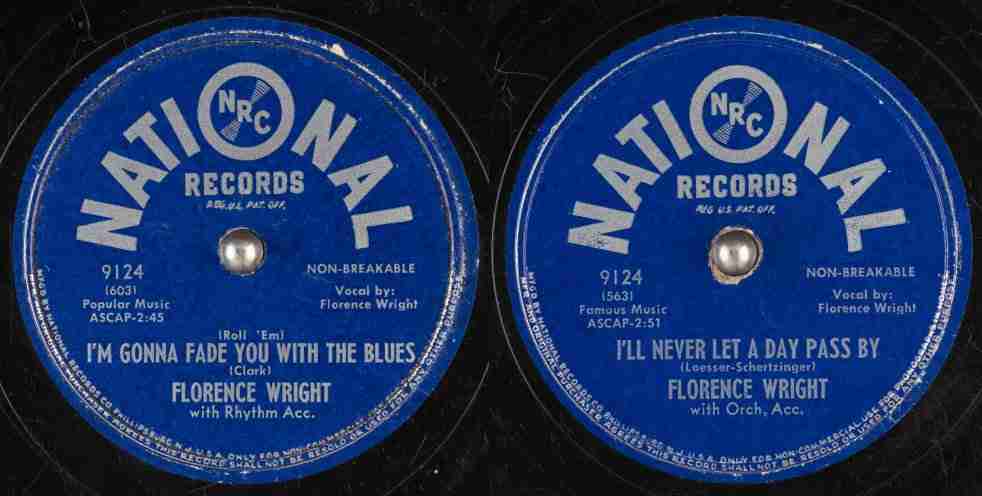 What I do know is that National released "(Roll 'Em) I'm Gonna Fade You With The Blues", backed with "I'll Never Let A Day Pass By", in October. For you non-gamblers, to "fade" is to cover the bet of the dice shooter in craps. They were reviewed in the November 11, 1950 Billboard:
I'll Never Let A Day Pass By (62): Careful, laborious treatment of a fine ballad standard.
I'm Gonna Fade You With The Blues (71): Thrush chirps a fancy blues bit with considerable vocal quality.
But that's the last we hear of Florence, until she recorded a couple of tunes for Savoy Records, almost two years later, on August 21, 1952: "I Went To Your Wedding" and "My Blue Heaven". "I Went To Your Wedding" was a cover of the #1 Patti Page tune, which was also done by the Red Caps, Little Sylvia, and Hadda Brooks that year. There were also versions by Sammy Kaye, Guy Lombardo, Grady Martin, Jimmy Wakely, and Hank Snow.
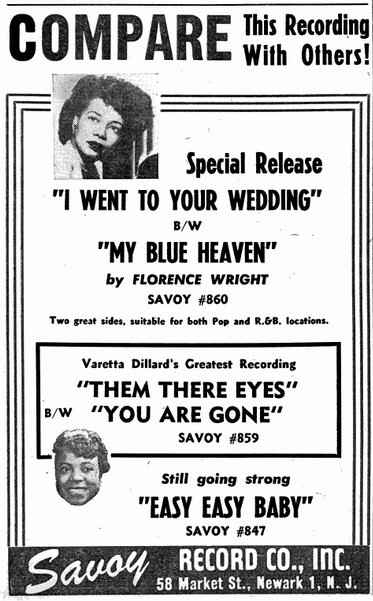
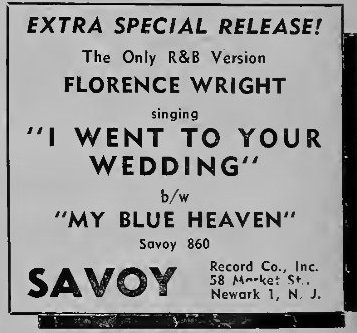
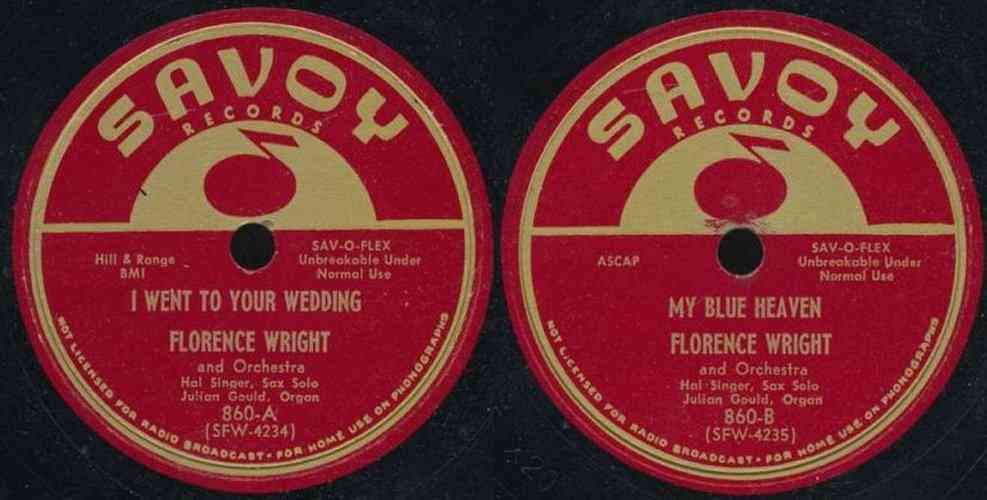 Savoy rushed them out later in August, just in time for Florence to appear, for a week, at Washington, D.C.'s Howard Theater, starting August 29. She shared the stage with the 5 Keys, Bull Moose Jackson, and Varetta Dillard.
The disc was reviewed in the September 6 Billboard and the September 13 Cash Box:
I Went To Your Wedding (BB; 80): The thrush comes thru with a mighty strong version of the current pop hit with ork and striking guitar backing. Rendition could give other cuttings a run for r.&b. loot.
My Blue Heaven (BB; 77): Another good performance by singer Florence Wright on the oldie, with some effective sax work from Hal Cornbread Singer. Side could catch coin.
I Went To Your Wedding (B+; 80): The Florence Wright interpretation of the beautiful pop plug tune is a warm and pleasant one.
My Blue Heaven (CB; B+): The Florence Wright Ork with miss Wright on the vocal chorus project the lovely slow oldie with much feeling. Hal Singer does an effective job on the sax and Julian Gould helps round out the side with a top flight job on the organ.
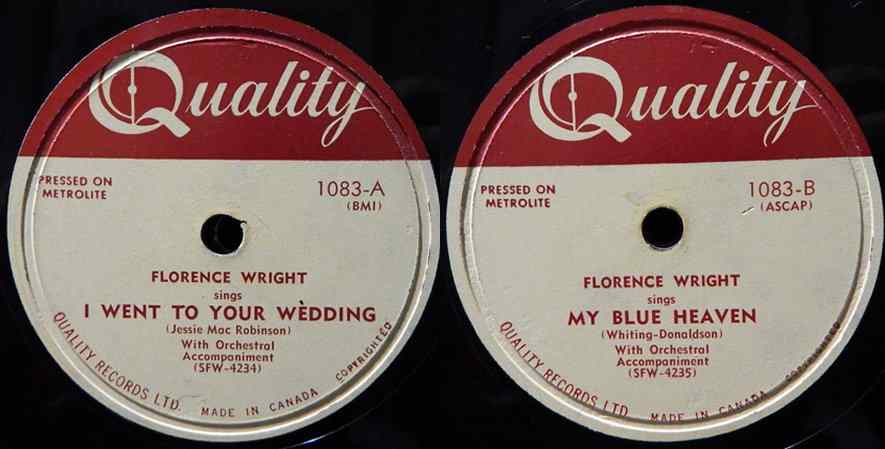
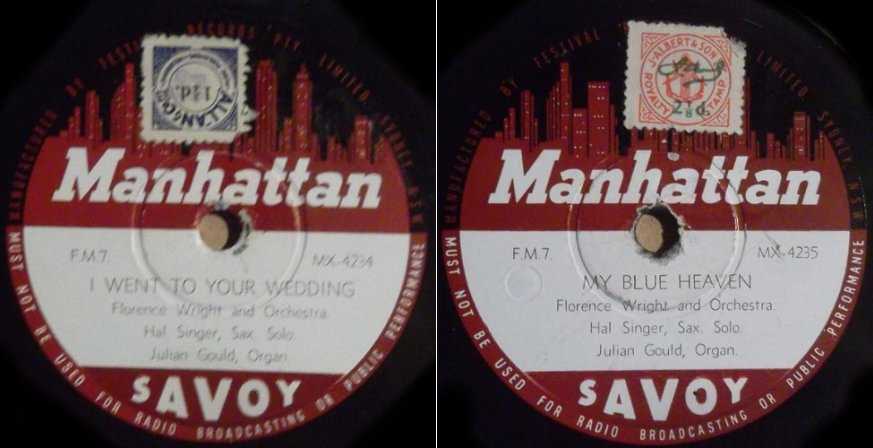 I don't have exact dates, but the same pairing was released on Manhattan Savoy (Australia) and Quality (Canada) that year.
1953 was another year with nothing at all written about Florence.
But she wasn't gone from the scene. On February 3, 1954 she appeared on the first "Club Caravan" variety show on WATV, hosted, of course, by Bill Cook. Also appearing were Roy Hamilton (whom Cook also managed), the Larks, and Billy Ford's combo. While I don't remember watching it (at 10:00 PM), it was broadcast, in New York, on Channel 13 (long before it became a PBS station). However, that was her only mention in 1954.
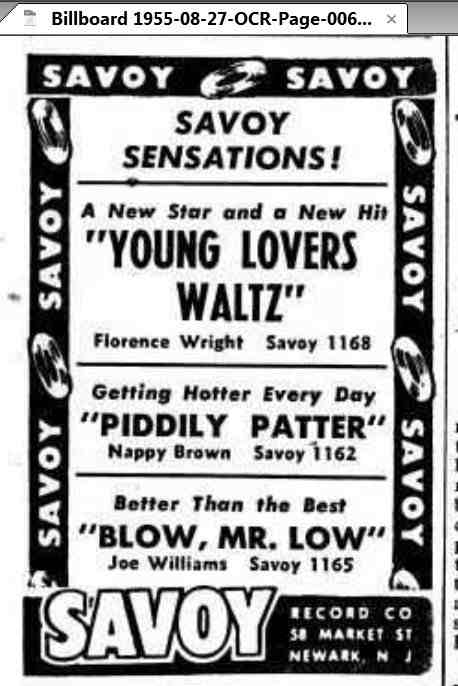
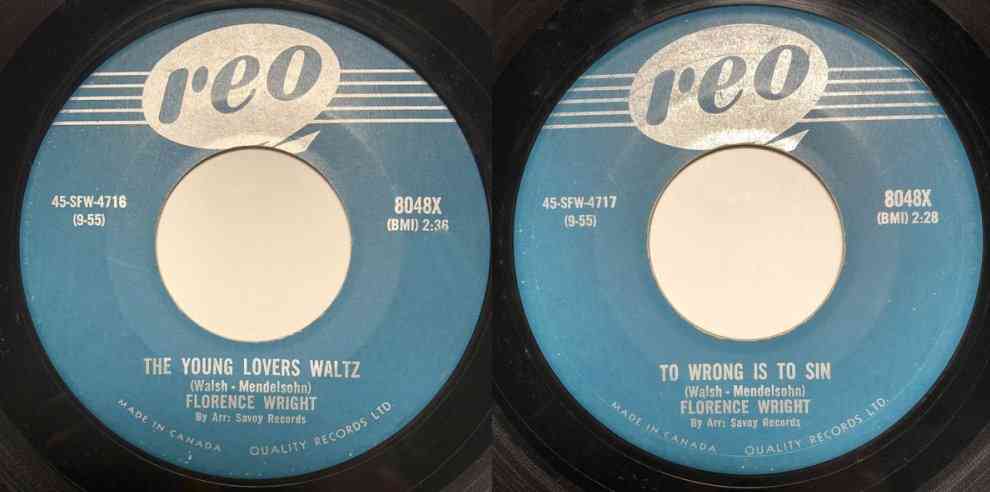
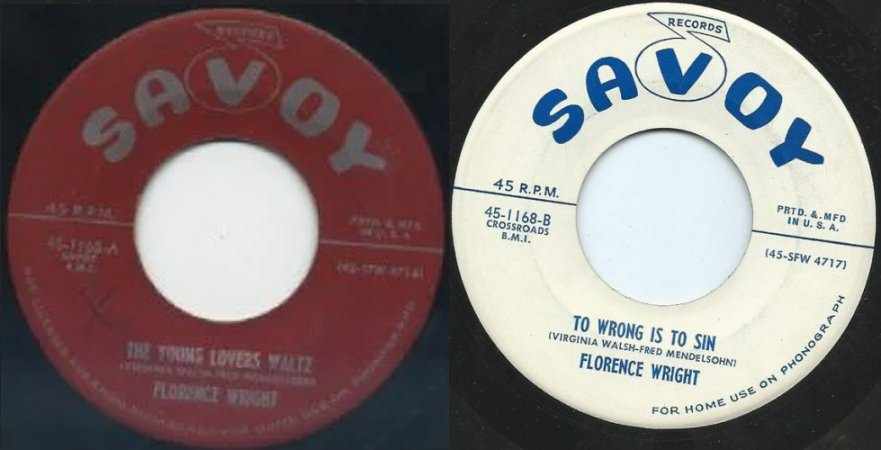 On August 3, 1955, she had one more session for Savoy, at which she recorded "The Young Lovers Waltz" and "To Wrong Is To Sin". Musicians present, most of whom you know, were: Budd Johnson (tenor sax), Ernie Hayes (piano), Leroy Kirkland (arranger), Mickey Baker (guitar), Milt Hinton (bass), and Panama Francis (drums). The sides were released on Savoy later that month (and also on Canada's Reo Records sometime that year). They were reviewed in the August 27 issues of both Billboard and Cash Box:
The Young Lovers Waltz (BB; 74): Altho the artist comes from the r.&b. field, both the material and styling here are strictly pop. There could be action on both of these tunes, here or with other versions.
To Wrong Is To Sin (BB; 73): As above. Another appealing job by the sweet-voiced thrush.
The Young Lovers Waltz (CB; B): Florence Wright debuts [sic] on the Savoy label with a wonderfully tender "Tennessee Waltz" type ballad. Lovely song. Thrush can sing. Disk has possibilities.
To Wrong Is To Sin (CB; C+): A sentimental bluesy love tune is warmly delivered here. Slow moving number.
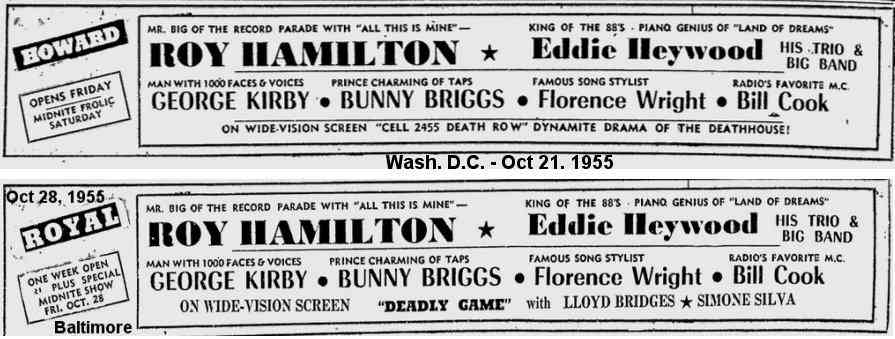
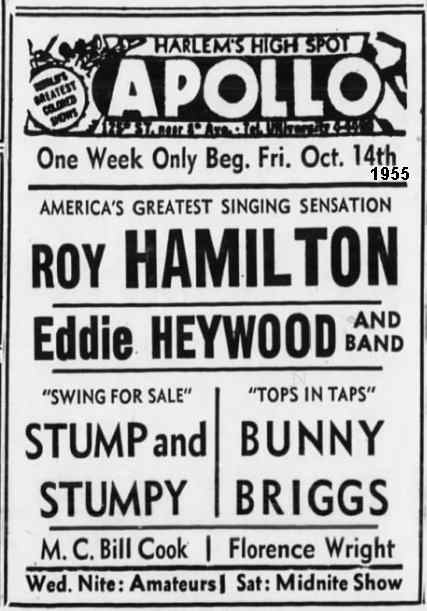 The Big Time. The week of October 14, 1955, Florence appeared at the Apollo Theater, along with Roy Hamilton, Eddie Heywood's band, Stump & Stumpy, and Bunny Briggs. Bill Cook was the MC. Owner Frank Schiffman's comment: "Satisfactory vocalist." For those who don't know, that was high praise from Schiffman. From there, the show went to the Howard Theater in Washington, D.C. (the week of October 21), and then to Baltimore's Royal (the week of October 28).
Florence opened at Newark's Club Caravan (which probably had something to do with Bill Cook) on December 9. There was only a single ad.
And that's the last time Florence Wright was mentioned as appearing anywhere. My guess is that she was now devoting her time to her growing family (there'd be five children in all).
On March 28,1964, husband Willie Wright died in Orange. This sad news was followed, the next year, by Florence herself passing away on September 11, 1965. She had only just turned 37 the month before.
As I said at the beginning, Florence Wright had a nice voice, but a short career. I wish it had been longer.
NATIONAL
9090 Deal Me A Hand (I'll Play The Game Anyway) / (Nobody Wins In) The Game Of Broken Hearts - 10/49
9105 Imagination / Poor Butterfly - 3/50
9118 Pie In The Basket / The Real Gone Tune - 6/50
9124 (Roll 'Em) I'm Gonna Fade You With The Blues / I'll Never Let A Day Pass By - 10/50
UNRELEASED NATIONAL
Farewell To Arms (rec 9/30/49)
Moody Music (rec 9/30/49)
Billy (rec 2/11/50)
SAVOY
860 I Went To Your Wedding / My Blue Heaven - 8/52
MANHATTAN SAVOY (part of Australia's Festival Records)
FM-7 I Went To Your Wedding / My Blue Heaven - 52
QUALITY (Canada)
1083 I Went To Your Wedding / My Blue Heaven - 52
SAVOY
1168 The Young Lovers Waltz / To Wrong Is To Sin - 8/55
REO (Canada)
8048 The Young Lovers Waltz / To Wrong Is To Sin - 55