The 4 Jumps Of Jive
By Marv Goldberg
© 2026 by Marv Goldberg
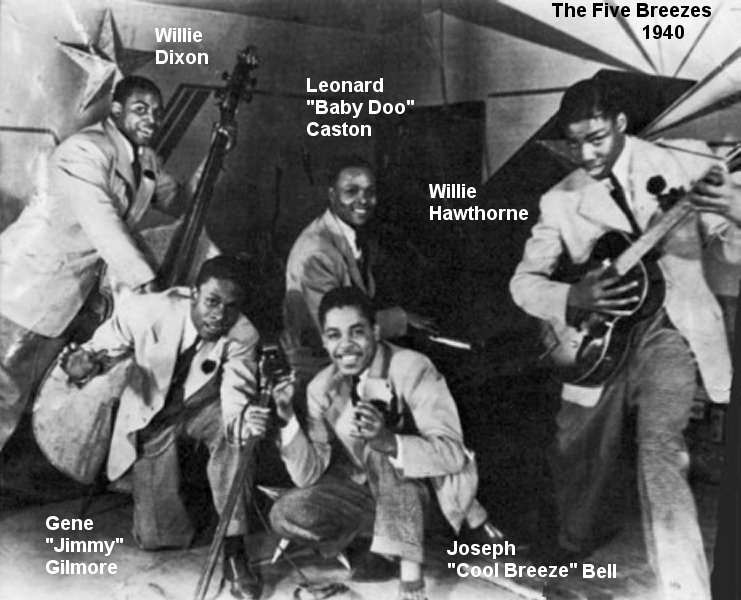
This will be another short one. The 4 Jumps Of Jive only existed for a short time, from around May 1944 to the spring of 1946, having only two record releases in that time. They were sandwiched between two groups that were more famous and shared some of the same members: the 5 Breezes and the Big Three Trio.
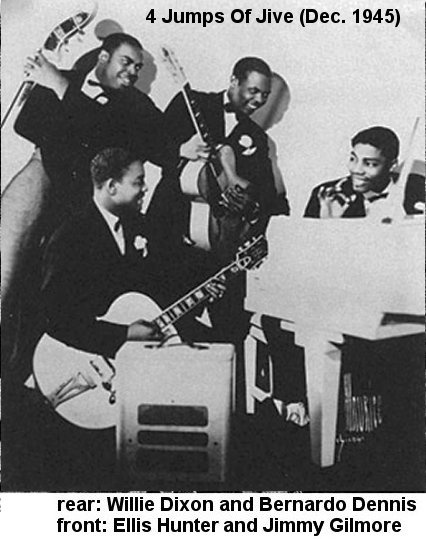
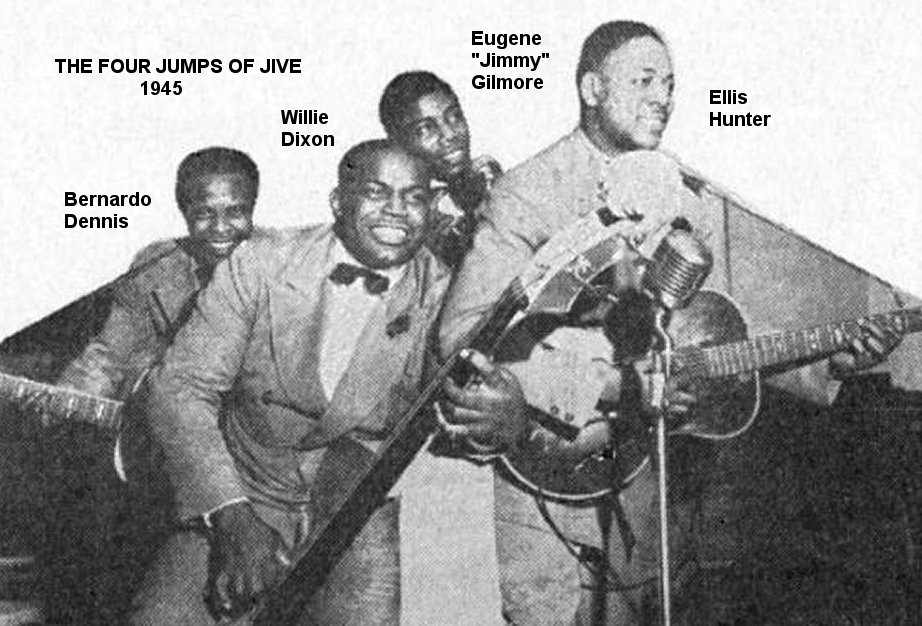
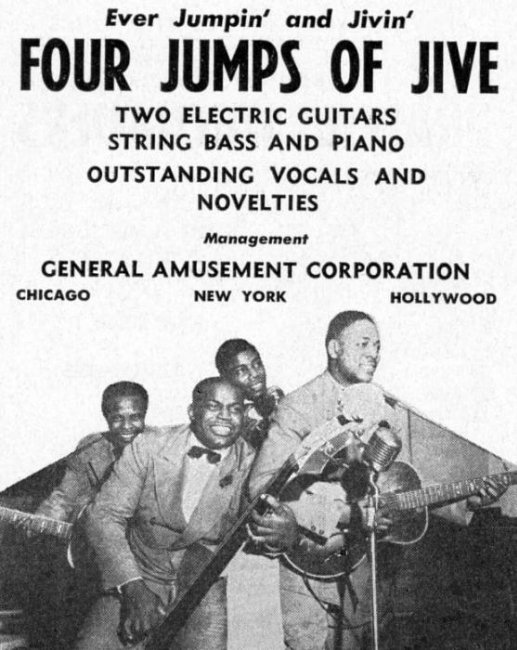
The 4 Jumps Of Jive were always: Willie Dixon, bass; Gene "Jimmy" Gilmore, vocal, piano, and guitar; Ellis Hunter, guitar; and Bernardo Dennis, guitar. Because their membership was constant, let's get their biographies out of the way first.
WILLIE JAMES "BIG JUMP" DIXON (bassist)
Willie was born on June 1, 1915, in Vicksburg, Mississippi, to Charley Dixon and Daisy McKinzie. He had six siblings: Johnnie (female), Katie, Rosie, Curtis, Louis, and Arthur.
In the 1920 census, he was living in Vicksburg with his mother, who was now divorced. In 1930 (as "W. J. Dixon") he was still living with her in Vicksburg.
In the mid-1930s, he wandered up to Chicago and became a Golden Glove boxer, as "James Dixon". He began winning fights in the Heavyweight class, until the February 25, 1937 Chicago Tribune named him as the Novice Heavyweight Golden Glove champion. There was only one other mention of him in 1937, when he won another fight in December. But he lost one in January 1938, and another in December, when he was beaten by that year's Golden Glove Heavyweight champion.
At that point, he returned home, and the April 1940 census has him living with his grandmother, as a farm laborer, in Tunica County, Mississippi.
But soon, he was back in Chicago, where he registered for the draft on October 16, 1940, the nationwide registration day.
When he'd been a boxer, he'd made the acquaintance of Leonard "Baby Doo" Caston, a guitar player who'd "serenade" the guys working out in the gym (he also played piano). Now, along with Gene "Jimmy" Gilmore (see below), Freddie Walker, and Willie Hawthorne, they formed the 5 Breezes (Walker would later be replaced by Joseph Bell). They were first mentioned on November 9, 1940 as being at the Pioneer Lounge. On November 15, they had their only recording session, for RCA's Bluebird subsidiary.
At the time of the April 1950 census, Willie Dixon ("musician") was living in Chicago with his mother (Daisy) and sister (Johnnie). At the time, he was married to Eleanor Franklin, but I can't find a marriage date. He'd later marry Marie Booker.
I'm not going to go into his subsequent (and lengthy) career; it's easy enough to research. Willie James Dixon died, in Burbank, California, on January 29, 1992.
EUGENE JACOBS "JIMMY" GILMORE (piano and guitar)
Jimmy Gilmore was born in Vicksburg, Mississippi on January 22, 1922. However, there are some events in his life which will give us problems. For example, his tombstone says January 22, 1920 (however, the 1922 date is correct).
Who his parents were is another mystery. In the April 1930 census, he was living in Vicksburg, in the household of "Dissie Ryals" (it should be Bessie). She's a widow and it says he's her son. But when I looked at the census record more closely, the relationship actually said "Son - Ad". I suppose that means "adopted son". If so, I have no idea who either of his parents were.
He's in the 1935 Vicksburg City Directory as a "student".
In the April 1940 census, in Chicago, Eugene Gilmore is a "singer, road show". He's a lodger, living in the same place as Leonard Caston (a "tavern waiter"). I don't believe the 5 Breezes had formed yet, but they'd both soon be a part of that group (see Willie Dixon, above).
When he registered for the draft on February 16, 1942, he gave his employer as "Jim Martin", who just happened to own Martin's Corner, where the 5 Breezes were appearing. The February 2, 1942 Chicago Defender identified the members (almost correctly) as Joe Bell (who'd replaced Freddie Walker), Eugene Gilmore, Leonard Coston, Willie Hathrone, and Willie Doxon.
Here's another problem with Jimmy. His tombstone, which has an incorrect birth date, shows his World War 2 service dates: December 28, 1941 through September 29, 1943. Those dates were supported by the Department of Veterans Affairs BIRLS Death File. BUT he didn't even fill out his registration until February 16, 1942! Fortunately, I was able to get a look at his actual Army record and he was drafted on December 28, 1942, not 1941 (it didn't say when he was discharged). It also correctly gave his birth year as 1922.
Later, in 1976, he said he'd been married, but didn't want to talk about it. I don't know who she was.
Eugene Gilmore died on January 14, 1986, in Memphis, after a long illness. His obituary said he was a retired truck driver, but made no mention of a singing career.
ELLIS HUNTER, Jr (guitar)
Ellis Hunter, Jr was born, per his World War 2 draft registration, on September 7, 1918 in Birmingham, Alabama. He was the son of Ellis Hunter, Sr and Mattie Simmons Kelley. He had two sisters: Fannie Mae and Inez.
In the April 1940 census, Ellis (a waiter) was living in Mobile, Alabama, with his mother, Mattie, and both sisters. When he registered for the draft, on October 16, 1940, he was still living there.
Ellis married Christine Simmons on January 27, 1941 in Mobile, but the marriage didn't work out. He subsequently married, according to the marriage record, "Dorian Lautitla", in Chicago, on June 29, 1948. They're married in the April 1950 census, when he's a "musician - orchestra". Dorian, it said, was born in Alabama around 1917. (Of course, there has never been anyone named "Dorian Lautitla". Either the marriage record got it wrong or it was difficult to read and didn't scan correctly.)
Ellis later played with Cozy Eggleston (and was on Cozy's 1952 recording of "Big Heavy"). In the late 50s and early 60s, he had the Big Ellis Hunter Trio in Chicago.
On October 9, 1966, his combo played for a fashion show at Chicago's Pick Congress Hotel.
I don't know when he died. There was an Ellis Hunter who passed away on May 4, 1972 in Chicago. That Ellis Hunter was born Nov 23, 1912, but it didn't say where. Although years can vary a lot between different records, the birth month usually stays constant. This tells me it's a different person.
BERNARDO RANDOLPH "BERNIE" DENNIS (guitar)
Bernardo Dennis was born on January 11, 1914 in Vicksburg, Mississippi, to Johnson Dennis and Carrie Davis. At some point before the 1940 census, he married Anna Ruth Hall, from Alabama. In that census (in Chicago), he was a porter.
When he registered for the draft on October 16, 1940, he was working for the Midland Tailoring Company.
At a folk party, on August 2, 1941 at the Southside Community Art Center in Chicago, Bernardo sang folk songs.
In the 1950 census, he and Anna were living with her father, in Gary, Indiana. Unlike his bandmates, he'd given up music and was a postal clerk in Gary.
By the time he passed away, on March 5, 1993, he'd moved back to Chicago.
Don't despair; we're almost ready for the 4 Jumps Of Jive.
The last time I can find the 5 Breezes appearing anywhere is in May 1941, when they were at Martin's Corner. Then a problem arose.
There was an organization Willie Dixon belonged to called the Peace Movement Of Ethiopia. They were pacifists and Willie refused to be drafted. In August 1941, he was indicted, saying (according to the August 30, 1941 Freeport, Illinois Journal-Standard):
I understood that since Abraham Lincoln's time that any colored person who rebelled against the government was deported to Liberia. I'm in rebellion.
The article went on:
Judge Barnes replied that he couldn't send Dixon to Liberia, but that he could send him to prison for failure to report for physical examination and failure to report change of address. However, final action on the case was delayed until Sept. 2.
Unfortunately, not another word was reported about his fate. He later claimed that he'd spent a year in and out of jail for draft evasion.
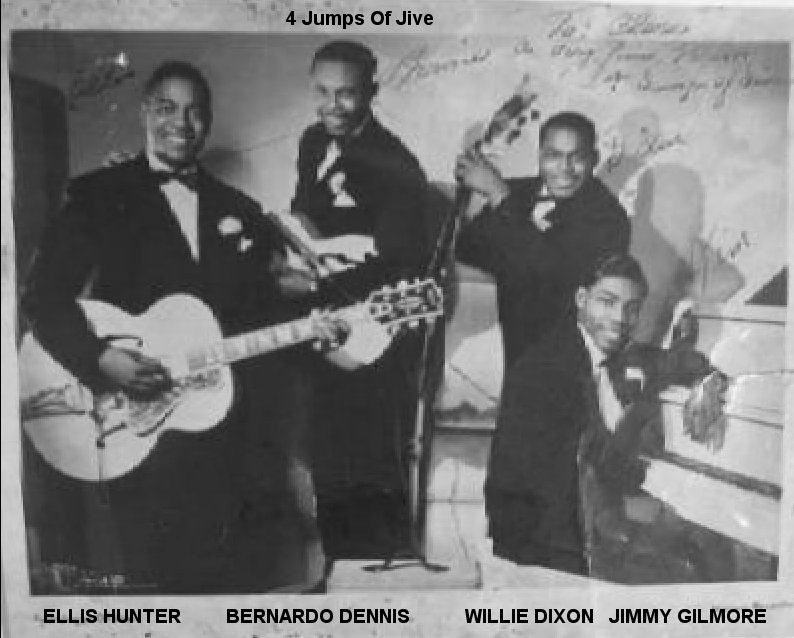 Sometime in the spring of 1944, the 4 Jumps Of Jive formed. "Jump" and "Jive" were a common combination back then, so the name was a natural. For example, Ralph Cooper had a radio show called "Jump And Jive" in New York (reported on in Chicago papers) and Chicago's Gertrude Cooper had her own "Jump, Jive And Jam" program.
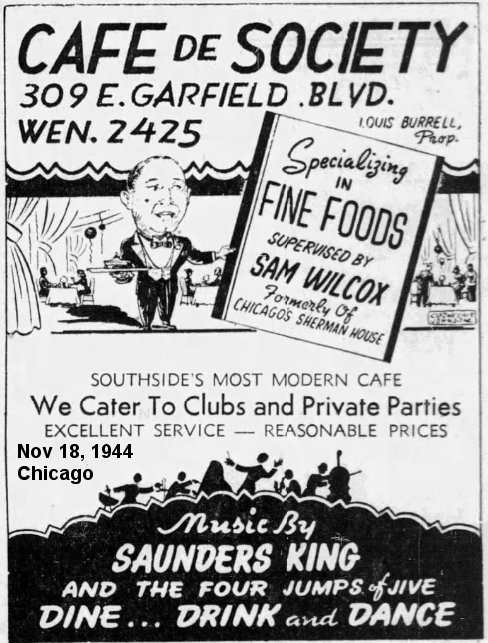 The group was first mentioned in the June 3, 1944 Billboard, as appearing at the Sky Club in Chicago. The November 25 Billboard said that they'd opened at the Cafe De Society (along with singer/guitarist Saunders King).
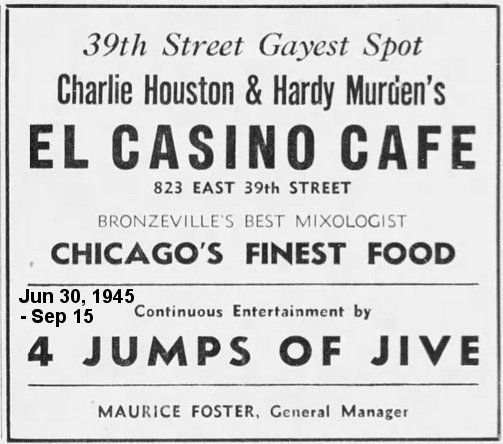
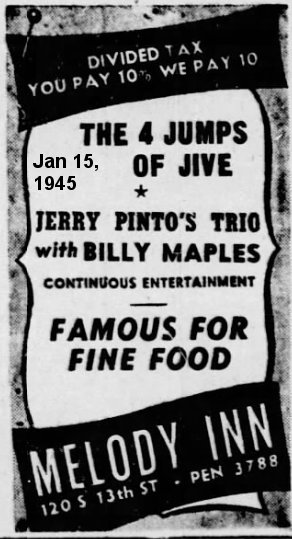 January 1945 found the Jumps at the Melody Inn in Philadelphia. In February, they were at the Happy Hour, in Minneapolis, for at least two weeks. On May 22, they (and Bill Gooden) started at the Sky Club; by the end of July, they were at the El Casino (both in Chicago).
On September 12, 1945, the 4 Jumps Of Jive had a session for newly-created Mercury Records in Chicago. The four songs recorded were: "Satchelmouth Baby", "It's Just The Blues", "Boo Boo Fine Jelly", and "Streamline Woman Blues".
"Satchelmouth Baby" had been written by pianist Mary Lou Williams and was first recorded and released by "Mary Lou and Her Chosen Five", on Asch Recordings #502, in 1944. (It's unison singing by the whole group.) Note that there was a rock group in the 1990s called "Boo Boo Fine Jelly".
The October 13, 1945 Billboard talked about the formation of the Mercury Label. Note that it was owned by Irving Green, who was the son of Al Green, owner of National Records. The article was titled "Windy City Gets Some New Pressing Plants":
CHICAGO - Chicago's potential as a recording center got a big shot in the arm with the announcement this week by Irving Green, local plastics expert, that he is heading a new firm, Mercury Records, which will eventually reach 250,000 disks per month. New firm has a Chicago pressing plant and a St. Louis manufacturing outlet. New firm is getting plenty of eyeing from the rest of the industry because it is considered a very modern record producer, in that the majority of its equipment, made by Green himself, is automatic and uses a minimum of trained personnel, an item which has been setting production back a good deal these days.
Thus far the new label has inked only Negro artists for records, with its catalog including sides by June Richmond, ex-Andy Kirk rhythm singer; Bill Samuels and His Cats 'n' Jammers; and the Four Jumps Of Jive, both cocktail units; Sipple Wallace and Karl Jones, blues shouters; Al Ammons, boogie pianist and half of the team of Ammons And Johnson; and Bob Shaffner and His Harlem Hot Shots.
Another article, in the same issue, said that Mercury was shooting for 700,000 pressings within a year. The figures were so high because it was also a pressing plant that did work for others. They'd reached a million per month by the time the first 4 Jumps Of Jive record was released.
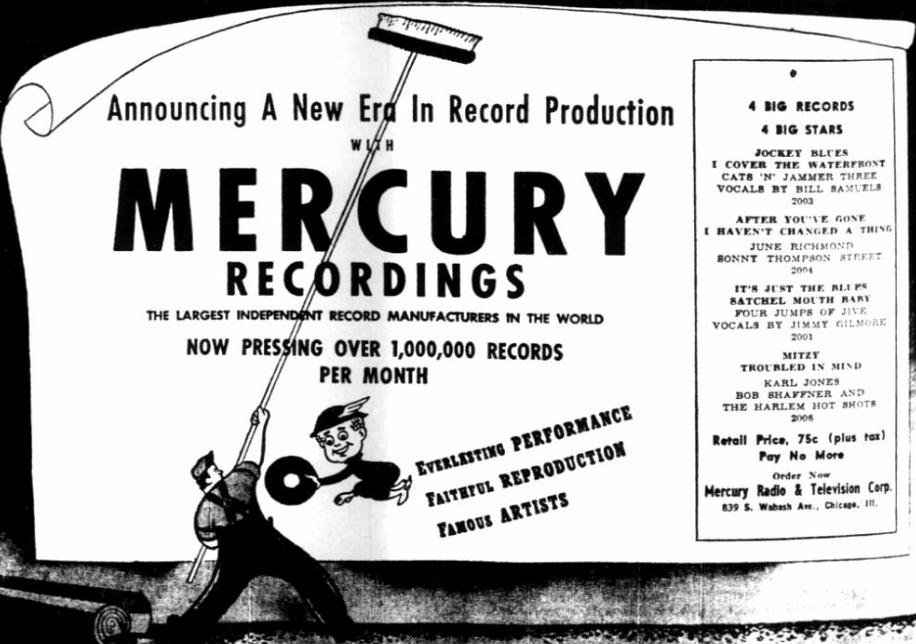
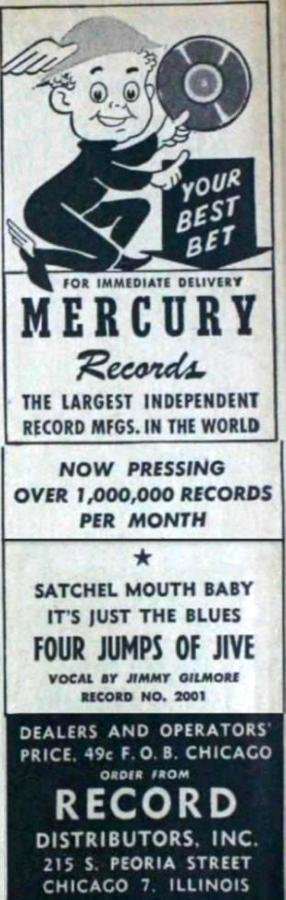
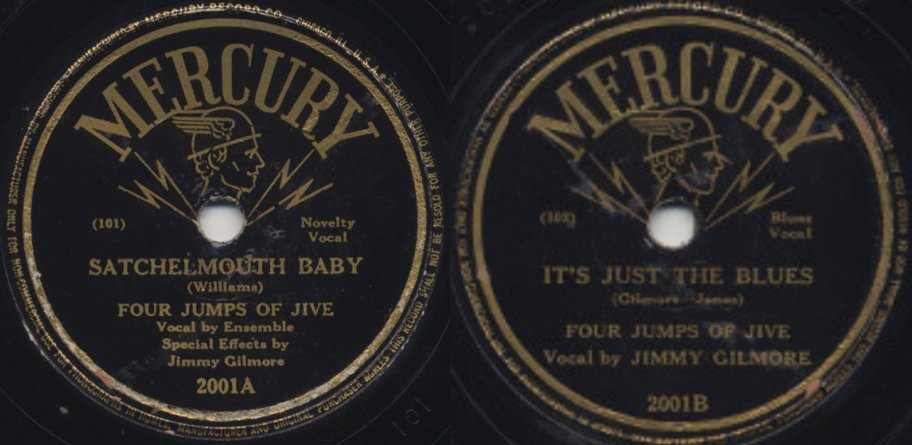 "Satchelmouth Baby" and "It's Just The Blues" were released, as the first Mercury record, in October. Jimmy Gilmore does lead on "It's Just The Blues" and scatting on "Satchelmouth Baby" (which also had unison singing).
The other two songs ("Boo Boo Fine Jelly" and "Streamline Woman Blues") were mentioned in Billboard's "Advance Record Releases" column on December 1, 1945. However, that column wasn't for records actually received for review, but was "... information supplied in advance by record companies." Therefore, since no one seems to have ever seen or heard the record, I have to assume that it was scheduled for release, but canceled at the last moment.
At an unknown date in December 1945, the Billboard 1945-1946 Music Yearbook had a profile on the Four Jumps Of Jive:
When the newly formed Mercury Record Company of Chicago was looking for potential artists, they secured the contract for the Four Jumps Of Jive because of the peak which they had received as cocktail and night club entertainers. [Who writes this stuff?]
These four sepia boys have been together for two years, and under the leadership of bass man Willie Dixon, they've been building a library of originals and standards, plus plenty of novelties and pops, that's large enough to handle most any call from a patron for a particular tune.
Remainder of the unit is: Bernard [sic] Dennis and Ellis Hunter, electric guitars, and Eugene Gilmore, piano. Boys are all able to deliver capably a solo at the mike, and have plenty of harmony, up to four voices, for those payees who like tricky vocalizing.

During the past year they've played long stays at the Belvedere, Springfield, Ill.; the Sky Club, Elmwood, Ill. [all other mentions said it was in Chicago]; and are currently featured at the floorshow at the Rhumboogie, Chicago. Managed by General Amusement Corporation.
Later in December, they opened at the Tradesmen's Club in Chicago.
The last noted appearance of the group was at the Club Lido (South Bend, Indiana) in March 1946.
Like many papers, the Chicago Defender had an Annual Popularity Poll; the 1946 winners were presented in their April 20 issue. In the Specialty Artists category, the winner was the King Cole Trio, with 106,653 points, more than twice the number for the Ink Spots, Mills Brothers, 4 Vagabonds, Charioteers, Golden Gate Quartet, Brown Dots, and Red Caps. The Jumps were right behind the Red Caps (with 40,165 points), beating out several lesser known groups that might not be too familiar to you: the Cats 'N Jammers, Deep River Boys, Delta Rhythm Boys, Johnny Moore's Blazers, 4 Tons Of Rhythm, 4 Shades Of Rhythm, 3 Loose Nuts, and the Bob Carter Trio.
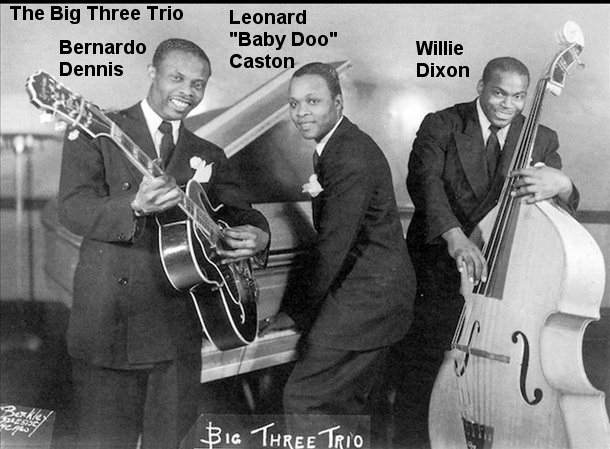 And then, it was all over. Sometime in 1946, Jimmy Gilmore and Ellis Hunter left the group. Willie Dixon and Bernardo Dennis then got Willie's old friend from the 5 Breezes, Leonard "Baby Doo" Caston, and re-named themselves the Big Three Trio. (In World War 2, that was a term that had been applied to Franklin D. Roosevelt, Winston Churchill, and Josef Stalin.)
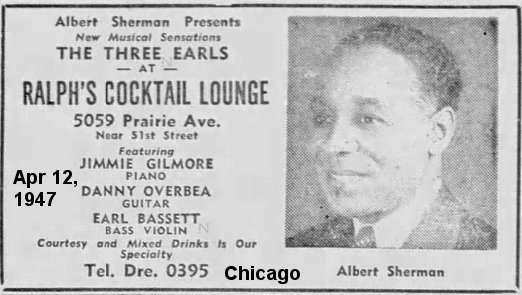 By April 1947, Jimmy Gilmore had teamed with Danny Overbea and Earl Bassett to become the 3 Earls. They appeared, that month, at Ralph's Cocktail Lounge and, later, Pitts Pub, both in Chicago. This is from my Danny Overbea article:
Overbea did not become a full-time professional until early 1947, when he began playing regularly at Ralph's Club (5059 Prairie Avenue). It was as a member of a jazz trio whose other members were pianist Gene "Jimmy" Gilmore and bassist Earl Bassett. Says Overbea, "I More or less started hanging around various clubs, spots where there were musicians. And I met Jimmy Gilmore, and he, I, and Earl Bassett formed a trio. Jimmy had been with the late, great Willie Dixon in the Four Jumps Of Jive, so he had connections with booking agencies. He was the leader of the trio, which was at first called the Jimmy Gilmore Trio and later the Three Earls. This was my first regular job."
By the early 1950s, Willie Dixon had begun working full-time for Chess Records in many different roles: recording manager, producer, composer, musician, talent scout, and a&r man.
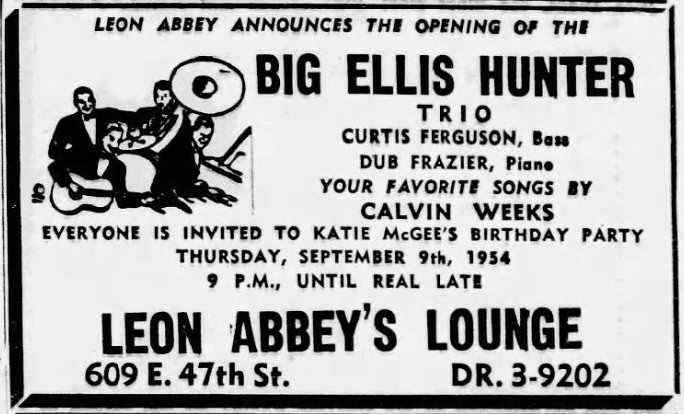 Guitarist Ellis Hunter wasn't quiet either, forming the Big Ellis Hunter Trio, along with pianist Dub Frazier and bassist Curtis Ferguson. They seemed to exist for a very short time, only being advertised in September 1954, at Leon Abbey's Lounge in Chicago. (Remember: everyone is invited to Katie McGee's birthday party, Thursday, September 9, 1954.)
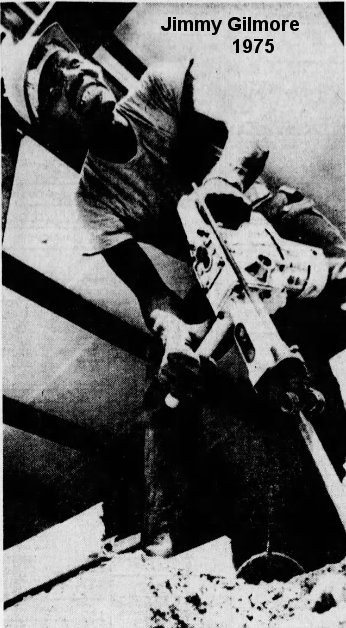 In mid-1975, there were a couple of interviews with Jimmy Gilmore each of which was printed in many papers. At that point, he was a tractor driver and construction worker in Altoona, Iowa and recalled his days in the music business. However, the only groups he mentioned were the 5 Breezes and the Ink Spots; the articles are riddled with errors.
He never mentioned the 4 Jumps Of Jive, but said he was with a group called the Aristocrats Of Rhythm when he got out of the Army.
He claimed to have been with the Ink Spots for 18 years. He said "Ollie Crawford took over Deek Watson's [Ink Spots] group when he died, and I was with Ollie." He said he became Crawford's bass singer in 1956. However, in December 1958, Deek was still with his group. They were named in an article and, although Crawford was there, there was no sign of Jimmy. Deek was gone by April 1961, but didn't die until 1969!
Ollie Crawford took over the group, but Jimmy's name was never associated with it until November 1961! And, as far as 18 years goes, he was last mentioned as a member of the Ink Spots in December 1969.
Jimmy left them, he said, due to illness. He was smoking heavily, lost a lot of weight, and developed diabetes. He went into the construction business in order to build himself up.
There were lots of articles about Willie Dixon over the years, but few of them mentioned his years with the 4 Jumps Of Jive. An obituary in the February 2, 1992 Arizona Republic had this bewildering item:
Then [after his boxing career] he started playing the blues full time. His writing talent was almost immediately appreciated. He sold songs for a flat fee at the time. He said that his first song was Somebody Tell That Woman, and it was recorded by the Four Jumps Of Jive, one of his first groups, in 1939.
He actually started saying that as early as 1982. The song itself is real; it was recorded by Peter, Paul And Mary as Big Boat, in 1962, but writer credit went to Paul Stookey and Elaina Mezzetti (who was Peter Yarrow's sister). Also, the sheet music to Somebody Tell That Woman, credited to Willie Dixon, was copyright 1962. I'll let someone else untangle that mess.
The 4 Jumps Of Jive were another one of those blips on the musical radar. In existence for only a short time, with only two records to their credit, they never achieved the success such talented performers deserved.
MERCURY (Four Jumps Of Jive)
2001 Satchelmouth Baby / It's Just The Blues - 10/45
2015 Boo Boo Fine Jelly / Streamline Woman Blues - 11/45
That record was, presumably, scheduled for release, but canceled.