Jewel King
By Marv Goldberg
© 2025 by Marv Goldberg
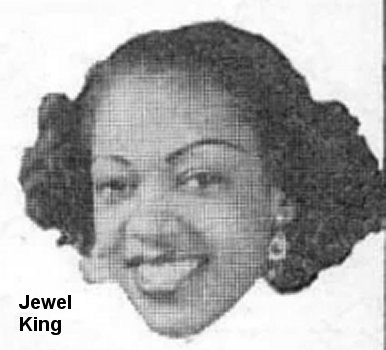
Jewel King had a big 1950 hit with "3 x 7 = 21". She might have gone on to a very successful R&B career, had her husband not derailed the whole thing. After divorcing him, she went on to have more appearances in the 1960s and 1970s than she seemed to have had in the 1950s. Note that there seems to be only the single photo of Jewel, taken in time for January 1950 ads; but they only ever show her head.
Mary Jewel King, was born on April 15, 1928, in Corpus Christi, Texas. Her father was George King, a longshoreman; her mother was Eddie Harris (and I was surprised to learn how many women were named "Eddie").
Jewel first made the papers at the tender age of 13 months. This was in the May 24, 1929 Corpus Christi Caller-Times:
Jewel King was awarded a $5 gold piece in a baby popularity contest which has been concluded at the St. Matthew Baptist church.... The church realized $95 through the conduct of the contest.
Nothing strange about the 1930 census in Corpus Christi. In it, we find George, Eddie, and Mary.
Mary Jewel King was in the Caller-Times again on December 12, 1935, when it reported the names of those students at the Solomon M. Coles school who'd made the honor roll.
In the 1940 census, Mary (who, at age 12, was the one who answered the census-taker's questions) was living with her maternal grandmother, Florence "Flossie" Harris, in Corpus Christi, at 1804 Ramirez. Also there was Jewel's 9-year-old sister, who was enumerated as "Berta King". However, her birth record says "Bird Mae King", although she was always known as "Birdie" (and seems to still be alive, in Florida, in 2024). In the 1940 Corpus Christi City Directory, Eddie King was listed as living at that same address, but neither she nor George was in the census. However, they were still together in the 1946 City Directory - at that same 1804 Ramirez address.
Mary Jewel King was on a list of the graduates from Solomon Coles junior school printed in the May 27, 1941 Corpus Christi Times.
On January 21, 1945, when Jewel was just short of 17, she gave birth to her son, Ronald Eugene King. The birth record doesn't give the name of his father.
Sometime after this, Jewel King moved to New Orleans for unknown reasons. There, she began to appear in local clubs, although I can't find any ads.
She must have impressed the Braun Brothers, of Linden, New Jersey, who owned DeLuxe Records (and who did a lot of recording in New Orleans). She recorded at least three songs for DeLuxe in 1948 ("Go Now", "Passion Blues", and "Give Me A Clue Baby"), but the Brauns never released them.
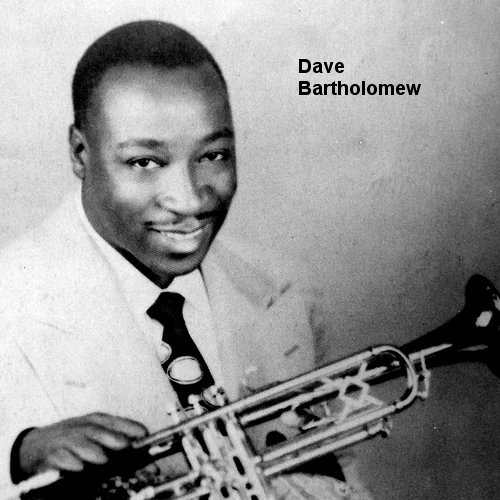 Then, on November 29, 1949, at Cosimo Matassa's recording studio in New Orleans, she waxed four sides for Imperial. The session was produced by Dave Bartholomew; the first time he'd overseen an Imperial session. The songs were: "Low Down Feeling", "Passion Blues" (the same song she'd done for DeLuxe), "Don't Marry Too Soon", and "3 x 7 = 21". Jewel wrote "Passion Blues"; the others were written by Dave Bartholomew. On these, she was backed by Bartholomew's band: Dave Bartholomew (trumpet), Joe Harris (alto sax), Herb Hardesty (tenor sax), Red Tyler (tenor sax), Salvador Doucette (piano), Ernest McLean (guitar), Frank Fields (bass), and Earl Palmer (drums).
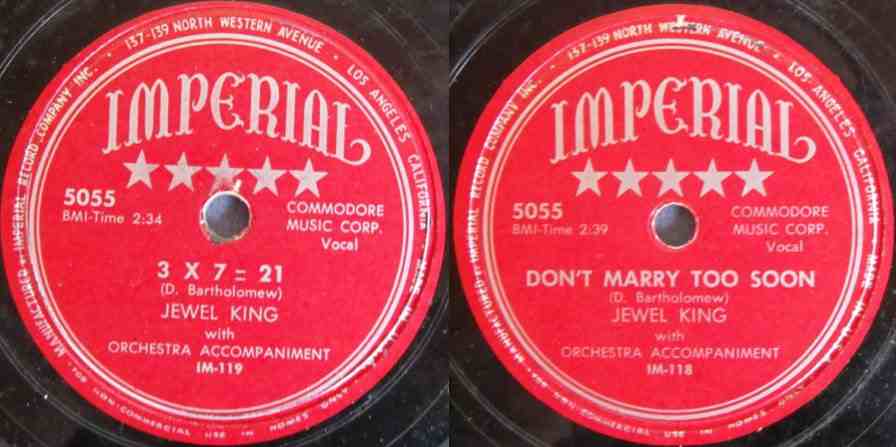 In December 1949, Imperial issued "3 x 7 = 21", backed with "Don't Marry Too Soon". They were reviewed in the January 14, 1950 Billboard:
Don't Marry Too Soon (52): Husky-voiced chirp shows some promise, but this draggy torcher isn't her meat.
3 x 7 = 21 (68): Jump blues is more like it. Good beat here too.
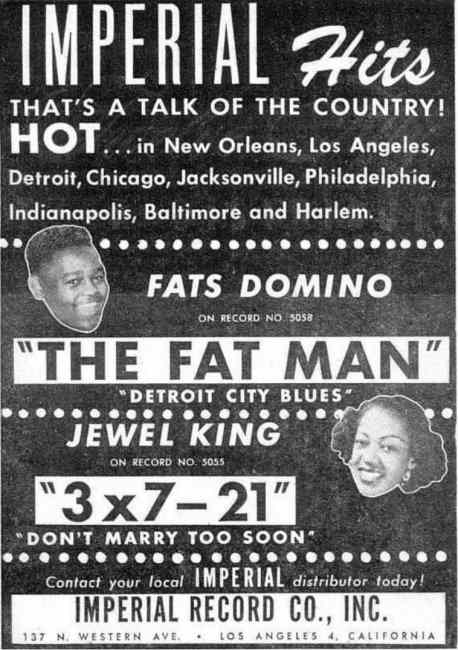 Imperial ads trumpeted "3 x 7 = 21" and the first release by another new Imperial artist, Fats Domino ("The Fat Man"). He sounds promising.
"3 x 7 = 21" had a 14-week run on Billboard's Most Played Juke Box Rhythm & Blues Records chart, where it reached #4. It became the #21 top juke box record for 1950 (Ivory Joe Hunter's "I Almost Lost My Mind" was #1). This isn't surprising; it's a great dance record and probably got worn out in the jukes. The song would also be recorded by the Spiders in 1954 (as "21"), and "Don't Marry Too Soon" would be redone by Little Miss Cornshucks in 1952.
Sometime in February 1950, Imperial, realizing that Jewel King was going to be big, held a second session, also run by Dave Bartholomew: "Keep Your Big Mouth Shut" (written by Jack Scott), "I Love a Fellow" (written by D. Bartholomew - M.J. King), "I'll Get It" (by Jack Scott), and "Broke My Mother's Rule" (written by Dave Bartholomew).
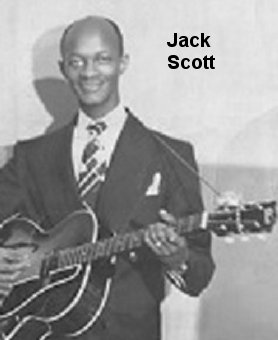 Since I mentioned him, Jack "Guitar" Scott is about to play a crucial role in our story. He'd been a guitarist in Paul Gayten's band in 1948-9 and was, at the time, both the leader of his own band and, more important, Jewel King's husband (although I can't find a marriage date).
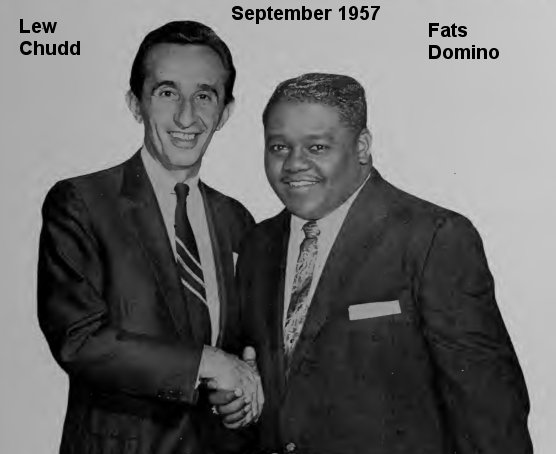 Now comes the drama. Lew Chudd, head of Imperial, found himself with two hits, "3 x 7 = 21" and "The Fat Man". What better way to rake in big bucks than to put together a tour featuring Jewel King and Fats Domino.
But it was not to be. Jack Scott got involved. He insisted that the band used on the tour should be his and not Bartholomew's; Imperial refused. Although she was supposed to be the headliner, Jewel was pulled from the tour and replaced with another new Imperial artist: Tommy Ridgley. Bartholomew told her she was making a mistake, but neither she nor Scott would listen. The tour left without her and that was pretty much the end of capitalizing on her hit. It couldn't have been much of a tour, however, I can't find a trace of it appearing anywhere.
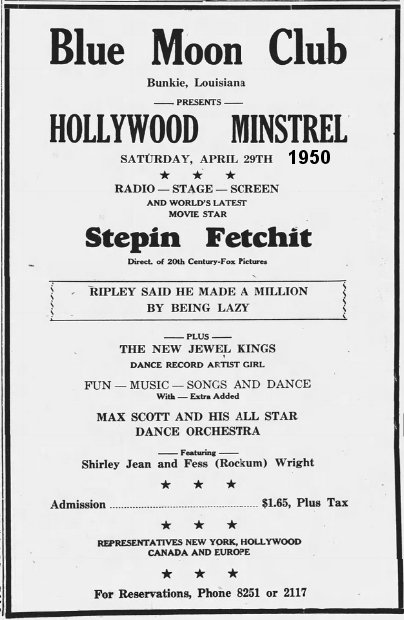
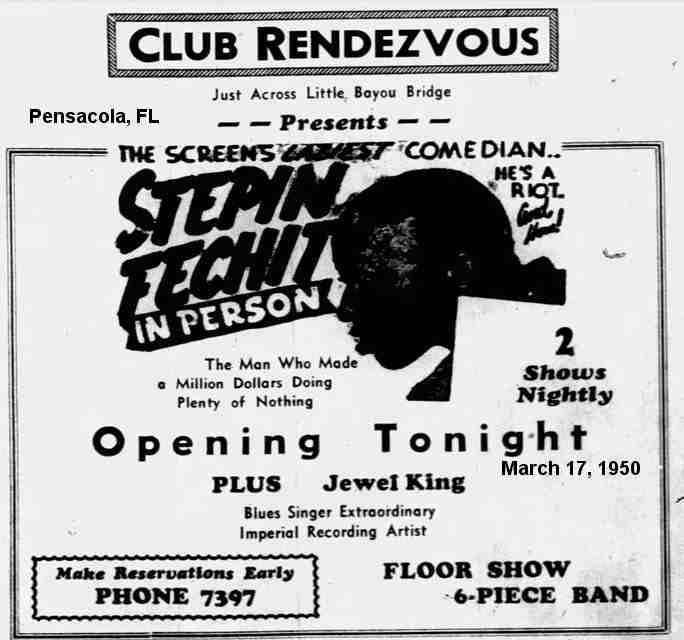
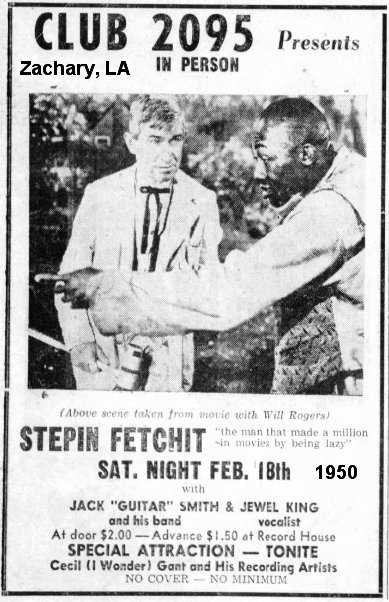 Instead, she and Scott toured with movie star Stepin Fetchit from February to April 1950. This was announced in early February and became another "not much of a tour": I could only find four ads - three in Louisiana and one in Florida. One didn't have her name, one corrupted it ("The New Jewel Kings - Dance Record Artist Girl"), one had the band of "Jack 'Guitar' Smith [sic]", and another had "Max Scott And His All Star Dance Orchestra".
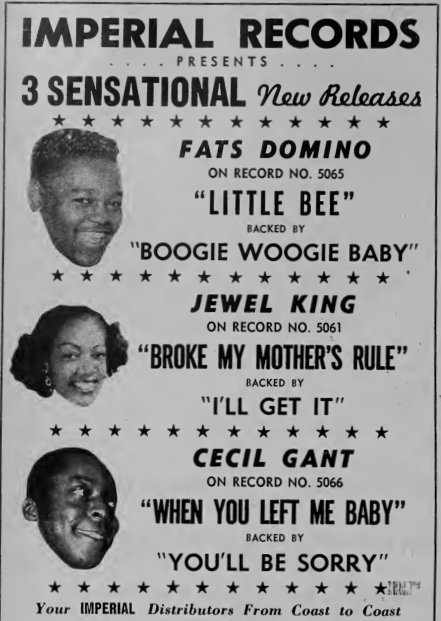
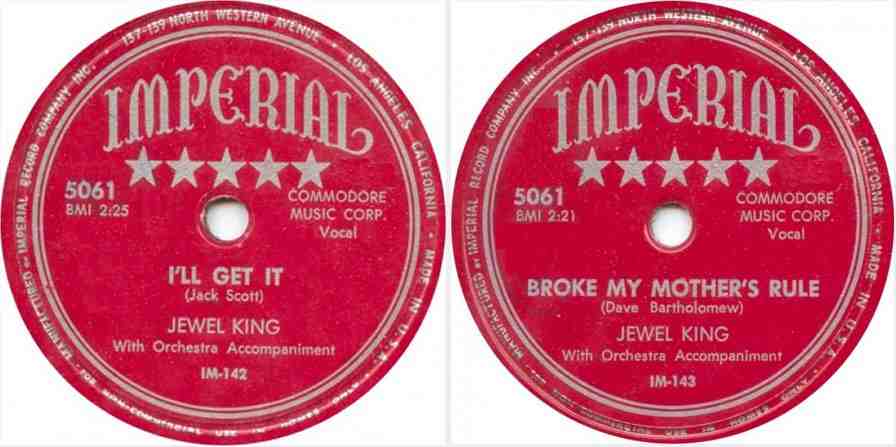 In February, Imperial issued "I'll Get It", backed with "Broke My Mother's Rule".
In the 1950 census, Jewel Scott ("vocalist") was living in New Orleans, the wife of Earlie L. Scott ("musician"). From this, we learn that Jack Scott's name was really "Earlie", which, as I found out, was not an uncommon name.
Back in Corpus Christi, Jewel's mother, Eddie King, was separated from George and living with her mother, Florence Harris, at the time of the April census. Also in the household was Jewel's son, who's enumerated as "Ronald Eugene Boyd". I suppose they knew his father's name was "Boyd", but this was the only time he'd be referred to that way.
"Broke My Mother's Rule" was reviewed in the April 29, 1950 Billboard:
Broke My Mother's Rule (62): Thrush warbles an up-tempo novelty blues and bop-scats a few bars. Gal is fine, material ordinary.
I'll Get It (73): Thrush delivers a smart up blues with verve and humor - minus bop this time. Distinctive piping here.
Jewel, along with Jack Scott's band, appeared at the Third annual spring dance of the Tes Trams Club at New Orleans' famed Dew Drop Inn, but the mention in the May 6 Pittsburgh Courier didn't bother to say when the dance was. On May 20, they were at Keeler Air Force Base in Biloxi, Mississippi.
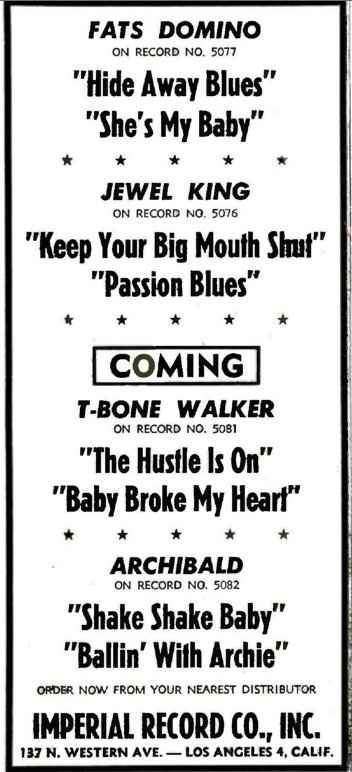
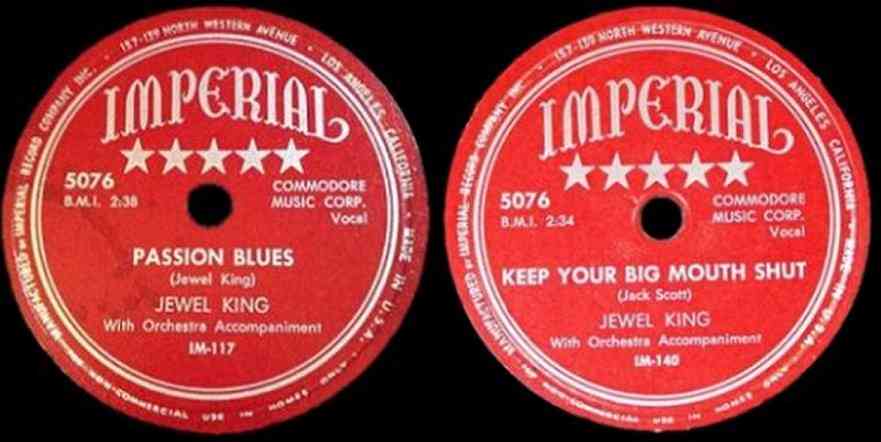 Also in May, Imperial issued "Passion Blues", coupled with "Keep Your Big Mouth Shut". They were very favorably reviewed in the June 3 Billboard:
Keep Your Big Mouth Shut (77): Fly novelty ditty is done pertly by Miss King, who sings with verve and persuasiveness.
Passion Blues (78): Thrush pours it on in a slow, torchy blues job.
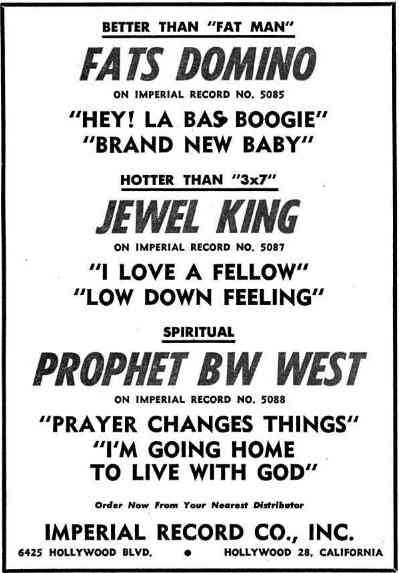
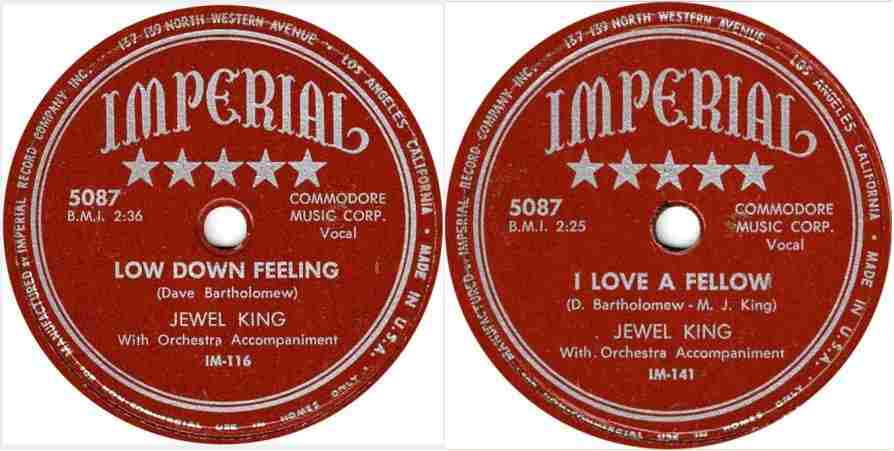 When that one went nowhere, Imperial tried again in July with "Low Down Feeling" and "I Love a Fellow". They were reviewed in the August 19, 1950 Billboard:
Low Down Feeling (66): Thrush delivers a rather routine slow blues with warmth.
I Love A Fellow (63): She does a jump blues with considerably less persuasion. Sturdy orking helps.
It looks like Imperial is just cleaning house, without really pushing the records.
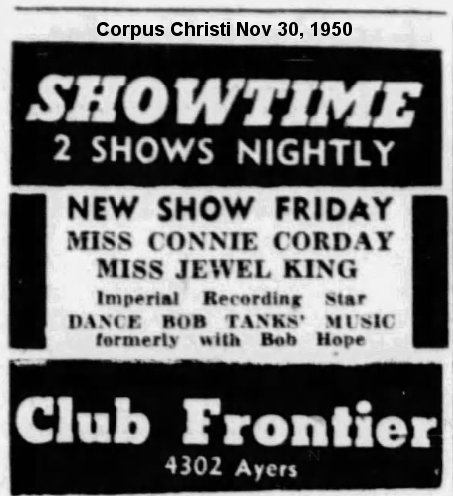
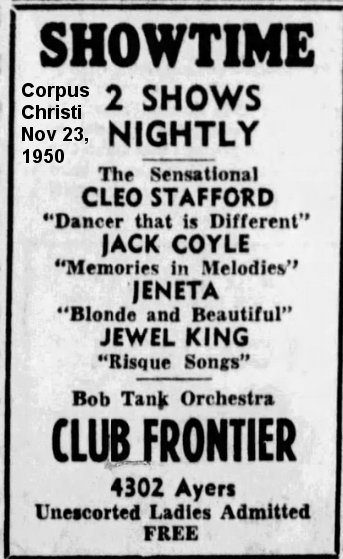 In late November 1950, Jewel appeared at the Club Frontier, in Corpus Christi. Not mentioned in the ads was Jack Scott's band. This is the last appearance I can find for her until 1956.
Not a word about Jewel in all of 1951.
Two paragraphs of confusion (for me at any rate). The January 19, 1952 Billboard said:
Jewel King returns to the Coast January 12 after eight months on the road and is slated for a wax session at Imperial. The New Orleans thrush will do a minimum of four sides.
And this was in the February 23, 1952 Billboard:
Lou [sic] Chudd of that label [Imperial] cut his first sides by Jewel King, songstress, who did "Three Times Seven" for Imperial a year ago. She was injured in a serious auto accident nine months ago and is back working in New Orleans.
Let's look more closely at both of those blurbs. The first one says she "returns to the Coast", when there's not a single hint of her ever being in Los Angeles. On top of that, her final Imperial session seems to have taken place in Texas. The second one says she cut her "first sides" for Imperial; I don't really know what that means. "Three Times Seven" was two years old at that point, not a year. This is the only report of an auto accident; there was nothing in the press about it. However, it could explain why there was no mention of her in all of 1951.
By this time, she'd probably moved back to Corpus Christi. Neither Jewel nor Jack Scott appears in the 1952 New Orleans City Directory.
In either January or February 1952, Jewel had her third (and last) Imperial session. It supposedly took place somewhere in Texas (Houston and Dallas are the usual candidates), and Dave Bartholomew wasn't involved this time. The four songs were: "'Round About Love Time" (written by Jewel King), "Lost Love" (written by Jewel King & Jack Scott), "Guide Me", and "Freight Train".
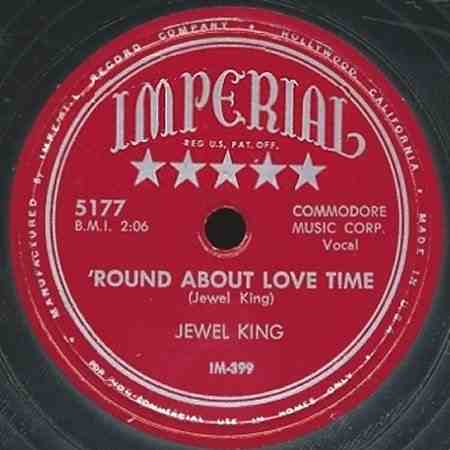 Imperial issued "'Round About Love Time" and "Lost Love" around March 1952. It would be Jewel's last release. They weren't sent out for review, nor were they advertised.
Jewel's father, George W. King, died on December 28, 1952. The obituary said his wife was still Eddie and his daughters were Birdie Mae and "Mary Jo". Sometimes I feel they just aren't trying.
Although I can't find a divorce record, Jack Scott was gone from her life. I'm reasonably certain of this because Mary Jewel King married Rufus Bell, in Austin, Texas, on May 4, 1953.
That one didn't work out either and she married Arthur Lee Thomas, in Corpus Christi, on March 28, 1955.
Finally, another appearance. On May 1, 1956, she performed at a luncheon of the Lions Club in Corpus Christi. Continuing at this mad pace, on May 5 she sang at the Fest-I-Rama at the Naval Auxiliary Air Station in Kingsville, Texas.
Jewel King wouldn't be heard from again until she turned up at the Noplace (Seattle, Washington) in late January 1960, along with the Dave Coleman Trio.
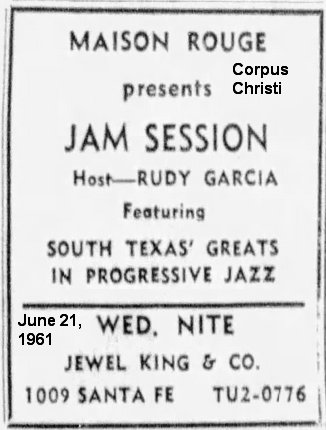
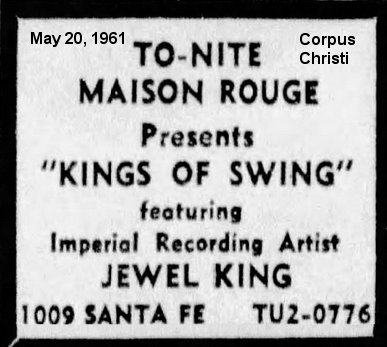 On May 20, 1961, Jewel was featured at the Maison Rouge (Corpus Christi). She was back on June 21.
And then, the start of a series. On July 2, 1961, Jewel was part of a Jazz Festival held in Corpus Christi. This would become an annual event and Jewel was usually there.
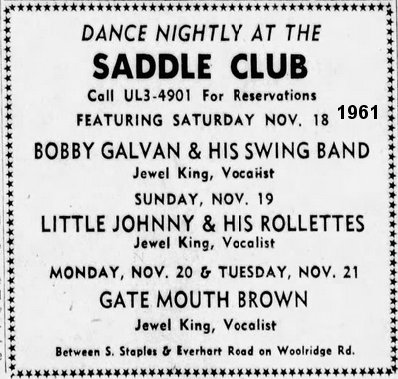
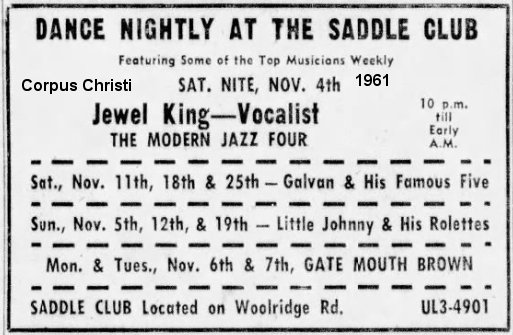
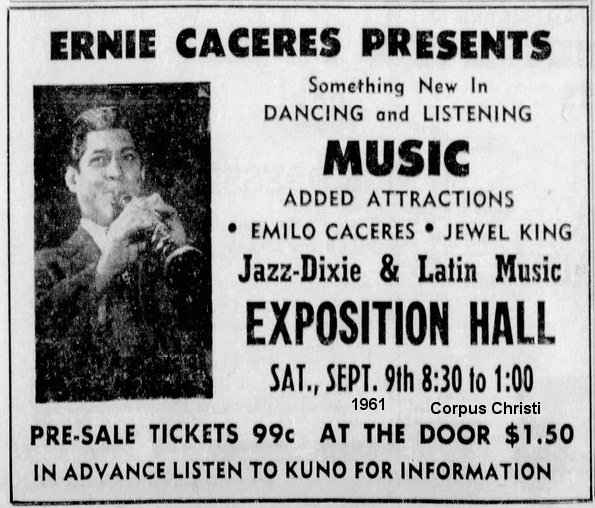
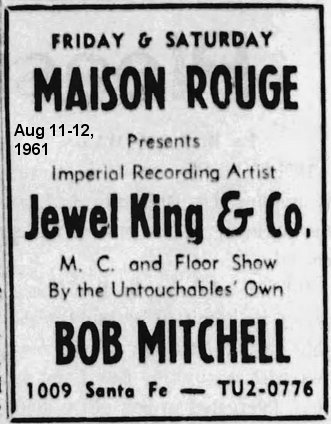 Jewel was back at the Moulin Rouge on August 11 and 12. On September 9, she was at Exposition Hall for a show just called "Music". On November 4, she was at the local Saddle Club, returning from November 18-21.
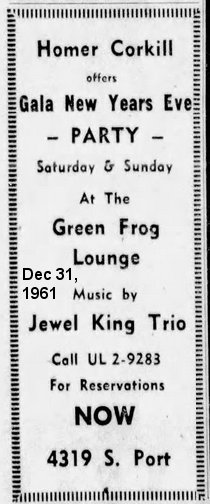 For New Years Eve 1961, the Jewel King Trio (whoever they might have been) was at the Green Frog Lounge in Corpus Christi. It was the only time they were ever advertised.
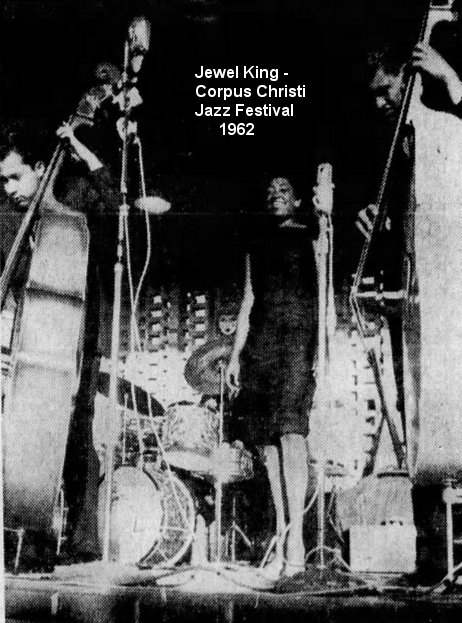
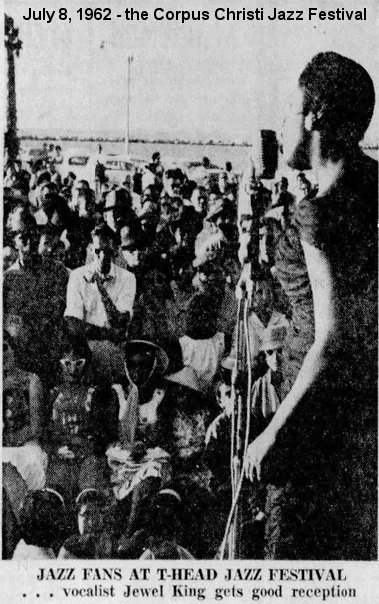
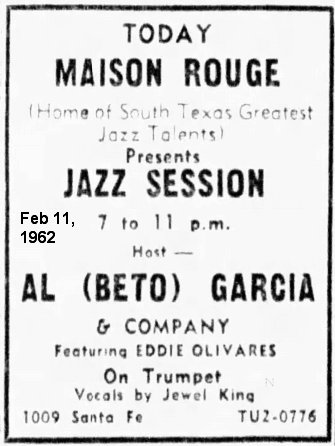 One more appearance at the Maison Rouge; this one on February 11, 1962. July 8 found her at the second annual Jazz Festival. She'd be there again on July 7, 1963 and July 5, 1964.
There was an article in the July 30, 1963 Corpus Christi Times about the recovery of a trove of burgled items. One of them was a guitar which had been stolen from Ronald E. King, whose address (3041 Sabinas) is the same as where he and grandma Eddie were living in 1950 (also at the time of the 1960 City Directory). Looks like her son was following a musical path.
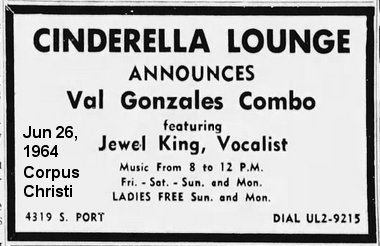
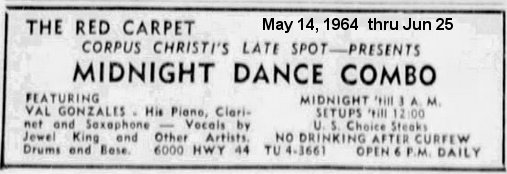 From May 14, 1964 through June 25, Jewel appeared at the Red Carpet, as the vocalist with the Val Gonzales combo. A day later, they were at the Cinderella Lounge. On August 7, they started a week at the Skipper's Club. These were all in Corpus Christi.
On July 18, 1965 Jewel was once again at the Corpus Christi Jazz Festival. I don't have a date, but by that time, she'd divorced Arthur Lee Thomas
When Corpus Christi held the sixth annual Jazz festival, on July 17, 1967, Jewel's name wasn't mentioned. I believe that this is the time she'd moved to the Fort Myers, Florida area, where her sister, Birdie, was living.
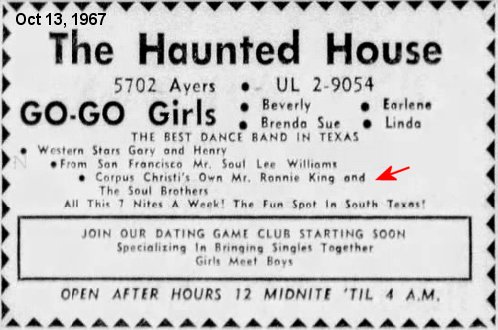 On October 13, 1967, there was an ad for a dance at The Haunted House (Corpus Christi). One of the acts was Ronnie King & The Soul Brothers. I'm sure this is Jewel's son.
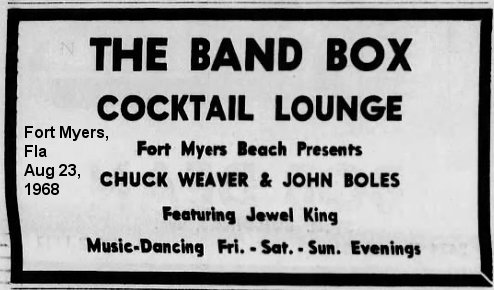 On August 23, 1968, Jewel, along with Chuck Weaver and John Boles, appeared at the Band Box in Fort Myers.
And here's husband number four: Leslie A. Watkins. In April 1969, she told Social Security that she was Mary J Watkins, but I have no idea when they married. This one lasted, however; they were still married at time of her death some 25 years later.
And then, Jewel embarked on a life of crime. The Ft. Myers News-Press of May 29, 1970 reported that she'd been fined $11 for an illegal U-turn. (OK, OK, it ain't Al Capone, but still...)
The June 27 News-Press named her as a program aide giving leadership to youth groups involved in the Expanded Nutrition Program.
After seemingly not having been at the Jazz Festival for a couple of years, she ("Jewel King of Florida") was back for their tenth annual show on July 26, 1970.
Jewel's mother, Eddie, died on October 3, 1970, still in Corpus Christi (as Eddie King White). Her obituary named both daughters: Mary Jewel and Birdie, both of Fort Myers.
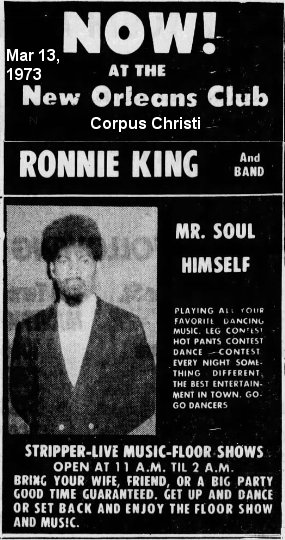 An ad for Ronnie King and Band had him at the New Orleans Club, in Corpus Christi, on March 13, 1973.
Not learning her lesson the first time, Jewel was busted again in February 1975. This time it cost her $25 for passing on a railroad crossing. Crime truly doesn't pay.
On November 15, 1976, Jewel entertained at a Ft. Myers jewelry and fashion show. It was the National Foundation March Of Dimes "Fashion Follies" at the Elegant Pelican.
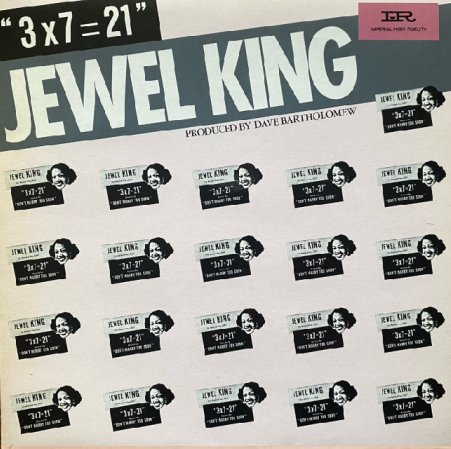 In January 1986, Imperial Pathe-Marconi, a French company, put out an LP with eight of her Imperial recordings, including the previously unreleased "Guide Me" and "Freight Train".
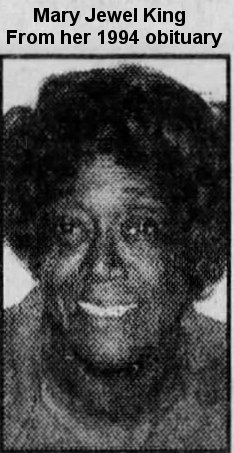 Mary Jewel King died, in Fort Myers, Florida, on September 26, 1994. At the time of her death, she was a retired educator from the Lee District School System (Ft. Myers is in Lee County). Her obituary, in the September 30 News-Press, had no mention at all of her singing career, but did say that she was a church organist, the only time she was mentioned as a musician. It gave the names of her deceased parents, her husband (Leslie A. Watkins), her son (Ronnie King), and her sister (Birdie Wicks, misspelled as "Hicks").
Her Social Security record shows that she changed her name six times (keep in mind that the date only indicates when she decided to tell Social Security about a name change, not when it actually changed by reason of marriage or divorce):
Mary Jewel King (6/43)
Jewel King Scott (11/51) - married to Earlie "Jack" Scott (guitarist)
Jewel King Bell (3/55) - married to Rufus Bell in 1953
Mary Jewel Thomas (9/56) - married to Arthur Lee Thomas in 1955
Mary J. King (7/65) - by July 65, she'd divorced Arthur Lee Thomas
Mary J Watkins (4/69) - married to Leslie A. Watkins
Jewel King had a great start to her recording career. Who knows where it would have led had Jack Scott let her go on tour with Fats Domino?
Special thanks to Gilles Pétard.
DELUXE (UNISSUED)
Go Now (recorded 1948)
Passion Blues (recorded 1948)
Give Me A Clue Baby (recorded 1948)
IMPERIAL
5055 3 x 7 = 21 / Don't Marry Too Soon - 12/49
5061 I'll Get It / Broke My Mother's Rule - 2/50
5076 Passion Blues / Keep Your Big Mouth Shut - 5/50
5087 Low Down Feeling / I Love a Fellow - 7/50
5177 'Round About Love Time / Lost Love - ca. 3/52
IMPERIAL UNISSUED
Guide Me 401
Freight Train 402
IMPERIAL PATHE-MARCONI (France)
1566390 Jewel King 3 x 7 = 21 - 1/86
3 x 7 = 21 **
I'll Get It
Broke My Mother's Rule
Don't Marry Too Soon
Round About Love Time
Lost Love
Guide Me
Freight Train
** Note: EMI/Capitol Records sent the wrong tape and this song is actually "Things You Should Know" by Gloria Jean Pitts.