Riff Ruffin
By Marv Goldberg
© 2026 by Marv Goldberg
Riff Ruffin, singer and guitarist, made some nice R&B vocals in the 1950s. He was also a musician on many sessions, but most of those remain undocumented.
Let me get this out of the way at the beginning. Everywhere it says that Riff Ruffin's actual name was "Edward Nehemiah Ruffin". I have no idea where people think the "Edward" came from. On every official document I have access to (birth certificate, censuses, World War 2 registration, marriage records, death certificate, and Social Security record), he's simply Nehemiah Ruffin. Therefore, unless someone can come up with an official source for "Edward", the entire Internet will have to change his name. Start working, Internet.
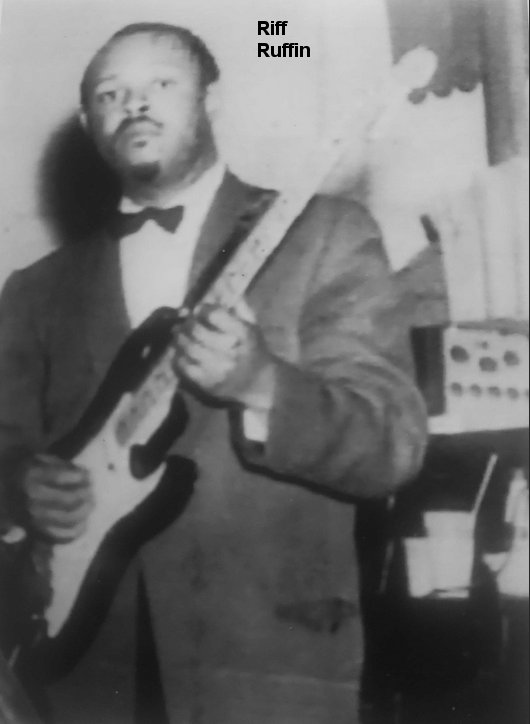
Nehemiah Ruffin was born on May 24, 1920, in Windsor, North Carolina (in Bertie County). His father was Moses Ruffin, a farmer, and his mother was Sarah Frances Roulhac.
In the 1930 census, the family was living in Murfreesboro, North Carolina. His father was now a preacher, and "Nemiah" has been joined by siblings Moses, Jr., Sarah, Mary Jane, Rayfield, and Joseph. His parents had had five previous children who were not with them by the time of the 1930 census: Ernestine, Emmeline, Enna, Celia, and James.
Father Moses died soon after that census and, by 1935, the family had moved to Philadelphia. In the 1940 census that's where the "Ruffing" family was. Nehemiah was a chauffeur and, keeping it in the family, Moses, Jr. was a truck driver.
On July 1, 1941, Nehemiah registered with the draft. At the time, he was still living at home and was a chauffeur for a church pastor.
On August 14, 1941, Nehemiah Ruffin (still a chauffeur) married Ernestine Bowe in Philadelphia. (That was the name she gave on the marriage license, but her real name was Lessie Harrison Bowe, which is the name she used when she remarried in April 1948.)
Nehemiah was in the Army from February to October 1945, but he was recalled from February to July 1946. At the time of his recall, he gave his occupation as "musician, instrumental". He and Ernestine would divorce around this time.
On September 30, 1947, Nehemiah Ruffin (musician), married Esther Cavelle Stewart in Hopewell, Virginia. This is where he'd live for the rest of his life (except for years spent in Los Angeles and Brooklyn).
In August 1949, Nehemiah began a four-year crime spree, as reported in the local Hopewell News:
August 8, 1949: speeding, $15 suspended fine; no city tag, $10.
June 14, 1950: disorderly conduct, $7.
May 15, 1951: improper license, $5.
August 5, 1952: speeding (50 mph in a 35 mph zone), $15.
June 11, 1953: speeding, $50.
September 14, 1953: careless and reckless driving, creating a disturbance, and driving without a city tag. To be given a hearing the following day (which wasn't reported).
OK, OK, it isn't Al Capone, but you have to admit that, for someone who was a chauffeur, he doesn't seem to take driving very seriously.
The November 21, 1949 Hopewell News reported that: "Nehemiah Ruffin has returned to his home in Davisville after being a patient at McGuire Hospital." That's a veterans' hospital in Richmond, Virginia; "Davisville" was a housing project in Hopewell.
In the 1950 census, he was enumerated as "Riff Ruffin". He and "Esta" were living in Hopewell, with their son, Ronald Nehemiah Ruffin, who'd been born in May 1948. Riff was a "truck helper in a chemical plant". (Note that Esther had a son, Jacques Tyrone Johnson, from a previous marriage. He wasn't enumerated in this household, however.)
Finally, something to do with music. "Riff Ruffin and his orchestra", played at a School Jamboree at the Davisville Projects Community Center on April 20 (a benefit for the Carter G. Woodson School). The April 17 Hopewell News identified members of the orchestra as Jay Peters (tenor sax), "Zonky" Jackson (drums), "Cluck" Nicols, and Nathan Johnson. This is the only time any of Riff's band members would be named.
Now in full R&B stride, Riff's band played at an outdoor square dance near the Davisville Community Center.
More domestically, in November, 1950, Riff and Esther had a daughter, Ginger Lafon Ruffin.
On May 5, 1951, he and his orchestra, played for a teen dance at the Davisville Community Center. That's his only mention in 1951 and, so far, these have all been small local appearances.
But those were better than 1952, during which he didn't seem to appear anywhere.
In 1953 and 1954, he played for a few dances in Petersburg, Virginia, about 10 miles from Hopewell. There was the Elks Home on March 13, 1953, the Dragon Club on March 15, and an Afternoon Tea at the Elks Club on October 25. Then, on January 16, 1954, a dance at the Byrne Street USO and a Pre-Valentine Dance there on February 12.
However, by early 1955, he'd relocated himself (but not his family) to Los Angeles, and began his recording career. Nothing ever said why he went there. All record releases, through the end of 1957, would be on California labels.
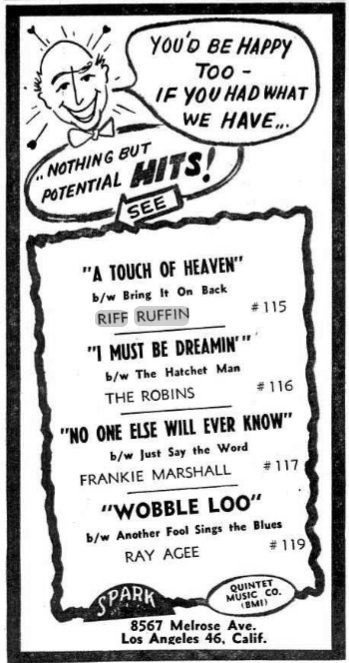
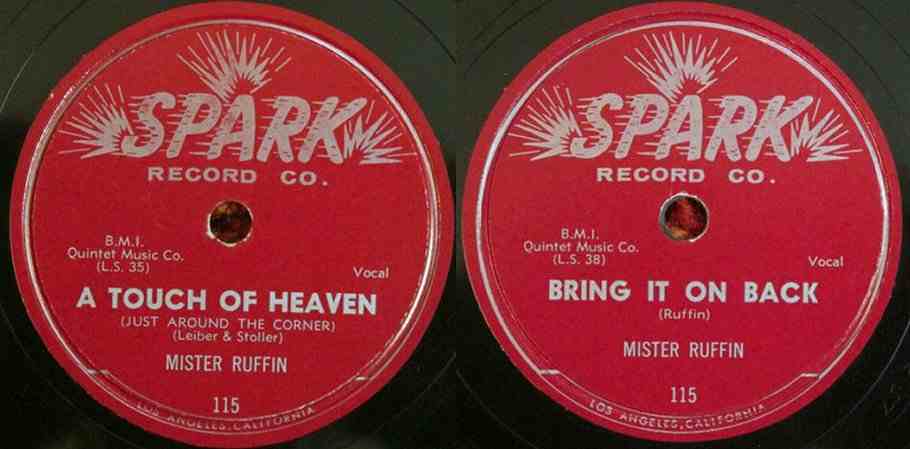 His first (as "Mister Ruffin"), was on Leiber & Stoller's Spark label, in May 1955: "A Touch Of Heaven (Just Around The Corner)", backed with "Bring It On Back" (written by Riff). They were reviewed in the May 21 Cash Box and the May 28 Billboard:
A Touch Of Heaven (CB; B+): Mister Ruffin, in a distinctive bit of vocal work, dishes up a middle beat bouncer in a big voice styling. Strong hornwork in the break keeps the ditty driving. Ok wax.
Bring It On Back (CB; C+): Ruffin rocks through a fast beat jump blues with gravel voice. Etching seems to lack the drive it needs.
A Touch Of Heaven (BB; 77): Ruffin has an emotional ballad into which he can pour his big voice and put it thru all the vocal tricks of which he is capable. This tailor-made material could go a long way if given proper exposure.
Bring It On Back (BB; 76): A jumpy blues that is strong on performance wherever it falls down material-wise. Loud and happily extrovert, the youngsters will find this especially appealing.
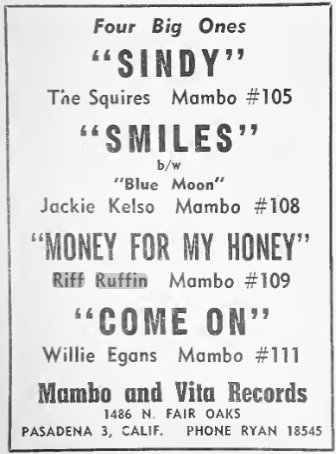
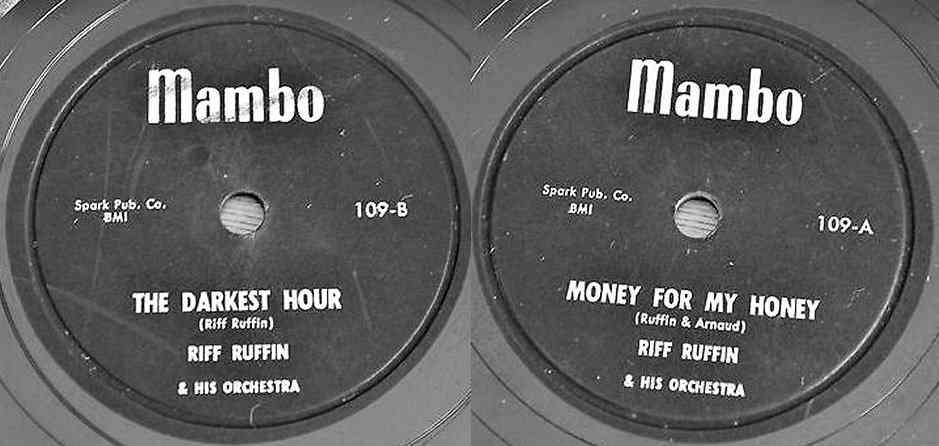 Next came "The Darkest Hour", coupled with "Money For My Honey", released on Larry Mead's Mambo label in August 1955. Both written by Riff, they were credited to "Riff Ruffin & His Orchestra". Since I doubt he brought any of his musicians with him from Virginia, he'd formed his own aggregation in California (unless they were session musicians). He'd have trios, quartets, bands, and orchestras over the years, but not one of the musicians would ever be named.
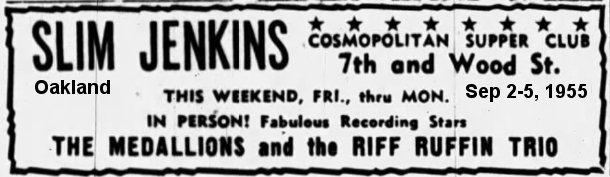 On September 2-5, the Riff Ruffin Trio, along with the Medallions, appeared at Slim Jenkins, a supper club in Oakland, California.
The Mambo record was reviewed in the October 1, 1955 Cash Box:
Money For My Honey (B): Riff Ruffin shouts out a quick beat jump blues with enthusiasm. Driving side.
The Darkest Hour (B): Ruffin gives a throaty reading to a slow rhythmic down home blues. A hard hitting performer who can spark a tune. Two ok sides.
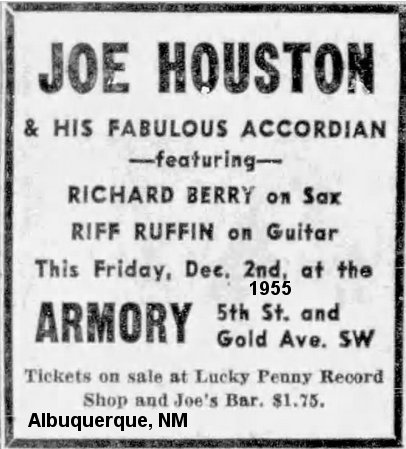
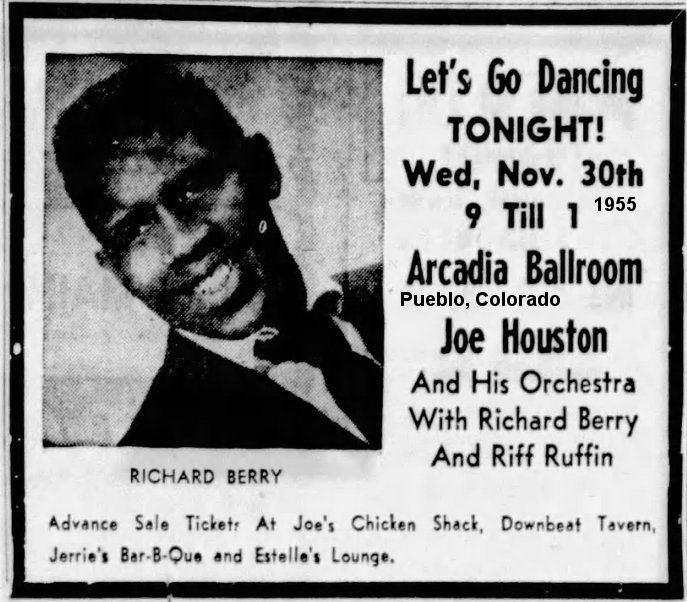
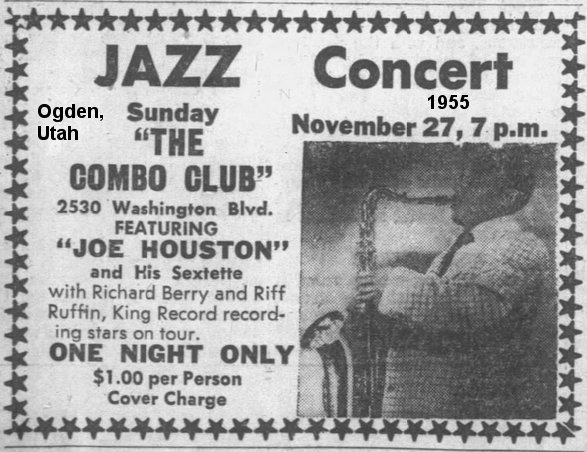 By November, Riff had hooked up with saxophonist Joe Houston's band, which was touring with Richard Berry. On November 27, they played the Combo Club (Ogden, Utah); on November 30, the Arcadia Ballroom (Pueblo, Colorado); and, on December 2, the Armory (Albuquerque, New Mexico). The ad for that one credited "Joe Houston & His Fabulous Accordian [sic], Richard Berry on Sax, and Riff Ruffin on Guitar". At least they got Riff right.
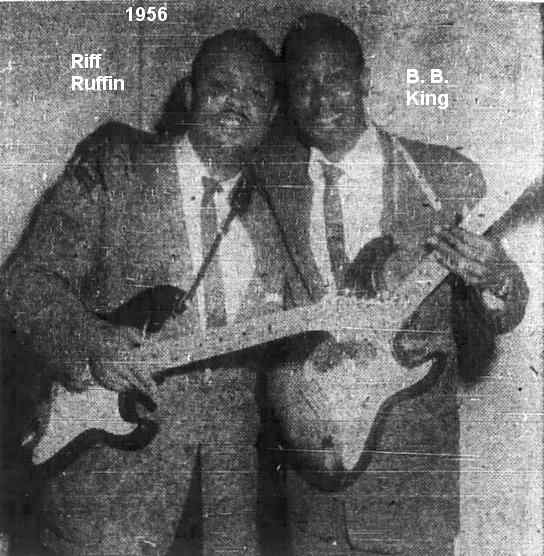
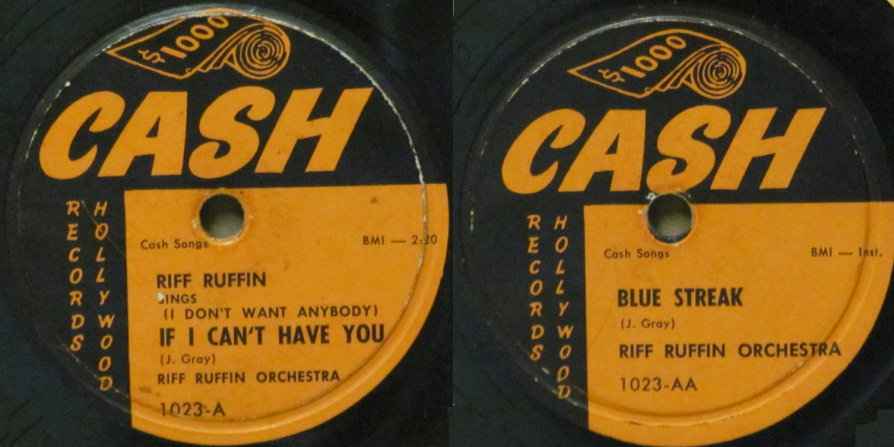 In March 1956, Riff (with the "Riff Ruffin Orchestra") released "(I Don't Want Anybody) If I Can't Have You", backed with "Blue Streak" (which I find to be, not only an incredibly boring instrumental, but one that has a beat much too slow to be called "Blue Streak"). This was the first of four releases on John Dolphin's Cash label.
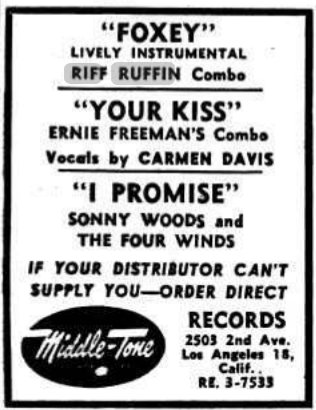
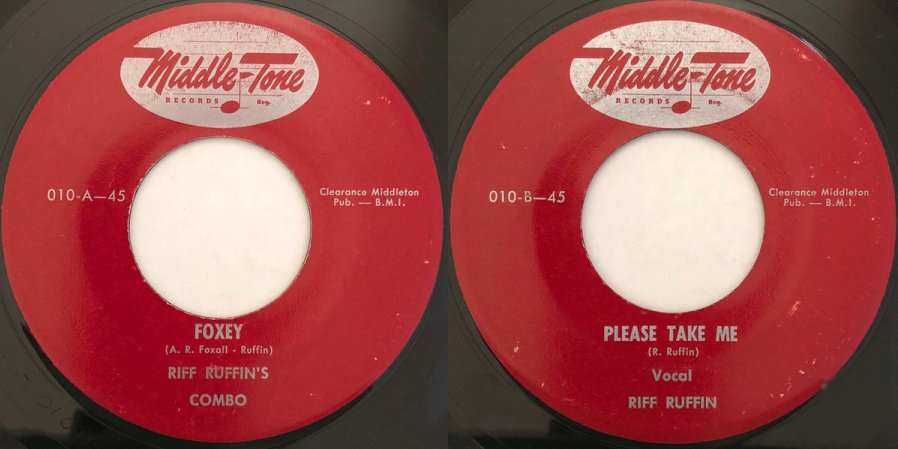 In April, "Riff Ruffin's Combo" could be heard on Emanuel Middleton's Middle-Tone Records: "Foxey" (an instrumental), backed with "Please Take Me". Riff wrote both sides ("Foxey" along with A. R. Foxall).
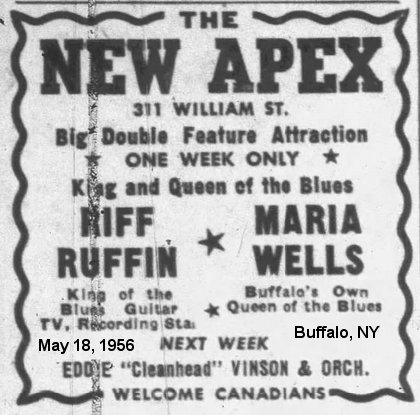 In May, Riff ("King Of The Blues Guitar") appeared at the New Apex, in Buffalo, New York. It was his only noted appearance in all of 1956.
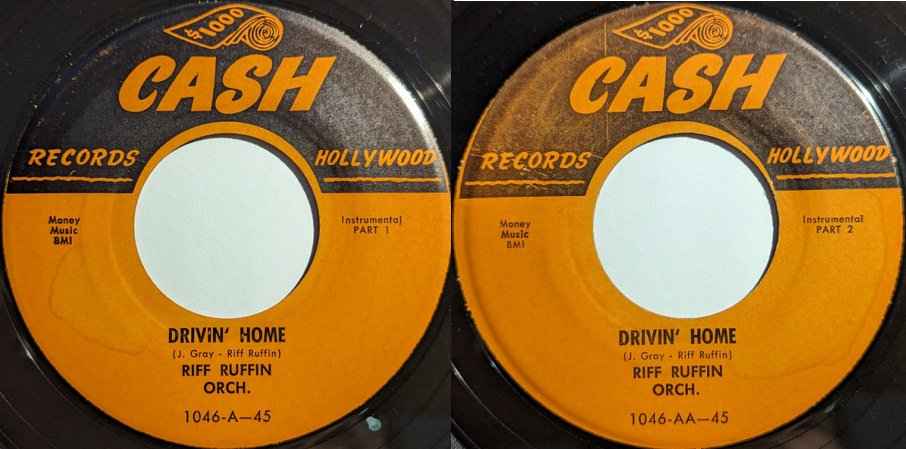
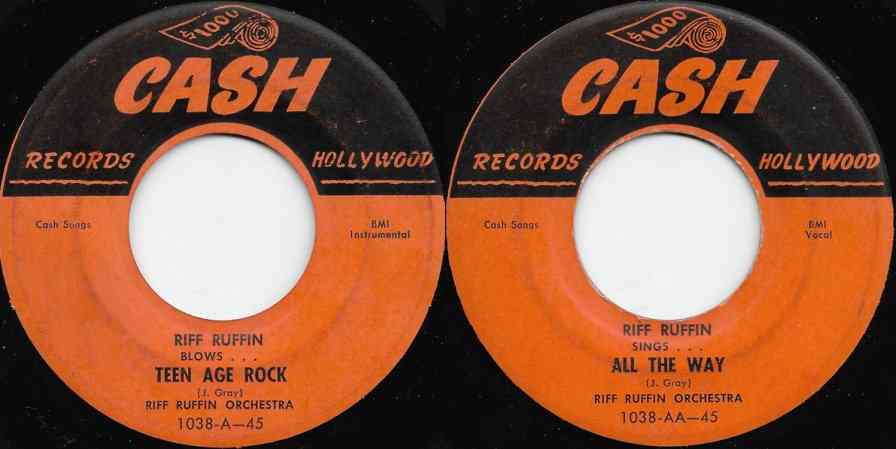 Riff's second Cash release was "All The Way ", backed with the instrumental "Teen Age Rock", in July 1956. The third was the instrumental "Drivin' Home (parts 1 and 2), from December.
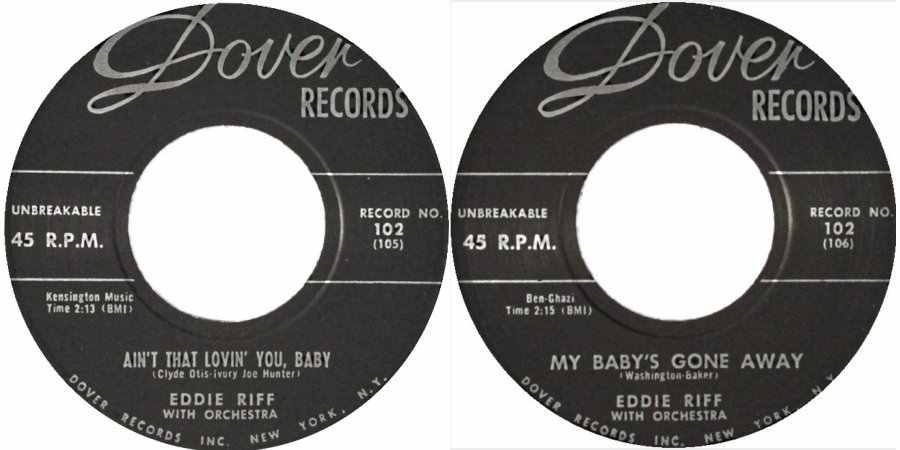 And then there's this. In late 1956, there was a release by "Eddie Riff" on Dover, a tiny New York City label: "Ain't That Lovin' You, Baby", backed by "My Baby's Gone Away". Most sites equate Eddie Riff with Riff Ruffin, but I don't believe it was him. My (not very accurate) ears tell me they don't sound alike, so I asked four singers to listen to "Ain't That Lovin' You Baby" and a side by Riff, "No More", which would be issued in early 1957. One singer said they were the same, two agreed that they were different, and one (Billy Vera) was a bit more precise with "Damned if I know". I'll put it in the discography, just in case, but I really don't think it's him. (But this is probably where the erroneous "Edward Nehemiah Ruffin" came from.)
Sometime in January 1957, Riff was part of the show at the Rendezvous Ballroom in Balboa, California (south of Los Angeles). Others on the bill were the 5 Keys, the Penguins, and a band that included Joe Houston, Chuck Higgins, Riff Ruffin, and Johnny "Guitar" Watson. Must have been a fun place; on February 13, it lost its business license due to charges of drug sales and disorderly conduct on its premises.
Meanwhile, back in Hopewell, Riff's son, Ronald, participated in the "Tom Thumb Wedding" at the Davisville Community Center on January 28. He performed the "wedding ceremony".
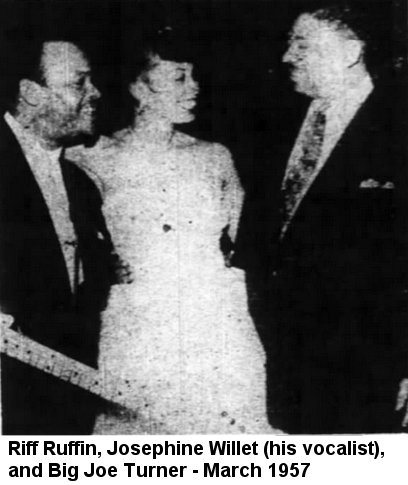
The March 16, Pittsburgh Courier had a photo of Riff with this caption:
GUITAR KING - California's guitar king, Riff Ruffin, and his vocalist, Josephine Willet, chat with Big Joe Turner during intermission at ballroom where the trio appeared together in Los Angeles. Maestro Ruffin opens March 15 for a week's engagement, and during his stay in the Pelican City, he will cut a record session for Ebb label.
Only two sentences, but what a mess. I can't find any appearances where Riff and Turner were together, especially at the unnamed ballroom. There was never another word about Josephine Willet, with or without Riff. He opened March 15th where? What's the Pelican City? (It isn't a nickname for Los Angeles.) At least they were correct about Ebb.
The April 13, 1957 Norfolk, Virginia Journal And Guide had a big article about Riff, the only biographical piece ever printed. Most of it I can't confirm, and I hope most of it is true, but since they called him "Jeremiah 'Riff' Ruffin", all becomes suspect.
HOPEWELL, Va. A former Fort Lee soldier who married a Hopewell girl is making a name for himself in the musical world on the West Coast.
Jeremiah [sic] "Riff" Ruffin is being hailed as California's "guitar king" and one of the newest "finds" in the rhythm and blues field since he moved out to the coast several years ago.
Ruffin conducted a 21-piece dance band at Ft. Lee [near Petersburg, Virginia] during World War II. He later formed a band of his own in 1946 and played for parties and dances in the southside Virginia area. He later joined the Du Droppers for a tour of three continents before going to California, with Ivory Joe Hunter's band. [There was never a mention of Riff on a Du Droppers tour (and the only time they left the U.S. was to play in Canada and Hawaii). Ivory Joe Hunter was in Modesto and Los Angeles in March 1955, but there was no mention of Riff.]
In California, "Riff" has written material for Ruth Brown and has played and sung with Jimmy Gorham, Erskine Hawkins and Lucky Millinder. [Not a single Ruth Brown release, up to this point, was written by Riff.]
Among the hit tunes which he has recorded are "Bring It On Back", "I Want You To Be My Baby", "Lonesome", "Money For My Honey", "My Child", "The Darkest Hour", "A Touch of Heaven", and "I Don't Want Nobody If I Can't Have You". His biggest hit during the past years has been "Blue Streak", a soulful instrumental solo featuring his singing and the torrid playing on his Spanish guitar. [I don't know what "I Want You To Be My Baby", "My Child", and "Lonesome" are; they may be unreleased tunes. Note that, even if an artist's mother bought the only copy of a record, it was always listed, in articles like these, as a "hit tune". "Blue Streak" was a pure instrumental, with no singing.]
Several of Riff's recordings have been heard over local radio stations in the Hopewell-Petersburg-Fort Lee area. [One hopes, but so what?]
Riff attended Virginia State college's school of barbering and after graduation, worked at the Main PX at Fort Lee. He is married to the former Esther J. Stewart, daughter of Mr. and Mrs. John Stewart of Dreamland. They are parents of three children, J. Tyrone, Ronald N. and Ginger L. Ruffin. [Remember Jacques Tyrone was his step-son.]
Mrs. Ruffin is a former secretary to Dr. Ina C. Hall. J. Tyrone is a junior pupil at Woodson high school where he is a member of the A Capella choir and plays in the school band. He also plays with the Tilters' "Rock-and- Roll" combo of Chester, Va.
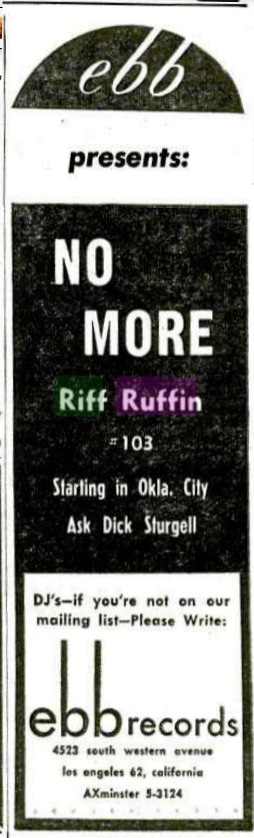
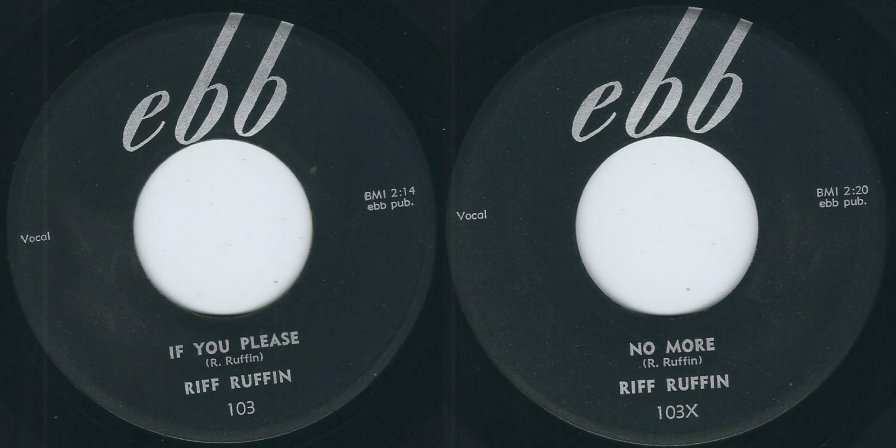 Riff's first Ebb release, in May 1957, was "If You Please", coupled with "No More". They were reviewed in the May 13 Billboard and the June 8 Cash Box:
No More (BB; 70): Standard blues. Vocal is shouted strongly, backed by chorus and a rollicking piano, rhythm and horns. Moves right along.
If You Please (BB; 68): This is the slow side. Riff Ruffin sings a bluesy ballad here. Rhythm is marked, including keyboard triplets and guitar, and persistent drum.
If You Please (CB; B): Riff Ruffin delivers a slow beat blues ballad with a cozy reading that comes through well. Ruffin sells the song well. Easy to listen to wax.
No More (CB; B): Ruffin about faces completely as he rocks out a quick beat jumper with an enthusiastic reading. Deck is a lively wax that gets the spirit jumping. Happy and driving wax.
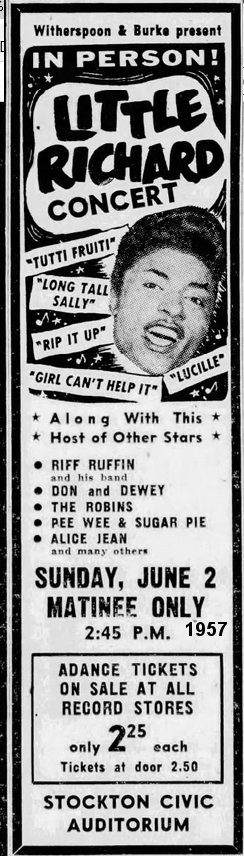 A May 20 Ebb ad for "No More" said that Riff was "Starting in Okla. City". Of course, it didn't bother to say where, and I can't find any appearances there. On June 2, Riff and his band were part of a big show at the Stockton, California Civic Auditorium. He shared the stage with Little Richard, Don & Dewey, the Robins, Pee Wee & Sugar Pie, and Alice Jean (of the Mondellos, although they weren't listed as being with her).
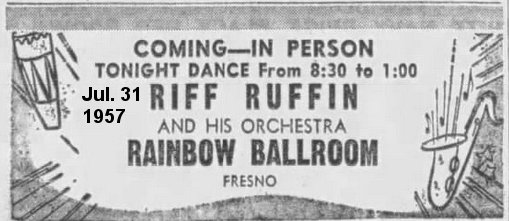 On July 31, the band was at the Rainbow Ballroom in Fresno, California.
The October 5, 1957 Norfolk Journal And Guide spoke of a dance band made up of "former and present Woodson High School Students of Hopewell". One of the members was tenor sax player Tyrone Johnson, "step-son of Riff Ruffin, famous singer and guitar player on the West Coast".
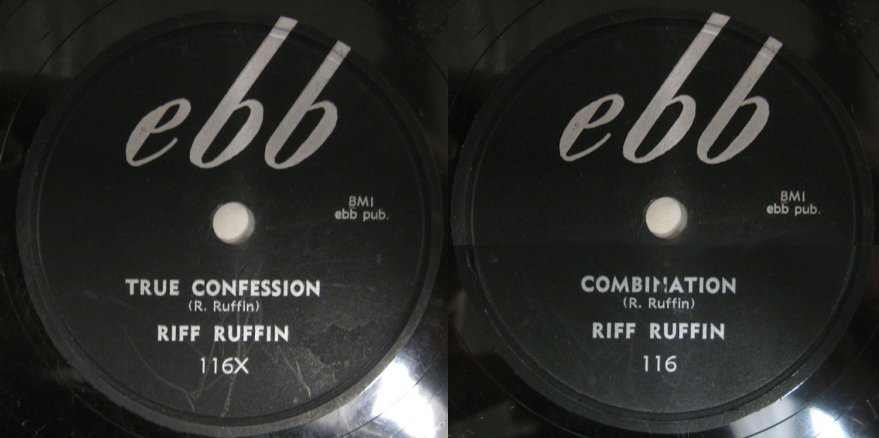 The second Ebb release, from September 1957, was "True Confession", backed with the instrumental "Combination". They were reviewed in the October 14 Billboard and the October 19 Cash Box:
Combination (BB; 71): Danceable, medium-beat instrumental features listenable interplay between organ, guitar and tenors. Fine jockey side.
True Confession (BB; 70): Weeper is presented by the artist against gutbucket backing. Fair chances.
True Confession (CB; B): Ruffin offers a slow beat down home blues. Ruffin gives an emotional portrayal of the pleading lover. Good wailing.
Combination (CB; B): Ruffin tries hand at a middle beat rhythm piece. An instrumental deck with a good commercial sound.
["Nehemiah Riff Ruffin" copyrighted "Combination" on January 30, 1958.]
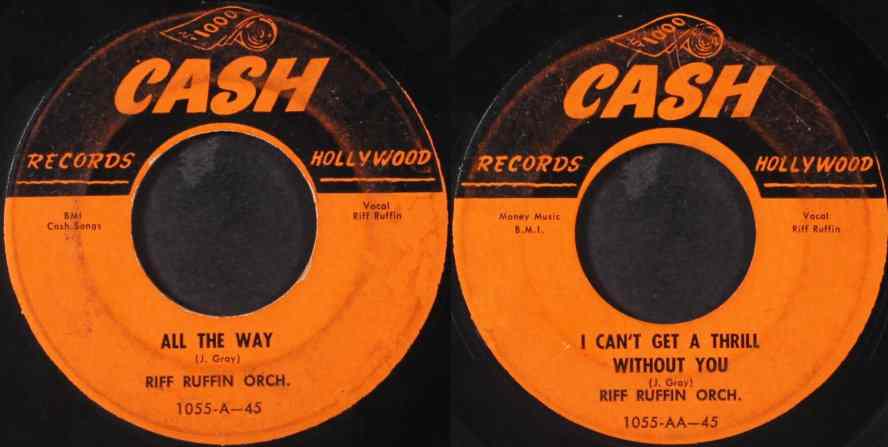 This was followed, in October, by the last Cash release: "All The Way", coupled with "I Can't Get A Thrill Without You". "All The Way" is a sound that would be classified as "Soul" years later. There's one other known Cash recording, unreleased on a single: "Xmas Baby".
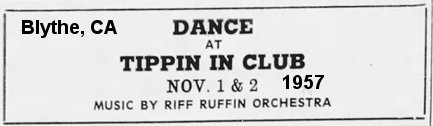 Starting for home: the October 26, 1957 Pittsburgh Courier said: "Bandleader Riff Ruffin, on the strength of his Ebb disc, 'True Confession', is about to quit the Los Angeles night club scene and invade the East because of demands by promoters to book him." This is, of course, the usual press agent nonsense. On November 1-2, the Riff Ruffin Orchestra played for a dance at the Tippin In Club in Blythe, California (between Los Angeles and Phoenix).
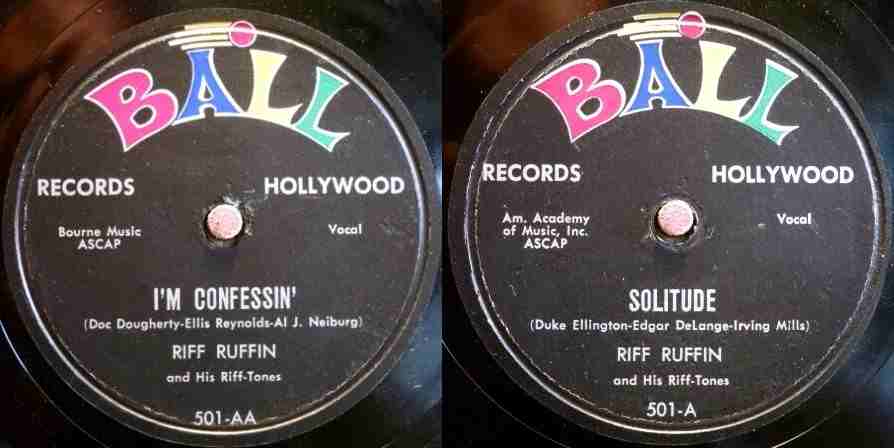 One more 1957 release, this time on the Ball label, in December. "Riff Ruffin and His Riff-Tones" (a chorus) sang two old standards: "I'm Confessin'" and "Solitude".
By that time, he was home (for a while). This was in the Norfolk Journal And Guide of January 11, 1958:
The Christmas dance, sponsored by the 26-50 Club was ranked as one of the social highlights of the season when it was held Thursday, Dec. 26 [1957] at Union Hall.
[Sax player Johnny] Crittendon's six-piece combo, featuring the guitar playing of nationally famous "Riff" Ruffin, rendered music. More than 40 persons jammed the Union Hall for this festive occasion. [Note that Crittendon was the manager of the group that Riff's step-son, Jacques Tyrone Johnson, was with.]
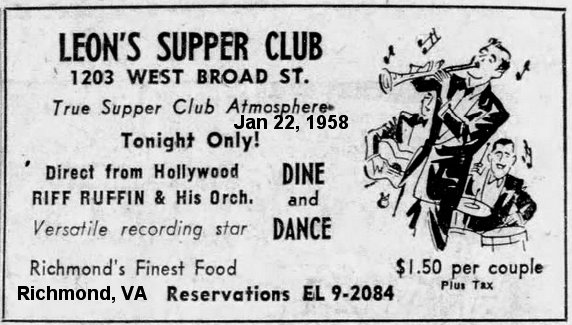 On January 22, Riff Ruffin and his orchestra ("Direct From Hollywood") appeared at Leon's Supper Club in Richmond, Virginia.
The Ball release was reviewed in the January 25, 1958 Cash Box:
I'm Confessin' (B): Riff Ruffin handles the classic evergreen with a delicacy and warmth that gives the oldie new life. Easy, moving waxing that could revive the tune. Watch it.
Solitude (C+): Ruffin backs with another memorable favorite and treats it carefully. Deck fails, however, to come up to the "Confessin'" side as the gimmicks somehow fail to fit into the mood of the tune.
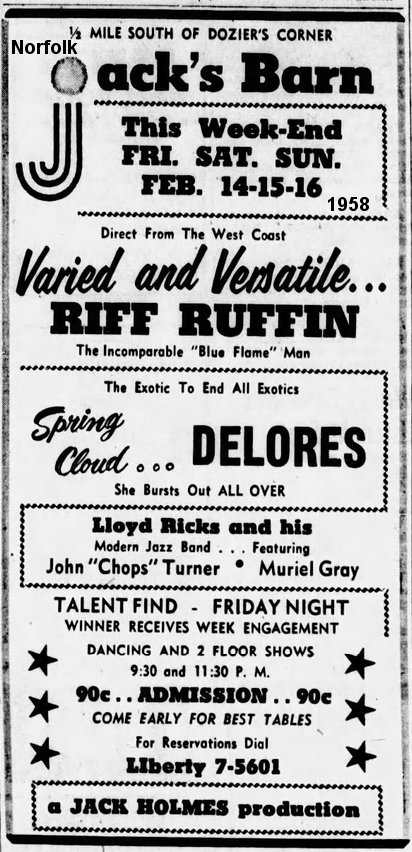 Staying close to home, Riff Ruffin ("The Incomparable 'Blue Flame' Man") appeared at Jack's Barn (Norfolk) from February 14-16, 1958. I assume that "Blue Flame" was the incorrectly-remembered "Blue Streak".
Some May and June ads for the Magic Carpet, in San Bernardino, mention Linda Fontainette, "Formerly with Riff Ruffin's Band and the Little Richard Show". However, she was never otherwise associated with either Riff or Richard.
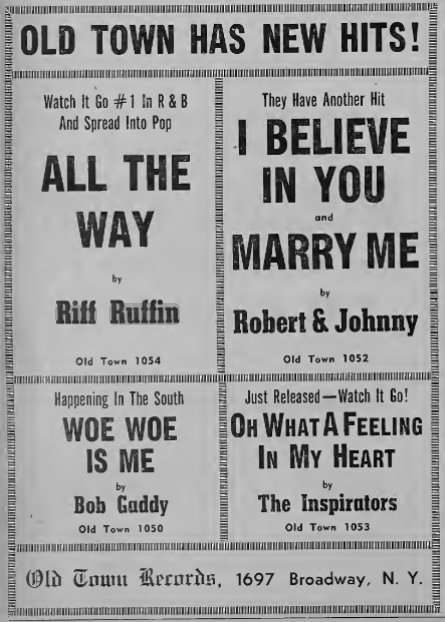
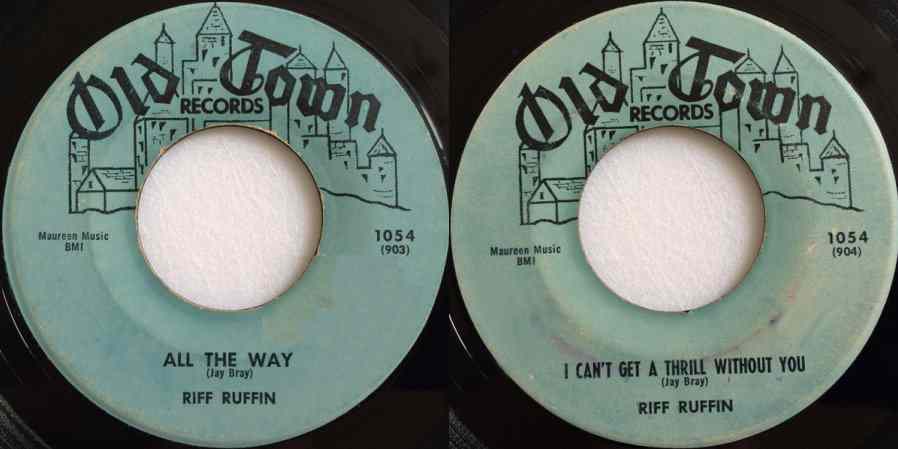 After John Dolphin, owner of Cash Records, was murdered on February 1, 1958, Hy Weiss, of Old Town Records in New York, purchased and re-released "All The Way" and "I Can't Get A Thrill Without You" in June. The June 14 Cash Box said:
[Hy Weiss, Old Town Records] ... advises that he has picked up the Cash master "All The Way" by Riff Ruffin. Reports solid action on it and has high hopes for a big one.
It received Cash Box's Award O' The Week in their June 21 edition:
Riff Ruffin, sounding very much like Ray Charles on this disking, "All The Way", comes through with a very powerful reading of the slow, rhythmic blues. Material is very strong, choral support and Ruffin's treatment give the entire production a feeling of the spiritual. Deck has a powerful potential. Watch it very carefully. The flip, "I Can't Get A Thrill Without You", is a slow beat ballad performed by Ruffin in his stylized manner. Deck is impressive, but without the overall appeal of "All The Way".
Whereas all Riff's recordings up to the end of 1957 were done in California, from here on, all his releases, except the last, would be on New York labels.
The September 27, 1958 New York Age said: "Riff Ruffin and his trio had them clapping and tapping at Hotel Theresa [Harlem] bar over the weekend."
In October, Riff recorded two songs for Atlantic Records: "Confession" and "No More"; they remain unreleased. I assume that "No More" was a reprise of the Ebb release; "Confession" was probably a reprise of Ebb's "True Confession".
By that time, Riff had moved himself (but not his family) to New York (probably Brooklyn), where he'd remain for many years.
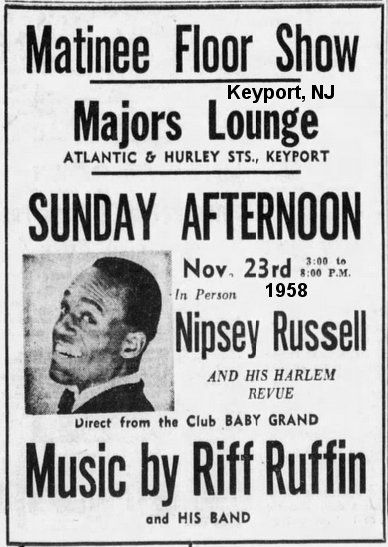 On November 23, he and his band appeared at Majors Lounge, in Keyport, New Jersey.
After this, he became associated with record producer Bobby Robinson. He was probably on many, many sessions as a guitarist, but the only one I know about was on June 30, 1959, when he backed up Buster Brown on "Fannie Mae" and "Lost In A Dream", released on Robinson's Fire records. Actually, that was the only trace of him in 1959.
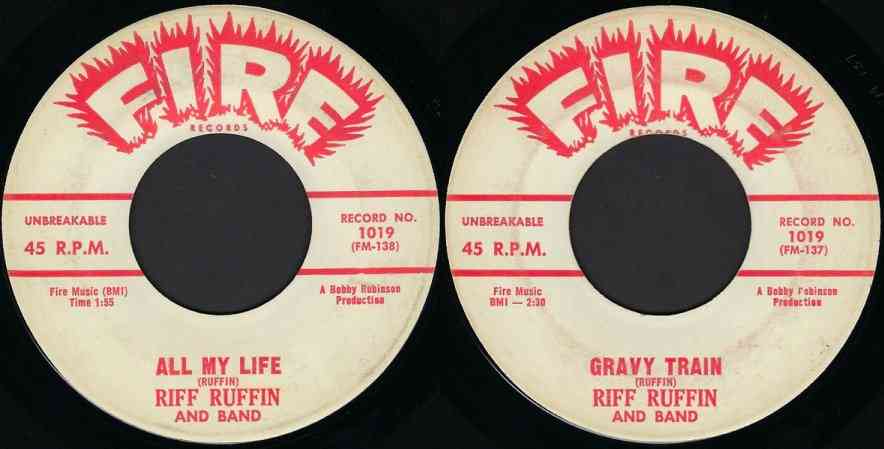 And then, he had his own release on Fire, in March 1960: "Gravy Train" (mostly an instrumental) and "All My Life". They were reviewed in the March 26 Cash Box:
Gravy Train (B+): Driving "train" blues is the Ruffin Band's object on this hard beat, swinging session. Chorus is on call now-and-then. Could come across with a chart niche.
All My Life (B): Here the setting is a low down, earthy blues wail, and it's done up with deep emotion by the vocalist.
On May 22, 1960, Riff appeared at Ralph Cooper's (DJ on WHOM) Sunday Record Hop at the Audubon Ballroom in Manhattan. Others on the bill were the Teenagers, the Cadillacs, Titus Turner, Norven Baskerville & the Admirations, Richard Barrett & the Sevilles, Tony Middleton, and the Holidays.
On October 17, 1960, Riff copyrighted five songs: "Gravy Train", "All My Life", "One Moment", "The Storm Is Over", and "That Night". All were recorded for Fire, but the last three were never released.
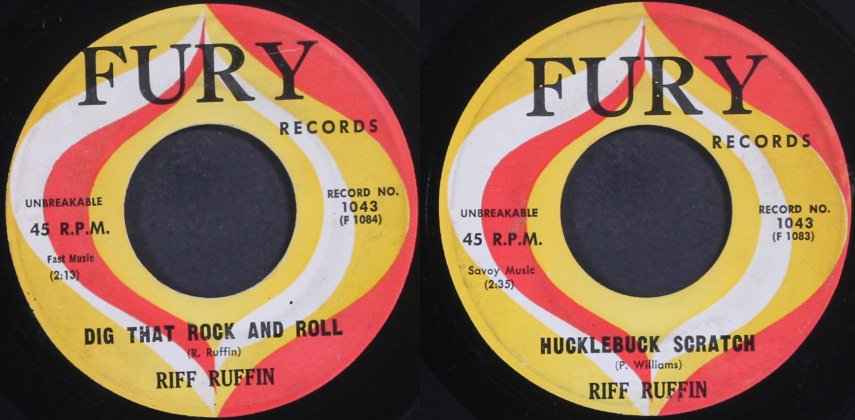 In January 1961, Riff had a couple on Bobby Robinson's Fury label: "Dig That Rock And Roll", backed with the instrumental "Hucklebuck Scratch".
An article in the March 25, 1961 Chicago Defender talked about Duke records signing singer Jackie Verdell. It said, confusingly:
Jackie had her first session on the Duke label this week under the supervision of Dave Clark, topper in Duke's production dept. Clark was successful in bringing together a bunch of Chicago musicians that he used from time to time. Included in the band that flew in from Chicago for this session were Johnny Griffin, Harold Owsley, Wesley Landers, Pat Patrick, Wilbur Ware, Hobart Dotson, Norman Simmons, and Riff Ruffin.
How did Riff suddenly become a Chicago musician?
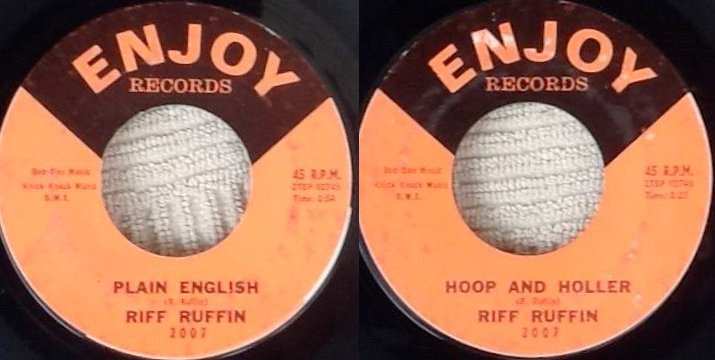 There was nothing at all about Riff in 1962 or 1963, although, I suspect, he did a lot of instrumental work for Bobby Robinson. In March 1964, he had a release on Robinson's Enjoy label: "Plain English" (a talking record) and "Hoop And Holler" (a dance record).
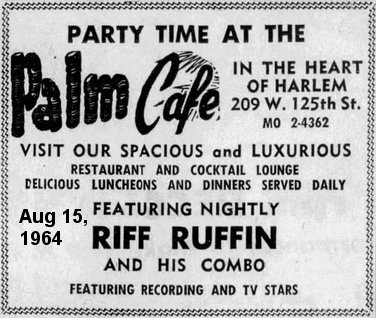 Riff was advertised at Harlem's Palm Cafe from August 15 through September 5, 1964.
When Riff's wife, Esther died, in July 1965, her death certificate said she was married to "Nehmiah" Ruffin. She still lived in Hopewell and her obituary said that her husband "Nemiah (Riff) Ruffin" lived in Brooklyn.
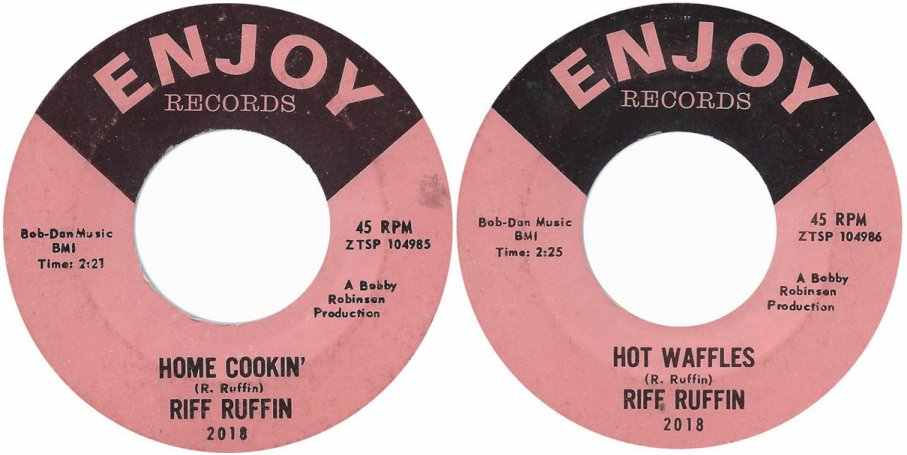 Enjoy released another record, around July 1965: "Home Cookin'" and "Hot Waffles" (both instrumentals), and that was the end of his known association with Bobby Robinson. There are other known cuts that Robinson never released on singles: "That Night", "I Don't Mind", and "Quaker City Hop" (a talking record).
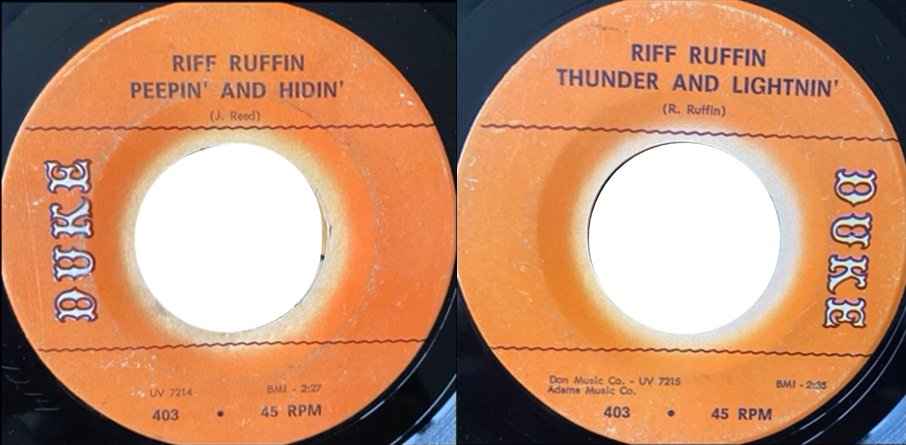 Riff's final record was on Don Robey's Houston-based Duke label, in March 1966: "Peepin' And Hidin'" (Jimmy Reed's "Baby What Do You Want Me To Do"), coupled with "Thunder And Lightnin'".
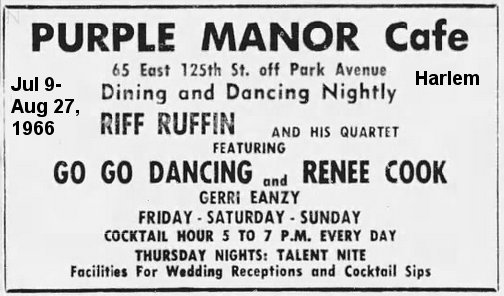 The last appearances I can find for Riff Ruffin (And His Quartet) were at the Purple Manor Cafe in Harlem, from July 9 to August 27, 1966. There was nothing at all in 1967.
And then, the August 15, 1968 Grand Rapids (Michigan) Press had a story titled "Nurse Helps Police Intercept Heroin".
Patient surveillance and the alertness of a student nurse at St. Mary's Hospital enabled Grand Rapids police to intercept $3,000 worth of heroin and arrest a 48-year-old New York man for possession of narcotics.
A warrant was issued Thursday morning for Nehemiah Ruffin, 48, of Brooklyn, who was arrested on the fourth floor of St. Mary's with 150 packets of heroin, valued at $2,000 to $3,000 in his possession
Vice squad detective William VanTuinen and assault squad Sgt. William Freeman had been "on to" Ruffin for some time and were keeping him under surveillance, waiting for him to receive a shipment of heroin from New York.
Last weekend Ruffin was beaten up and taken to St. Mary's Hospital where he was admitted.
Late Wednesday afternoon Ruffin had a visitor. After the visitor left, the student nurse entered his room and saw him looking into a paper bag which he quickly dropped when she approached.
Ruffin, on crutches with a knee injury as a result of the beating, then hobbled from the room. The student nurse picked up the bag, saw it was filled with packets of white powder and took it to the head nurse.
A doctor examined it, knew it was some form of narcotic, locked it up and called police. When Ruffin returned, the student nurse casually told him she had locked up his "medicine" for him for safekeeping.
Two uniformed officers, already in the hospital, stood by in the hallway until Freeman and VanTuinen arrived to make the arrest.
The officers then checked the motel room Ruffin had been using until admitted to the hospital, and said they found the paraphernalia required to use heroin.
While Riff wasn't the only Nehemiah Ruffin in the country, he was the only one who lived in Brooklyn and was the only one who was 48 in 1968. The February 28, 1969 Press followed up on the story:
Five persons began terms in Southern Michigan Prison following sentencing by Circuit Court Judge Stuart Hoffius.
Ordered to serve 2 to 10 years were Nehemiah Ruffin, 48, of Brooklyn, N.Y., for possession of heroin, and Michael C. Bessemer, 23, of Rockford, for arson, both of whom had pleaded guilty earlier.
This is extremely confusing to me. It has to be him, and yet, sometime in 1970 (exact date unknown), in Brooklyn, Nehemiah Ruffin married the mysterious Rovena Stephens. Shouldn't he have been in jail in Grand Rapids? (As an interesting coincidence, Rovena was the widow of Guy Mannie Stephens, who'd been born in Ruffin, South Carolina.)
In early 1980, Riff's son, Ronald, died in Hopewell. The cause was listed as "marked fatty liver". The exact date is uncertain; his death certificate said "Found 1/6/80", indicating that no one else was present at the time of his death.
On February 9, 1991, Nehemiah "Riff" Ruffin died in Hopewell. The cause of death was congestive heart failure, with coronary artery disease, not helped by diabetes. At some point, he'd relocated back to Hopewell and lived at the same address given for Esther, when she'd died in 1955. The death certificate said he was Esther's widower; there was no mention of Rovena, who appears nowhere but on the 1970 marriage record.
His Social Security record is interesting. He'd originally set up his account in May 1937 as "Nehemiah Ruffin" (of course), but his Social Security number was issued to him by the Railroad Board. This was a special series of numbers issued to those who worked for railroads, but I can't find anything else that makes him a railroad employee.
Riff's daughter, Ginger, died in April 2007, still living in Hopewell.
In spite of press-agent releases, Riff Ruffin was never a nationally-known singer. Mostly a guitarist and bandleader, much of his career seems to be undocumentable, with long stretches where he isn't mentioned at all.
SPARK (Mister Ruffin)
115 A Touch Of Heaven (Just Around The Corner) / Bring It On Back - 5/55
MAMBO (Riff Ruffin & His Orchestra)
109 The Darkest Hour / Money For My Honey - 8/55
MIDDLE-TONE (Riff Ruffin's Combo)
010 Foxey / Please Take Me - 4/56
CASH (Riff Ruffin w. Riff Ruffin Ork.)
1023 (I Don't Want Anybody) If I Can't Have You / Blue Streak - 3/56
1038 All The Way / Teen Age Rock - 7/56
1046 Drivin' Home (part 1) / (part 2) - 12/56
1055 All The Way / I Can't Get A Thrill Without You - 10/57
UNRELEASED CASH
Xmas Baby
EBB (Riff Ruffin)
103 If You Please / No More - 5/57
116 True Confession / Combination - 9/57
BALL (Riff Ruffin & His Riff-Tones)
501 I'm Confessin' / Solitude - 12/57
OLD TOWN (Riff Ruffin; masters purchased from Cash)
1054 All The Way / I Can't Get A Thrill Without You - 6/58
ATLANTIC UNISSUED (Riff Ruffin)
Confession (recorded 10/58)
No More (recorded 10/58)
FIRE (Riff Ruffin And Band)
1019 All My Life / Gravy Train - 3/60
FURY (Riff Ruffin)
1043 Dig That Rock And Roll / Hucklebuck Scratch - 1/61
ENJOY (Riff Ruffin; a Bobby Robinson label)
2007 Plain English / Hoop And Holler - 3/64
2018 Home Cookin' / Hot Waffles - ca. 7/65
UNRELEASED CUTS RECORDED FOR BOBBY ROBINSON
That Night
I Don't Mind
Quaker City Hop
One Moment (possibly)
The Storm Is Over (possibly)
DUKE (Riff Ruffin)
403 Peepin' And Hidin' / Thunder And Lightnin' - 5/66
DOVER (Eddie Riff, with orchestra)
102 Ain't That Lovin' You, Baby / My Baby's Gone Away - ca. 12/56