Beverly White
By Marv Goldberg
© 2026 by Marv Goldberg
Here we go again. A couple of years ago, I wrote about Gladys Palmer, who, every time she gave an interview, invented her past. We'll see that Beverly White did the same after a point. The strange thing about these women is that they were both constantly reviewed as being good singers and pianists; there was no need for what they did. (For example, piano great Teddy Wilson said he preferred Beverly White's voice to Billie Holiday's.) Ah, well.
She appeared as Magnolia White, Beverly White, and Baby White. However, she wasn't the only performer with those names. One of Jimmie Lunceford’s students was pianist/guitarist Annie Baby White, who, in 1937, helped to form the all-woman jazz band, the International Sweethearts of Rhythm. Then, from 1957 on, recordings by "Beverly White" were actually by Josh White's daughter, Beverly White Saunders.
And, I bet you didn't know there was a popular color called "Magnolia White", or how many people named "White" lived on a street called "Magnolia". Oh, the trials of the researcher!
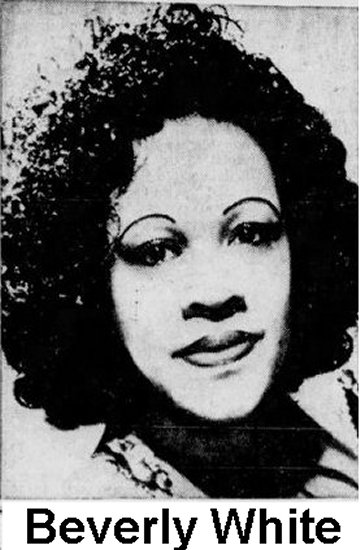
Magnolia Beverly "Baby" White was born in St. Louis, Missouri, but there are no existing birth records available to me.
Magnolia was the daughter of George Thomas White and Bessie Walton, who'd married in Cincinnati in 1903. He'd been born in Lafayette, Mississippi and she in Danville, Kentucky. At the time of the marriage, he was already living in St. Louis. By 1929, at the latest, they lived at 3320 Lucas Ave. in St. Louis, an address you should remember, because it will figure in many newspaper accounts. For example, a 1939 article talked of Beverly White, daughter of the late George White, 3320 Lucas Ave, St. Louis.
Let's see what we can do to uncover the shadowy beginnings of Beverly White.
In the 1910 census (taken as of April 1), George & Bessie White were living in St. Louis; Magnolia had not yet been born.
In the 1920 census, in St. Louis, we find Tom, Bessie, and 9-year-old Maggie White. Since the census that year was taken as of January 1, this indicates a birth year of 1910. (Tom is a railroad car cleaner, the usual occupation of George Thomas White, so I'm confident I have the right family.) We'll see later that "November 17" enters into the picture, so, since I have no other reasonable date, let's say that Magnolia Beverly White was born on November 17, 1910, which ties into her being 9 years old on January 1, 1920.
I wonder, though, if "Maggie" was really their child. The 1920 census said that Maggie had been born in Ohio and that she was a "lodger" in their household.
The first mention of Magnolia White in the press was in the June 15, 1923 St. Louis Argus. She was in a list of those who'd just graduated from Marshall Grade School.
Somewhere along the way, Magnolia learned to play the piano and to sing. A blurb in the February 19, 1926 St. Louis Argus talked about some sort of program at a church. The relevant line is: "Special music will be rendered by Miss Magnolia White...." That's vague enough that it could mean singing or playing the piano, but probably the latter.
The July 30, 1926 Argus thanked some people for attending a funeral service, including "Miss Magnolia White for the music".
This appeared in the May 20, 1927 Argus:
We, the Van Dykes, wish to extend our heartiest thanks to the Papillion Girls for the wonderful way in which we were entertained by them May 10 at the residence of Miss Magnolia White, 3320 Lucas Ave.
A January 25, 1928 column in the St. Louis Globe-Democrat has Magnolia White and Roosevelt Thomas taking out a marriage license in East St. Louis, Illinois (just across the Mississippi River from St. Louis). She lied a bit about her age, telling them she was 22 (she'd recently turned 17). However, the marriage record names her parents as George White and Bessie Walton, so it's her. The wedding took place there on January 28.
In the 1930 census (taken as of April 1), parents George & Bessie were still at 3320 Lucas Ave, but Magnolia isn't there. Magnolia Thomas is a boarder in another household, and the census says she's 33 (meaning a birth year around 1897), no occupation, born in Illinois, and married. Since the info is so far off, either this isn't the right person, or she wasn't home when the census-taker came around and the head of household made wild guesses. Roosevelt Thomas is also by himself (a lodger who says he's single). At any rate, Magnolia's marriage to Roosevelt didn't work out. As far as I can tell, she never again married.
Since I hear so much grumbling, I suppose you'd like to know something about her entertainment career. OK, here goes. The July 16, 1932 Pittsburgh Courier had this:
Sam Davis is readying his new floor show for his Green Cave at Saratoga (New York) for the summer, and the list of entertainers include such names as ... Baby White....
Did she ever appear there? There were no ads, but, more important, Sam Davis died on July 29, so there possibly was no summer floor show.
The September 24 Courier had this:
Every seat is a ringside seat at Dickie and Gene's Theatrical Club, and there was grand entertainment, too, furnished by Baby White, another torch singer whose name slips our memory at this moment, and with the inimitable Putney Dandridge at the baby grand.
The November 5, 1932 Pittsburgh Courier said that Baby White ("from Dickie and Gene's Theatrical Grill") had been at a November 4 charity function. The Theatrical Grill was on West 134th Street in Harlem and was managed by Dickie Wells (not the trombonist with the Teddy Hill orchestra) and Gene Tyler. Since Claude Hopkins (currently at Roseland Ballroom) was also at that charity event, he would have heard her years before eventually hiring her.
There was a surprise party at the Theatrical Grill, on December 1, 1932, for Gene Tyler who'd just gotten married. Baby White sang "Puhleeze".
She was still at Dickie Wells' (called that, as well as the Theatrical Grill) in February 1933, when she received an orchid (highest praise) from Walter Winchell in his February 27 syndicated column: "An orchid to 'Baby' White, a sepia, whose contagious and different delivery in ditties is dandy - at Dickie Wells' den in Harlem."
On March 24, 1934, Baby White performed at a Harlem Republican Club dance at the Renaissance Casino. She was at the Old Log Cabin at the time and was introduced by Bill "Bojangles" Robinson.
In the December 22, 1934 New York Age's "The Talk Of The Town" column, Baby White was named as one of Harlem's favorite entertainers. Also on that list were Monette Moore, Jackie (the future "Moms") Mabley, and Gladys Bently.
Baby White was at the new Dickie Wells Club in time for its grand opening on December 29 (at 169 West 133rd Street). Wells and Tyler had split, leaving Tyler with the Theatrical Grill. Also at the opening were Rubber Legs Williams and the Shim Sham Band.
Another Harlem Republican ball at the Renaissance Casino on March 31, 1935. Part of the entertainment was the Dickie Wells Revue, with vocalist Baby White.
Baby White was back at the Renaissance on May 18, 1935 for the Royal Buddies' "Melody In Spring" show. The May 25 New York Age called her "Baby White, local stage luminary, who substituted for Doris Rheubottom, the promised songbird. Miss White's renditions evoked enthusiastic appreciative applause from the assembly."
Baby was at the Apollo Theater the week of August 2. Also there was Billie Holiday (called "Billy" in the ad); both were part of the Leonard Harper Revue, but Baby wasn't mentioned in the ad. Here's what the August 10, 1935 New York Age had to say about the show:
Billie Holiday, still singing in her dragging way, should stick to the faster-timed numbers, such as "Living In A Great Big Way", rather than the slow, draggy tunes which she has been doing. Her renditions of songs don't quite fit in with her personality and voice type.
Baby White, on the other hand, can get the most out of the song she sings, as evidenced by the insistent demand for encores during the second show Friday. In addition to the vocalizing, Miss White does one number in which she plays her own piano accompaniment.
Remember what I said at the beginning of the article: piano great Teddy Wilson said he preferred Beverly White's voice to Billie Holiday's. Looks like the Age's critic agreed.
Baby was mentioned by Walter Winchell again, in his December 6, 1935 column.
Have a tip on me: Her name is "Baby" White. She's a blackbird at Anna Held, Jr.'s place. And she reminds me of Florence Mills.
Anna Held, Jr was the daughter of the famous opera star. The club was known as Anna Held's In Town (on East 52nd Street, near First Avenue). Florence Mills, one of the stars of Shuffle Along and Lew Leslie's Blackbirds was very popular until her untimely death in 1927.
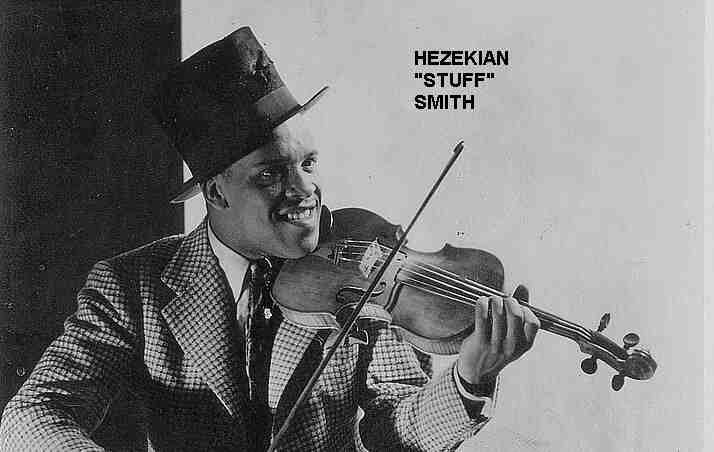
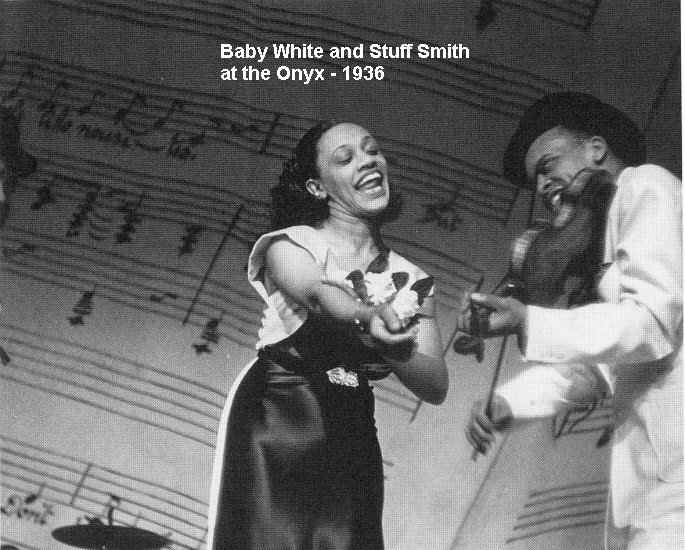 In mid-March 1936, Baby was at the Onyx Club (on West 52nd Street in Manhattan), along with pianist Kirby Walker's band. A couple of weeks later, Charlie Beal (pianist and singer) had replaced Walker for cocktail hour entertainment, but Baby was still there, playing and singing during the afternoon. Stuff Smith's swing band provided the nighttime music.
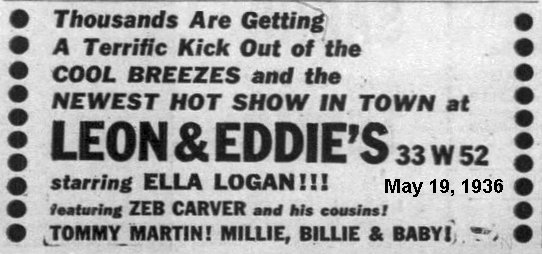
 Then, in May, she moved down the block to the famous Leon & Eddie's, where the star was Ella Logan. The ad said that another act was "Millie, Billie & Baby". Baby White later said that she worked with a musical team called Millie And Billie at Leon & Eddie's. Was she part of the act? Both the ad and the later memory were vague. They were a dance act and could have been dancers Mildred "Millie" Cruse and Billy Martin (who married in January 1938). Millie And Billie had been at the Apollo the weeks of February 28 and May 15, 1936, but their last names weren't given.
On June 4, 1936, at the Imperial Theater in Chicago, you could hear Glen Gray & His Casa Loma Orchestra, as well as 16 other bands, including Stuff Smith, Louis Armstrong, Red Norvo, Bunny Berrigan, Paul Whiteman, and Artie Shaw. The June 6 Indianapolis Recorder said: "In Stuff Smith's band, Baby White, girl vocalist, stood out for her clever singing. The tune was 'My Last Affair', with Smith and Jonah Jones featuring on instruments [swing violin and trumpet, respectively]."
 Off to the Big Time. The November 7, 1936 Chicago Defender had an article titled "Beverly White is signed with Hopkins' Orch":
NEW YORK, N.Y., Nov 6 - Beverly White, petite torch singer of night club fame, has been signed by Claude Hopkins to appear as the featured vocalist with his orchestra now filling an engagement at the swanky Roseland Ballroom on Broadway, and she will be heard with the Hopkins outfit three times weekly over the mutual Broadcasting System, WOR, New York.
The schedule for the new broadcast series will be: Tuesday night 12 midnight to 12:30 a.m; Thursday night, 12:20 a.m. to 1:00 a.m [didn't anyone sleep?], and Saturday afternoons, 5:30 to 6 p.m.
Miss White has been featured in several Broadway night clubs, including Leon and Eddie's and the Famous Door.
[The word "swanky" in these write-ups is usually meaningless, but I've danced at Roseland Ballroom and, in this case, "swanky" is an understatement. It must really have been magnificent in the 30s.]
 I believe she was hired by Hopkins in October 1936 to replace the departing Orlando Roberson. As well as the above, the November 7 Chicago Defender also said: "Beverly White is the young femme canary with Claude Hopkins' orchestra at the Roseland and she sounds much better over the airlanes than Orlando Robeson." She'd rarely be called "Baby" from now on. Note that Hopkins had a very popular orchestra and I'm not going to list all his appearances, just a selection.
Beverly appeared with Hopkins at the Apollo Theater the week of December 25, 1936, but her name wasn't in the ad. The write-up, in the January 2, 1937 New York Age said:
Beverly White is nothing short of colossal. We found ourselves in accord with someone in back of us, who declared:
"Shucks, Bobbe Caston ain't half as good as she is."
Her "When Did You Leave Heaven" [and] "You Turned The Tables On Me" numbers are sweet and lovely. But her rendition of the beautiful "Pennies From Heaven", nothing short of colossal.
The January 2 Pittsburgh Courier had a little blurb titled "Claude Hopkins discovers Sensational Girl Artist":

The latest female sensation to flash across the musical and theatrical horizon is talented and pretty Beverly White, who recently "wowed" blasé New Yorkers by her work with Claude Hopkins and his revamped orchestra.
Miss White, who is also talented as an arranger and composer, is taking the place of Orlando Robeson, and seemingly fits in perfectly with the new style of "swing" music which Claude is perfecting.
The January 9, 1937 Billboard had this to say about her Apollo appearance:
Colored vocalist with the Claude Hopkins Band. Personable young lady with a soft voice, lots of expression enhanced by good phrasing and employing a straight style without frills. Did two numbers, When Did You Leave Heaven? and You Turned The Tables On Me.
In addition, Miss White was in a piano duel with the leader, Hopkins, and besides her playing and singing, handled punchy comedy asides very capably.
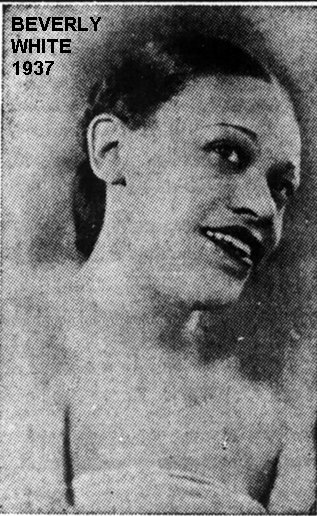 The January 29, 1937 St. Paul Recorder called her "a rising star" and said: "New vocalist with Claude Hopkins' orchestra, who has won the admiration of severe Broadway critics for her spicy interpretation of present day song hits. Miss White also plays the piano exceptionally well and Maestro Hopkins has arranged a brilliant pianologue which the two are using on their current tour." [That is, she and Hopkins had a routine wherein they played dual pianos.]
 On February 2, 1937, Hopkins had a session for Decca Records. The two tunes that Beverly sang on were "Sunday" and "Swingin' Down The Lane" (both were big band-type vocals). Right after that, on the 5th, the band was at the George F. Pavilion in Binghamton, New York.
 Decca released those two tunes in March, with label credit as "Claude Hopkins And His Orchestra - vocal by Baby White". However, from here on, other than on Decca labels, not a single ad or write-up referred to her as "Baby", only "Beverly".
 On March 28, the band was at the Easter Cotillion, held at the Armory in Hopewell, Virginia.
 There was another Decca session on April 21, 1937, at which Beverly recorded three more songs: "Honey", "June Night", and "My Kinda Love (One Way To Paradise)". Once again, they were big band-type vocals. Decca released "June Night" in May, backed with "Church Street Sobbin' Blues", a Hopkins instrumental that had been recorded at the same session.
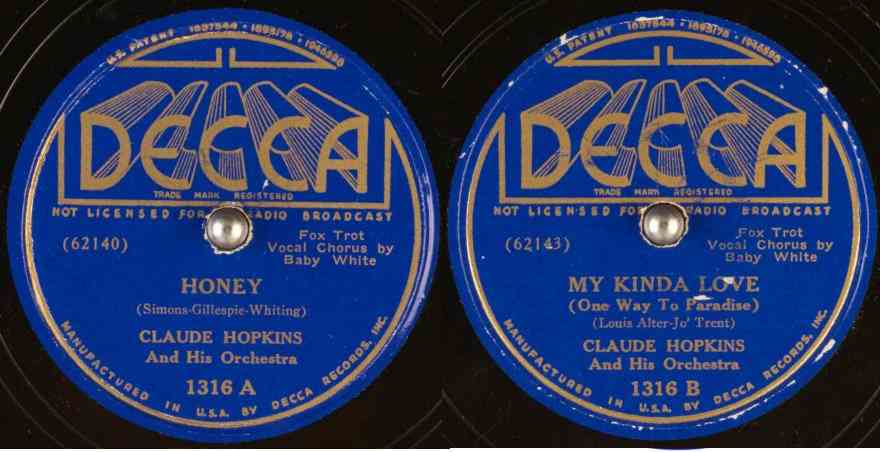 In June, Decca, issued the other two "Baby White" vocals: "Honey" and "My Kinda Love (One Way To Paradise)". "Honey" is the standard that the Ravens would record in 1946.

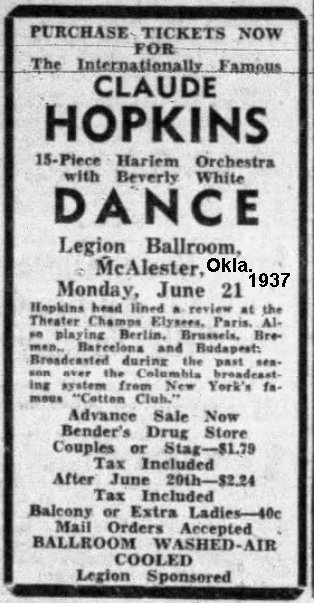 The band was at the Legion Ballroom in McAlester, Oklahoma on June 21. Beverly was almost back home on July 18, when the band played the Harlem Country Club in Brooklyn, Illinois, right across the Mississippi River from St. Louis.
 However, when they played the Forest Park Highlands in St. Louis, on July 20, both the ad and the preliminary write-up got the band name wrong. They were advertised as "Claude Hopkins and his famous Clouds Of Joy" (which was the name of Andy Kirk's orchestra). The Naborhood Link News of July 15 called Beverly "America's First Lady Of Swing".
 The band was back at the Apollo the week of August 13, 1937, along with Johnny & George. I mention them because I've been trying, for years, to find a place to put this (under the heading of "knowledge shouldn't be wasted"). You've all heard the Andrews Sisters' hit "Bei Mir Bist Du Schön (Means That You're Grand)". Well, it probably would never have existed if it weren't for Johnny & George. Read on:
The original "Bei Mir Bist Du Schön" had been written by Jacob Jacobs and Sholom Secunda for a 1932 Yiddish production called "I Would If I Could". The song became popular in New York City and in the Catskills, selling 10,000 copies of the sheet music. It seems to have originally been spelled "Bei Mir Bistu Shein", meaning "to me, you are beautiful".
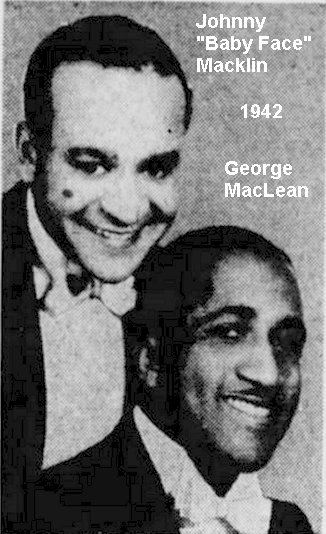
Johnny & George (Johnny "Baby Face" Macklin and George MacLean) had been around for a few years; their first mention was on January 14, 1934. Johnny was the main singer; George played piano and also did some singing.
They'd been appearing at the Yacht Club (one of the West 52nd Street jazz clubs in New York City), and were advertised there in April and May 1937. However, by the end of May, the Yacht Club had closed for the summer (this was before air conditioning), so they hunted around for somewhere new to perform.
Over the summer of 1937, they played Grossinger's Hotel in New York's Catskill Mountains (which catered to a Jewish clientele). It was owned by Jennie Grossinger, who, in early 1938, claimed to have taught the song (in Yiddish) to Johnny & George. (Why she did this was never explained.)
Whatever the reason, they learned it, taking a Yiddish song, singing it with the original Yiddish lyrics, but using a Swing arrangement. It went over so well with Grossinger's customers that they kept it in their act.
On August 13, 1937, back in New York, they played the Apollo Theater. Some later accounts said they sang their swing arrangement of BMBDS there, to thunderous applause, but I doubt it. The August 21, 1937 New York Age, talking about J&G at the Apollo, said that they'd been there once before (although I can't find any prior appearance), and: "The two boys from Leon & Eddie's, Johnny and George (MacLean and Macklin [last names were reversed]) whooping it up on the Apollo Theater stage. Beyond the tops in their particular field these boys, after almost three years at the celebrated Yacht Club where they co-starred with the glamorous Alice Faye and the scintillating singer of the Blues, Helen Morgan, come to Harlem for the second time and have shown every sign of being held over. The last time Johnny and George played the 125th Street boards they were mobbed at the stage entrance after the performance by autograph hunters." Note that it said nothing about them having sung a Yiddish song, which would have been unusual enough to have been noted.
Therefore, I have to believe that they introduced it at the Yacht Club later on that year (after it had re-opened in early October). This is borne out by an article about BMBDS in the January 31, 1938 Life magazine. It had a photo of J&G and said: "Johnny & George sang it in Yiddish at the Yacht Club in Manhattan where, they claim, songwriters Sammy Cahn and Saul Chaplin heard them...." The next time they appeared at the Apollo, on January 28, 1938, they were called the "Originators of 'Bei Mir Bist Du Schoen' in Swingtime" (by this time, the Andrews Sisters' English-language version was a smash hit).
Songwriters Sammy Cahn and Saul Chaplin did hear the tune and thought the song would have promise (although not in Yiddish). They hunted up the original writers (Jacob Jacobs and Sholom Secunda, who'd unsuccessfully tried to sell the song to Eddie Cantor, who thought it was too ethnic). When Cahn offered each one $30 for the rights, the offer was accepted.
Cahn and Chaplin kept the swing arrangement, writing English lyrics for it. On November 24, 1937, the relatively unknown Andrews Sisters (mostly advertised as dancers up to now), recorded it for Decca as "Bei Mir Bist Du Schön". Released in early December, it was a smash hit by the end of the year. (Note that it was the "B" side of the record; Decca thought the flip, "Nice Work If You Can Get It", was going to be the hit.)
Now, what was I talking about? Oh, yes, Beverly White.

 The ad for the August 20, 1937 appearance of the Hopkins band at Hedges Lake (Cambridge, New York) said that Hopkins was "Featuring the golden voice of Beverly White." From there, they went to Kansas City and then to Washington, D.C.'s Howard Theater, the week of September 17.

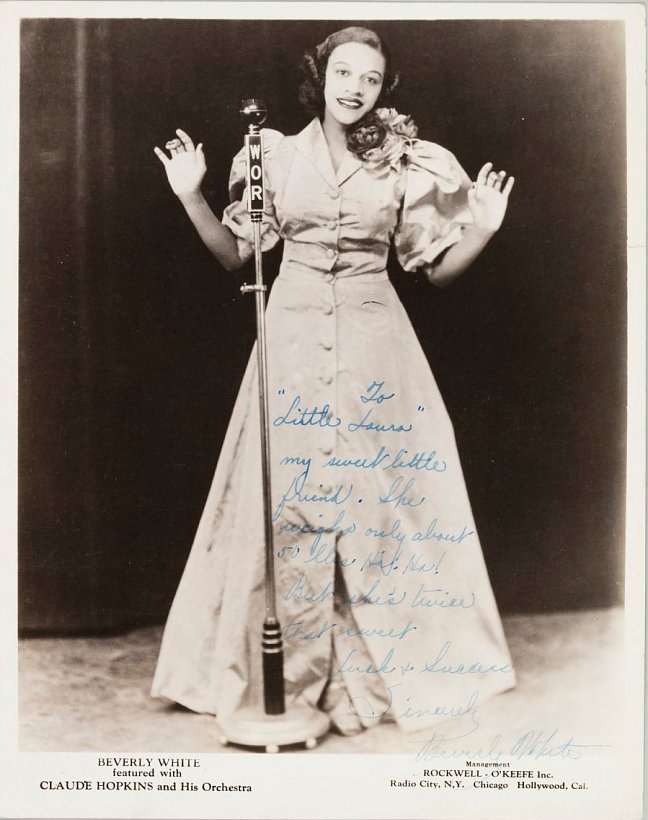 And then, the lies began ("truth" is such a subjective thing). There was an article in the Baltimore Afro-American on October 2, 1937:
"I want to be just like a woman I've admired but never seen - Florence Mills. She died when I was just a little nobody and never dreamed I would be on the stage."
Thus Beverly White, dynamic vocalist with Claude Hopkins's orchestra perched her 125 pounds on top of a trunk backstage at the Howard Theatre and expressed her secret ambition.
"Lots of people have told me that I looked like Flo and I have certainly done all in my power to develop my talent so it will be worthy of her."
Beverly, who prefers to be called "Baby," because everybody always called her that, did not always weigh 125 pounds. While she was struggling around New York waiting for a break, the best she could, do in the avoirdupois handicap was 115, but when she went on a Southern tour with the orchestra the good old Dixie chefs put ten pounds on her.
But Southern cooking was no new thing to the little brown girl of the ivories, who is equally as famous as a pianist as a vocalist because she was born in New Orleans and reared in St. Louis.
She got her first professional start as accompanist to Walter Richardson and later studied at the Treniere School of Music in Gibraltar.
One of her prized keepsakes is a snapshot of herself sitting on the peak of the great rock which figures so prominently in international strife today. [The Spanish Civil War.]
Her hobby is writing music and so far as love is concerned, she insists that she has no time for such thoughts because she is already happily married to her career, and doesn't want to be a bigamist.
This is the first instance I can find of the "I was born in New Orleans" story. She repeated the Gibraltar story once more in 1939 (but there's no trace of a Treniere School of Music on the Rock, or anywhere else, for that matter). Her name was never associated with baritone Walter Richardson, nor is there any record of her ever leaving or re-entering the U.S.

 Claude Hopkins was popular enough to be on radio a lot. Here's an ad, from October 26, 1937, when the band was heard over WWSW, Pittsburgh. The ad for their appearance at the Armory in North Adams, Massachusetts (on November 6) said: "Claude Hopkins and his Broadcasting Orchestra (C.B.S. and N.B.C.) with the sweetest singer on the air - Beverly White."

 They played the Apollo Theater again the week of January 28, 1938. Johnny & George were back too. And, as I said before, they were now being billed as "Originators of 'Bei Mir Bist Du Schoen' in Swingtime".
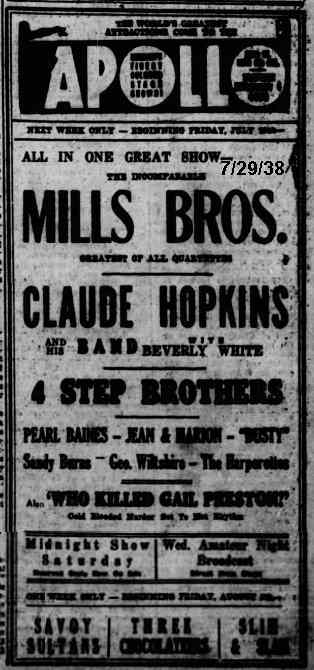 And another trip to the Apollo, the week of July 29, 1938, when they shared the stage with the Mills Brothers and the 4 Step Brothers.
 On September 16, they were part of a show put on by radio personality Martin Block at a Bronx armory. Also there were Tommy Dorsey, Artie Shaw, and Slim & Slam. I would have begged my parents to let me go, but, annoyingly, I hadn't been born yet.
When the Hopkins band and the Mills Brothers appeared at the Howard Theater in Washington, D.C., the week of October 14, 1938, she was billed as Beverly "Magnolia" White ("torrid songstress). This is possibly the first time "Beverly" and "Magnolia" were used together in any appearance.
On October 29, father George White died of stomach cancer. Lest than a month later, the November 25 St. Louis Argus noted that mother Bessie was off to spend a couple of weeks in Toledo and Cincinnati.
 Another trip to the Apollo the week of January 06, 1939, once again with the Mills Brothers. Her performance there got a write-up in the January 21 Norfolk (Virginia) New Journal And Guide:
Beverly White, soloist with the Claude Hopkins aggregation, has a way with the inhabitants of that section known as [the] "Peanut Gallery" that simply beggars description.
Whether the scene shifts to the Paramount or, as it did this week, to Harlem's Apollo, gracious Beverly manages to start a stampede in that sector of the playhouse that calls for three to four curtain calls every performance.
The greatest risk a singer faces at the Apollo is to warble a song not already popularized, and fail to give it the . . . umph those hard to please Gallery Gods require of one. Even a Beverly White runs afoul of this law. Friday nite, lovely Miss White opened with the difficult to sing, and far more difficult to put over, "You're My Thrill".
We'd venture to say that no other songstress would have fared quite so well with this opening vehicle for what it lacks in the racy sort of jazz or romantic numbers these high perched patrons demand, might be comparable to the mechanical differences existing in a Ford coupe . . . and England's celebrated Rolls Royce.
But lo and behold, four curtain calls later, there was our sweet little lady right out there before the "flickering globules," resplendent in all white, matching curtsies for each bow of courtly Claude Hopkins . . . her employer and director.
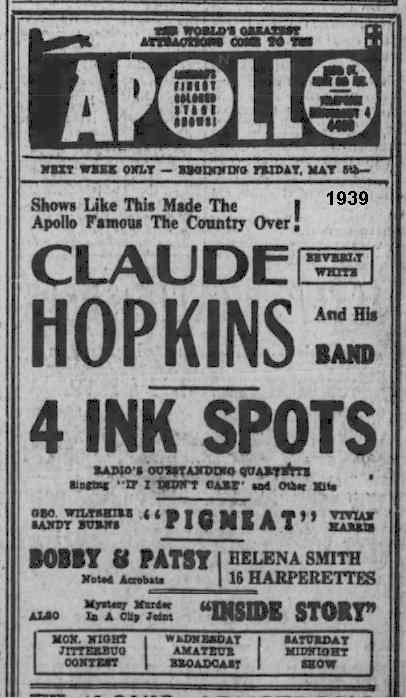 Glad they liked her, because they were back at the Apollo the week of May 5, 1939, this time with the Ink Spots (who were still being billed as the "4 Ink Spots"). The May 20 Chicago Defender talked about the show and Claude Hopkins:
As vocalist here he used the popular Beverly White, a big favorite in Harlem. Miss White stole the show many times with her unique rendition of the trio of popular numbers entrusted to her.

 But, right after that show, Orlando Robeson returned to the Hopkins orchestra, and, from then on, he would get top billing over Beverly in ads. An article about her appeared in the July 2, 1939 Macon Telegraph:
Beverly (Magnolia) White, featured swing vocalist with Claude Hopkins and his famous Harlem orchestra, will be one of the alluring attractions on the stage at the Macon Auditorium July 4, at 8:30 p.m., when she appears with Claude Hopkins and his orchestra.
Miss White is a native of St. Louis, Mo., which might account for her fame for singing the "St. Louis Blues" as no one else is known to sing it. She began her career by singing in night clubs in and around St. Louis, she migrated to New York in 1936, when she sang at Leon and Eddie's well known 52nd street hot spot. [While she was at Leon & Eddie's in 1936, she'd actually come to New York some four years previously.]
It was while Claude Hopkins and his orchestra were fulfilling an engagement at the popular Roseland Ballroom on Broadway in New York [from September 28-October 30, 1936] that Miss White secured her first opportunity to sing with the band. Hopkins was then broadcasting over the Columbia network and needed a vocalist who could adapt herself to his style of rhythm. Her first program so impressed the maestro that he immediately signed her to appear with his orchestra.
For the past two years, Beverly has been featured with the Hopkins band whether it is in clubs. theaters, dance tours or broadcasting. Incidentally, when Miss White sings a sweet swing tune her name is Magnolia, which in one word explains the use of her full name.
Not only will you be thrilled with Miss White's singing but she will have singling and pairing with her on the program the one and only Orlando Roberson, who almost sweeps you to ecstasy.
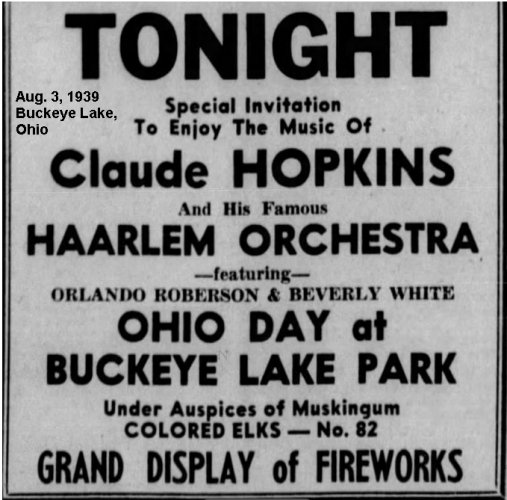 On August 3, the band celebrated Ohio Day at the Park at Buckeye Lake.
More flights of fancy in the August 11, 1939 Kansas City Call, which presented more of her fictionalized history:
The Castle ballroom will play host next Thursday night, August 10, to three of the most famous personages on the theatrical horizon. Claude Hopkins, Orlando Robeson, and Beverly White nee Magnolia.
Claude Hopkins and his celebrated Mercury Fleet, which is composed of some of the best musicians in the country will arrive in the city Thursday for the mammoth one night engagement.
Hopkins band will arrive here from the east where he has scored time and time again. Many new arrangements have been added to the band's repertoire that are "solid senders".
With Hopkins will come Orlando Robeson, silver voice tenor, whose reputation has been built for a great number of years. Robeson is the one man in the country who has a perfect mike voice. When he sings over the ether waves, radio technicians find it unnecessary to make any control adjustments.
His rendition of "Trees" has been acclaimed by critics for several years. [And, as I'm fond of saying, the word "acclaimed", by anonymous critics, has no meaning whatever.]
Also with the Hopkins unit is Beverly White, one of St. Louis' most beloved daughters, who rates among the five best female vocalists. Beverly is the daughter of the late George White, who resided at 3320 Lucas avenue. [And why would anyone in Kansas City care about that?]
[Here we go:] This sensational swing vocalist got her start way back at the age of nine years when she played the piano for Ethel Waters when the famous personage was guest in her mother's home. [Ethel Waters was in St. Louis the week beginning January 2, 1921, when Beverly was actually 10. However, her parents didn't run a boarding house, nor were they famous. There's no reason for Ethel to have stayed there.]
She played at the opening of the Roosevelt theater on Leffingwell at only 13 years having to put her age up to come within the limits of the musician's union. [It opened in 1927, so that statement gives her a birth year around 1914.]
She was attending the Sumner high school at the time and answering to the name of Magnolia. The school band enlisted the talented girl's services who at this time had paid little or no attention to her marvelous voice. [It's unclear who "who" refers to.]
It was in 1932 that she first turned her attention to her vocal attributes and began to use them in a commercial way.
Swanky Park avenue held her for four months at the exclusive "Ann [sic; should be 'Anna'] Held's". Jersey City next captured the White girl who at this time was pretty well in the swing of things.
Along with a musical team called Millie and Billie, she set an all-time record at Leon and Eddie's, where champagne sells at 50 dollars a bottle. During this engagement she was doubling cocktails at the Onyx Club. [I think that means she was playing in the cocktail bar. As I said previously, there was a single Leon & Eddie's ad that mentioned "Millie, Billie & Baby".]
In 1936 [close, it was 1935] she played Dickie Wells, another exclusive ofay resort. These spots are mute testimony of the type of entertainment the little lady from St. Louis was producing.
In '34, she went abroad to study at Gibraltar. While on the continent, she played spots in Paris, Scotland, and Brussels. [Again, there's no record of her ever leaving the country.]
Upon her return to America, she was noticed by Hopkins who was contemplating a split with Roberson, at that time the only vocalist with the band.
The popular maestro signed the singer-player fresh from her tour of Europe and played her two weeks before he released the temperamental Roberson. [She was signed in October 1936; she'd been at Leon & Eddie's and the Onyx for most of that year, not off in Europe.]
Since being with the band, she has played at several institutions of learning, including Yale, Harvard, Princeton, and Vassar. [This makes it sound like she was the one invited to play, not the band.]
 And back to the Apollo the week of September 22, 1939. The Kansas City Call had a small review of the show, saying "Lovely and gracious Beverly White (they make her take three and four bows)...."
 The last time she was in an ad with Hopkins was when the band played the Cathedral Theater in New Castle, Pennsylvania the week starting November 29. Strangely, only "Beverly (Magnolia) White" was mentioned, not Orlando Roberson. However, the February 17, 1940 New York Age said that she'd be with Hopkins and Robeson on February 21, 1940, in Beacon, NY at the Memorial Hall.
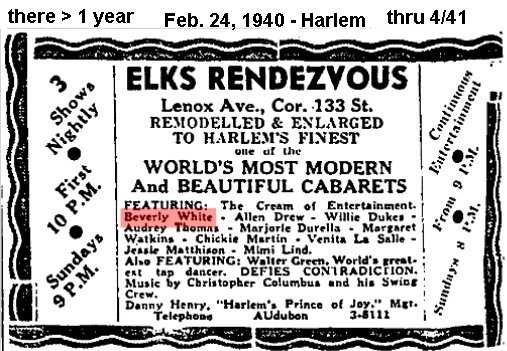 But three days later, Beverly started an engagement at the Elks Rendezvous (Harlem) that would last over a year. She was advertised from February 24, 1940 through April 1941.
In the 1940 census, mother Bessie, a widow, was still at the same St. Louis address. I can't find Beverly, although she was probably in New York.
One of those "it would be nice if it happened, but it never does" articles appeared in the August 24, 1940 Chicago Defender. It was titled "Hear Beverly White May Land With Tom[my] Dorsey".
The week of September 6, 1940 found Beverly at the Harlem Opera House with Louis Jordan.
Here comes Ethel again. The September 14 New York Age said: "During Louis Jordan's recent appearance at the Harlem Opera House, Ethel Waters was twice seen backstage trying to lure Beverly White, popular singer-pianist, into becoming her personal accompanist." And the September 21 Age followed it up with
Beverly White has been engaged for the show, "Little Joe". Ethel Waters has taken her in hand, impressed by Beverly's unusual pianistics and singing style. Incidentally, by becoming personal accompanist to Ethel Waters, Beverly realizes a life ambition. [See my Herb Lance article to learn about how relevant it is when blurbs mention "fulfilling an ambition".]
"Little Joe", a musical, was talked about as early as April 1940, when the producers were trying to get Ethel to star in it during the Fall season. Cab Calloway was also supposed to be in it, but had dropped out (salary dispute) by mid-August.
The show finally opened on Broadway, on October 25, to great critical acclaim. [What do you mean you never heard of "Little Joe" on Broadway? Oops, forgot to tell you that, before it opened, they changed the name to "Cabin In The Sky".] I searched the opening night cast and, missing from the applause, was Beverly White.
 Actually, we don't hear of Beverly again for a year, when she turned up in Ziggie Johnson's Club Plantation Revue, at St. Louis' Comet Theater the night of October 1, 1941. On October 10, Ziggie's revue ("The Blues Is Back") opened at a St. Louis venue called West End Waiters. There was only one ad, so I don't know how long the show lasted.
After that, it was back to New York and the Elks Rendezvous. The February 28, 1942 Billboard reviewed the show that was broadcast from there (over WMCA) on the 16th. The reviewer didn't particularly care for Chris Columbus' band: "Boys swung out some Public Domain stuff and few standard jive numbers, and their music must have been just the thing for any wild parties going on in this area. Living-room listening was less satisfying, since the boys' ensemble playing was ragged and their solos rather commonplace." In other words, if you were at the club, it would have been great; at home, not so great. Of Beverly, they said: "Beverly White was the best of the bunch, doing two choruses and a verse of a low-down ditty called Let My Heart Alone."
The May 30, 1942 Afro-American said:
Beverly White, famed songstress, formerly with Claude Hopkins and Ovie Alston's orchestras, is now starring in the elaborate revue at the Elks Rendezvous, one of the fastest stepping floor shows in Harlem.
Miss White stops the show with her fine rendition of songs. She is on the air twice a week over station WMCA and is slated to do some recordings for Decca and Columbia.
It would actually be about three more years before she recorded for Decca again; as far as I can determine, she never recorded for Columbia. Ovie Alston was a vocalist/trumpeter who'd been with Claude Hopkins until 1936. While he formed his own band after that, this is the only time that his name and Beverly's were linked.
 In June 1942, Beverly introduced "Don't Take The Sweetheart From A Soldier" over WMCA. The June 13 Michigan Chronicle called it "the patriotic song of the year" and said "it has won the approval of the soldiers and the public". Of course, the song was never heard from again. She was in Detroit at the time, advertised at the Club Congo from mid-June through late September.
Actually, Beverly began producing Club Congo shows. The first ("Victory Varieties") began on July 31. The second ("Rockin' In Rhythm"), beginning August 21, was mentioned in the September 5 Chicago Defender:
Beverly White premiered the second show of her production career Friday night before a near full house at Club Congo and amid a series of mishaps which detracted from a not-too-strong show. Miss White's present "Rocking In Rhythm" opus is a far cry from her initial production, which is partially accredited to her shortage of sock talent....
A faulty microphone completely smothered the vocal renditions of Miss White despite her delivery of four or five numbers.
The third show, "Turn Back The Clock", began on September 11. However, Rollo S. Vest's column in the September 26 New York Amsterdam News said: "After three tries as a producer, Beverly White will most likely return exclusively to her singing. Her first show was nice, but the next two, phew!" Everyone's a critic.
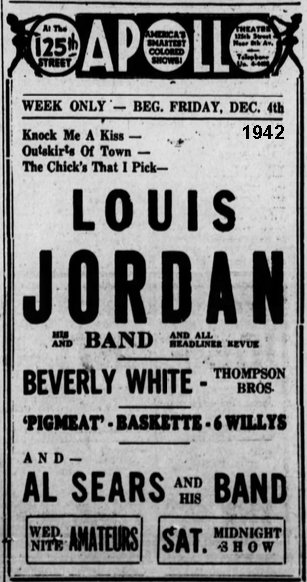 But he was right, by December 4, she was back in New York and appearing, with Louis Jordan, at the Apollo. After hours, she also appeared at the Elks Rendezvous, along with Dewey Brown, Edna Mae Harris, and Manhattan Paul. The December 5, 1942 New York Age said:
Then there's Beverly White, thrilling the revelers [war workers] with her resonant voice, as she sang "I'm Dreaming Of A White Christmas". For this number, the room was blacked out (in the nitery manner) with one spotlight playing on the singer, and the wall in the background reflecting little white spots traveling down the wall, giving the effect of snow falling at night. Miss White's style is much like that of Ethel Waters, which means she knows how to sell a song with showmanship and personality."
At some point, Beverly recorded some tunes for producer Joe Davis: "Don't Stop Now!", "My Baby Comes First With Me", "Hot Bread", and "If Things Don't Get Better (I'm Gonna Make A Change)". All would be released as by "Beverly White & Her Blues Chasers", who were Al Casey (guitar), Willie "The Lion" Smith (piano), and a bassist who was possibly Cedric Wallace.
They seem to have been cut in New York in early 1943, but there's a problem. On August 1, 1942, a musicians' ban went into effect: no union musicians were allowed to record; the strike wasn't settled until the fall of 1943. I imagine that those three musicians were union members, so they were risking fines for recording. However, Beverly wasn't in New York right before the ban went into effect, so they'd have to have been recorded after that.

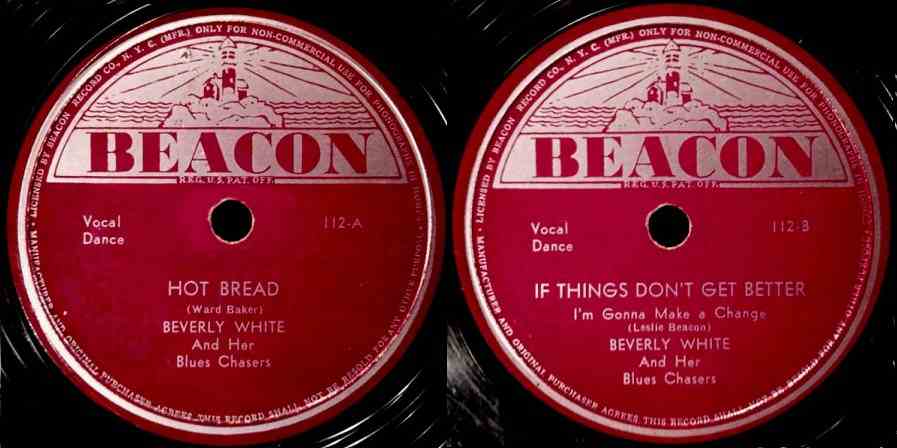
 Davis released them on his Beacon label: "Don't Stop Now!" and "My Baby Comes First With Me" in March 1943, and the other two in April. "Don't Stop Now!" was a cover of the tune released by Bonnie Davis & the Bunny Banks Trio on Savoy in January. The "Bunny Banks Trio" was a pseudonym of the Piccadilly Pipers, meant to get around the strike; I guess that the "Blues Chasers" was an invented name for the three studio musicians for the same reason.
"Don't Stop Now!" was reviewed by Billboard, not once, but twice in their April 17, 1943 edition:
Just as the ASCAP-radio sparring of a few seasons back [the ASCAP-BMI war] took the spotlight into most unexpected corners and brought forth such stardust as I Don't Want To Set the World on Fire, the present Petrillo freeze on the major recording studios is also instrumental in forcing to the top of the heap some material that might ordinarily be lost in the shuffle. Such is the happy accident that brings Don't Stop Now to the fore. And it stands an excellent chance of remaining out in front for a long time to come. Originally introduced on the waxes under the Savoy label, featuring the singing of Bonnie Davis, the disk has been selling well. The tune, by William Campbell [for more on him, see my Baby Dee article], was published a few weeks ago [March 26] when Joe Davis, head of the Beacon record firm, took the song for his music house. In bringing it out on his own label, Davis introduces a new voice to his growing list of Beacon artists. Beverly White, sepia songbird devoted to the sultry and blues-shouting style of singing, is remembered as the canary with Claude Hopkins's band a half dozen years ago. With a blues flavoring that is typically a Harlem brand, Miss White is at home in bringing out all the innuendos of this bright rhythmic ditty. Hits into it from [the] start with a bright tempo set by her accompanying Blues Chasers, comprising piano, guitar and bass. The Chasers get the second stanza under way, with Miss Beverly bringing it up again at the bridge to finish out the side. In the same rhythmic and vocal pattern, with the tempo picked up a bit, Miss White is equally effective for Ward Baker's My Baby Comes First With Me for the complementing side. Taking the opening chorus to start, piano fingers adequately enough for a second stanza, Miss White gives the lyrics another sultry once-over for a third stanza, guitar picks away to get a fourth chorus under way, with Miss White picking up the last half to finish out the side.
"Don't Stop Now" has already proved a sleeper. And now with Beverly White's entrance into the field, music ops have another forceful entry to realize the most of this rhythmical hit.
And:
This rhythm ditty, hot from Harlem, is a definite sleeper. It has already shown its first signs of strength following its introduction by Bonnie Davis on a Savoy record label, enjoying boom sales. With Beverly White now making the most of the lyrical innuendos with her blues-shouting style of singing, there should be no stopping the song in phono circles since the appeal of the ditty has gotten beyond the race locations. Altho a new name for the records, and this name particularly [she'd formerly recorded as "Baby White"], Beverly White may be remembered as the former vocalist for Claude Hopkins's band of a half dozen years ago. Gets adequate instrumental support on the side from her Blues Chasers, taking in a piano, guitar and bass.
Billboard reviewed "Hot Bread" and "If Things Don't Get Better" in its May 8 issue:
This blues-shouting sepia songbird adds laurels to the label and herself as a result of the punch she packs into the lyrics for both of these typical race ditties. Plenty of spice to the songs, but Beverly never gets them salty, with the result that the appeal should reach out to wide circles. The hot side is Hot Bread, and it has timely import, with Miss Beverly, in the hot Harlem-style, singing that fancy meat is out for the duration [war rationing] and that girls should learn to use their ovens to make some hot bread. Taking it at a bright tempo, Miss Beverly gets good support from her Blues Chasers. a trio comprising piano, guitar and bass. Disk-mate is even more in the race groove. If Things Don't Get Better (I'm Gonna Make a Change). It's the slow blues, with Miss White wailing in low-down style that her sweetie has been neglecting her.
Appeal of "Hot Bread" is such that it should catch on almost immediately. And while it is one of those hot-from-Harlem spice songs, its appeal goes beyond the race locations, particularly among the youngsters.
On May 15, 1943, Beverly's "Don't Stop Now!" was #9 on Billboard's "Harlem Hit Parade" listing.
Starting on May 25, Beverly was at the Hurricane (49th and Broadway, in Manhattan, on the entire second floor of the Brill Building), along with Duke Ellington. However, as the June 1, 1943 Down Beat told us: "Beverly White, blues singer, whose work has been recorded on the Beacon label, is now appearing in the floor show at the Hurricane, although vocals with the Ellington band are still being handled by Betty Roche and Jimmy Britton."
The show was reviewed in the June 5 Billboard: "Beverly White, buxom singer whose Beacon records are very hot now, came on for I Heard That Song Before and St. Louis Blues, giving them a low-down Harlemese rendition that caught attention easily."
There were radio broadcasts from the Hurricane, and there's a recording, dated June 13, 1943, of "Creole Love Call" (Duke Ellington with Beverly White, Wallace Jones, and Harry Carney). It's in the Leonard Feather collection at the University Of Idaho Library. Someone there was nice enough to listen to it for me and Beverly's introduction did not say that she was a member of Ellington's band.
The July 1, 1943 Down Beat reported that Ellington got some new musicians. It also said: "Beverly White, former Hines vocalist ["Hines"; "Hopkins"; they both begin with "H" and are therefore easily confused], has joined Duke."
But, only a month later, the August 1 Down Beat said: "Beverly White has left the show at the Hurricane nitery, where she was working with Duke Elllington's band." When I queried "ellingtonia.com" about Beverly (sending them the actual Down Beat pages), they said it was the first they'd ever heard of a Beverly White as an Ellington singer.
 But "Duke Ellington" was a powerhouse name in the entertainment world. When she (along with the Billy Moore Trio) played Lindsay's Sky Bar" in Cleveland, the September 19 ad said: "Beverly White - Appearing In Person - The featured vocalist with Duke Ellington's Band for the last two years". Two years; two months; what's the difference?
Remember that I said Beverly never got to be in "Cabin In The Sky" on Broadway? Well, she made up for it when the February 15, 1944 Down Beat told us: "Beverly White, singing pianist, is at the new Cabin In The Sky on the South Side [of Chicago]." Better late than never, I guess.
She was still in Chicago in June, appearing at the new Pershing Cocktail Lounge.

 When she appeared at the Riviera Club in St. Louis on September 15, 1944, The ad billed her as Beverly Magnolia White. She was still there on September 29, as Magnolia White. The October 12 ad called her Beverly (Magnolia) White, a name used throughout November. She was last advertised on December 15, when the star was Gatemouth Moore. The December 15 St. Louis Argus said it was the last week she'd be there (singing I Want A Little Boy and The Man I Love). That seems to be the last time she was ever called "Beverly (Magnolia) White".
[Just as an aside, next to that day's Riviera ad, there was a September 29 ad for the Carver Club, which featured Jewel Bell, "Singing Songs You Like To Hear". That phrase pops up very often in ads, but I don't understand it. Why would anyone go to a club where the vocalist was singing songs you hate? Isn't it kind of implied that you'll like them (at least management hopes so)?]
Ready for some more fables? The May 12, 1945 New York Age had a small article about her:


"Revelry with Beverly" that's how they greet the comely Beverly White who is a "Pin-Up" choice with talent and voice. A favorite with those in the armed forces and the civilian crowd too, Beverly has appeared at the Club Regal, Columbus, Ohio; at the Pershing and DuSable Lounges in Chicago, and featured at the Onyx Club, Cafe Society, in New York - she was "acclaimed" by music critics when she opened the now famous Cabin In The Sky nitery in Chicago. [The use of quotes indicates, to me, that they didn't believe it either.] An alert cameraman ... upon interviewing her learned that she was the first Negro girl to fill an engagement at Carnegie Hall in New York City, where, for a number of years she was the featured vocalist with Claude Hopkins Orchestra. Miss White has appeared with both W. C. Handy and Duke Ellington in concert work. In St. Louis, Beverly was a sensation at the Club Riviera. At present she is available for bookings through Associated Booking Corporation 745 Fifth Avenue, New York, N. Y And, yes, a deluge of fan mail from G.1. guys keeps Beverly up most of the night. That's her hobby!
There's no proof that she was ever at Carnegie Hall or that she ever appeared with W.C. Handy, although she'd repeat those stories over the years. Sorry Beverly, but contralto Marian Anderson made her first appearance at the Hall in 1920, when you were around 10.
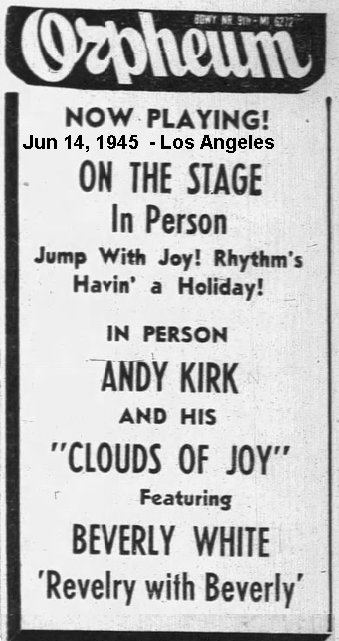

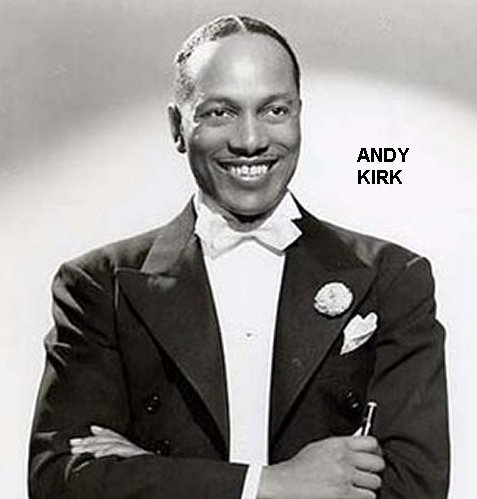 On May 10, 1945, bandleader Andy Kirk and His Clouds Of Joy opened at the Club Plantation in Los Angeles (with previews on May 5-6). Beverly was hired to replace Gwen Tynes, but Kirk was hedging his bets: the ad shows an unnamed woman [it's Gwen], with the caption "Vocalist With Orchestra". By June, when they switched to the Orpheum Theater, Beverly was called his new vocalist. The June 16 Pittsburgh Courier made it official:
Andy Kirk, whose orchestra recently completed a sock engagement at the Plantation Club and the Orpheum Theater, has signed Beverly White as featured singer and piano soloist. Beverly replaces Gwen Tynes, [who] held the featured vocalist spot with the band for several months.
The June 23 Billboard reviewed the Orpheum show:
Beverly White is brought in as Kirk's vocalist. She does a tiresome He's My Guy, but goes solid on Somebody's Got To Go and wins an encore, Nothin' But The Blues. Gal's high up on the low-down.
 Beverly, along with Andy Kirk, was back at the Apollo the week of July 20, 1945.
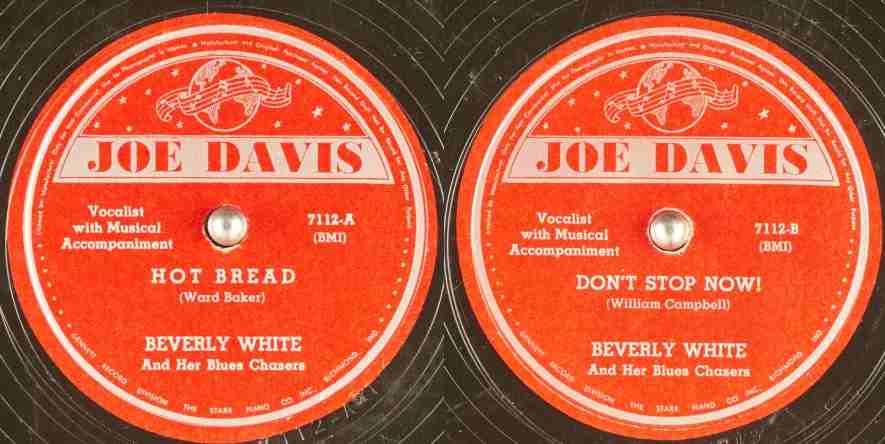
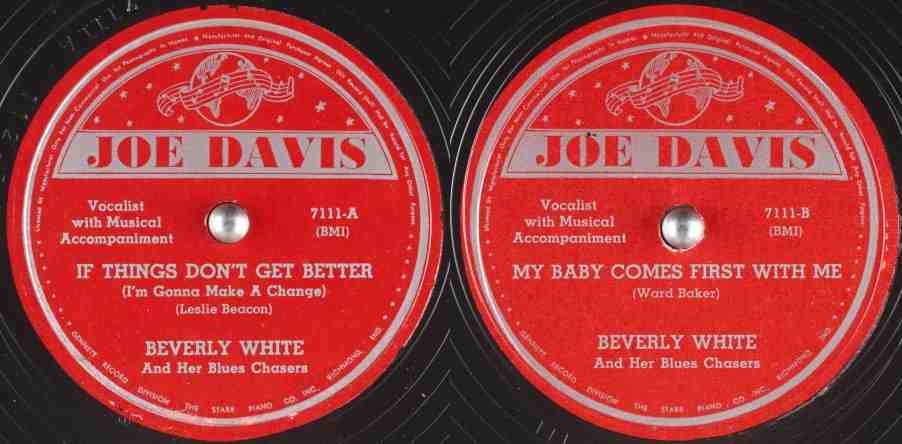 In August 1945, probably because she was now with Kirk, Joe Davis re-released the 1943 Beacon sides, although paired differently. This time, "Don't Stop Now!" was coupled with "Hot Bread" and "My Baby Comes First With Me", was backed by "If Things Don't Get Better (I'm Gonna Make A Change)".
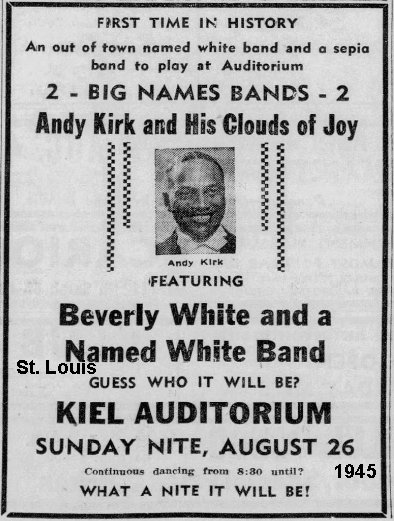
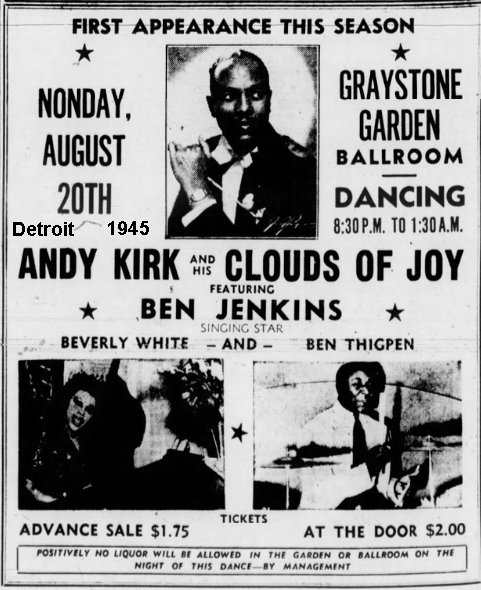 On August 20, 1945, they appeared at the Graystone Garden Ballroom in Detroit. On August 26, they were at the Kiel Auditorium in St. Louis. The strange ads said that there'd be two big name bands: Andy Kirk's and a "Named White Band - Guess Who It Will Be". However, no subsequent article ever said who it was.
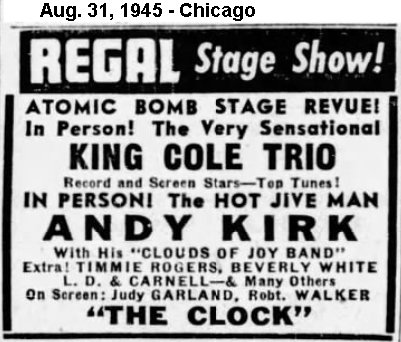 From there, it was up to Chicago's Regal, where they, Timmie Rogers, and the King Cole Trio, appeared the week of August 31. The three acts would tour together through early November.
Then, they played the Palace in Cleveland, the week of September 13. The next day's Cleveland Plain Dealer said: "The band is as stereotyped as Beverly White's singing, but they all put their hearts and plenty of volume into their work." At least they loved the King Cole Trio, since it "caresses your eardrums with its dulcet, artful arrangements...."

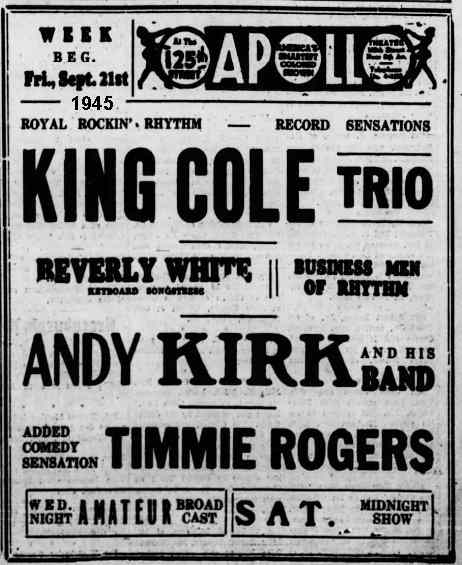 Next, the acts played the Apollo, the week of September 21, 1945 and were held over for a second week. The September 29 New York Age said of the first week's show:
Both Timmie Rogers and Beverly White gave great performances. Miss White plays the piano through the entire show. In addition to her specialty, she sang What More Can A Woman Do, Somebody's Gotta Go, and I'm Gonna Leave That Man. All of the headliners in this show are changing their material next week.
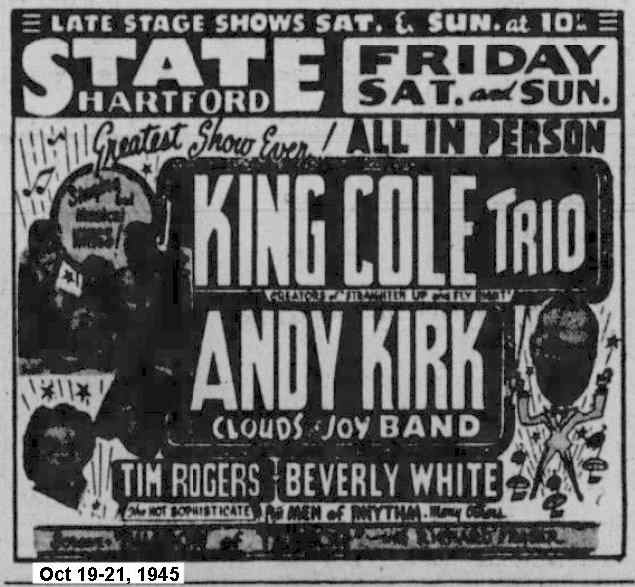 On October 19-21, they were all at the State Theater in Hartford, Connecticut. The October 20 Hartford Courant said:
Andy Kirk's large, dressed up band does good work. Plays solidly and has plenty of stand-out music men. His warbler, Beverly White, made the audience beg for more. Her blues songs and her ad lib patter and her pianistic ability plus personality got them at the opening performance and will probably get them at every show over the weekend.
The week of November 9 found the troupe at the Earle Theater in Philadelphia. For the first time in weeks, there was standing room only in the theater. Said the November 10 Philadelphia Inquirer:
Beverly White, vocalist, stepped away from her post with the band at the piano and took over the microphone to sing "How Much Do I Love That Guy" in such a way that she almost stopped the show.
By November 21, however, the troupe had broken up and the Kirk orchestra was present at the re-opening of the old Cotton Club location in Harlem, now named "Club Sudan". (The Cotton Club itself had moved to midtown Manhattan in the mid-30s.)
The December 28, 1945 Kansas City Call had this nearly-factual blurb:
Andy Kirk's singer and pianist, Beverly White, now appearing at the Club Sudan with the orchestra, is the god-child and protege of Ethel Waters, and was the first Negro girl ever to fill an engagement at Carnegie Hall. She appeared there in W. C. Handy's "Evolution Of Jazz" concert, and returned there in 1943 as vocalist in Duke Ellington's concert. [I've since seen the playbill for Handy's April 27, 1928 "Evolution Of Jazz" Carnegie Hall appearance. Guess whose name isn't in it.]
There's no trace of any of this. When Ellington was at Carnegie Hall (January 23, 1943), his vocalist was Betty Roche.
The Andy Kirk band started off 1946 with a Decca recording session on January 3. Beverly waxed "He's My Baby" with the band, although it would be over a year before it was released.
On January 11, 1946, Andy Kirk & his Clouds Of Joy, with vocalist/pianist Beverly White, guitarist Floyd Smith, and trombonist/vocalist Henry Wells opened at Fans Theater in Philadelphia. Both Smith and Wells were former members of Kirk's orchestra, but the draft had gotten them both. Now with the war over, Kirk was trying to get some of his old musicians back. Also on the bill was John "Spider Bruce" Mason, no doubt doing a version of "Open The Door, Richard", prior to it being recorded by Jack McVea at the end of the year.
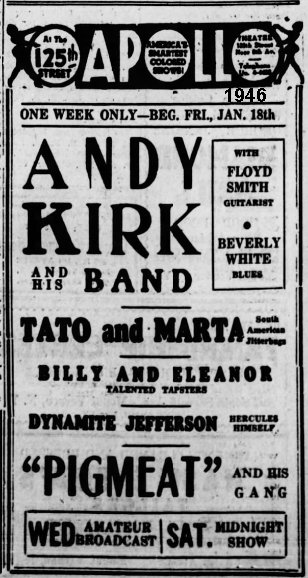 After Fans, it was straight into the Apollo Theater (the week of January 18), where Floyd Smith shared billing with Beverly (as he would in most subsequent ads).
The blurb in the February 16 Pittsburgh Courier was titled "Andy Kirk Tours Dixie". He'd been in West Palm Beach (Florida) at an unnamed venue. Of Beverly, it said: "Beverly White, who has always been a prime favorite in these parts, was given a great ovation as soon as she appeared on the bandstand. Miss White sang many request songs during the evening."
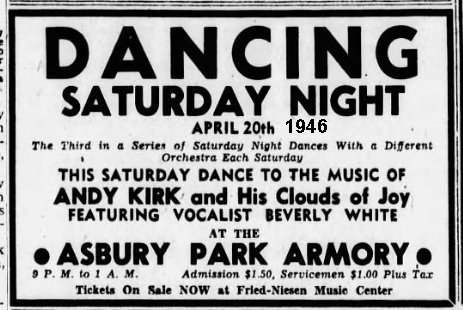
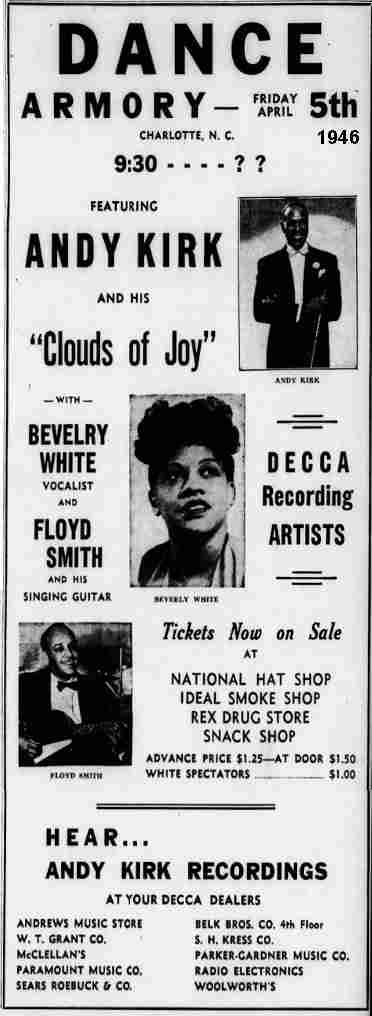 On April 5, it was the Armory (Charlotte, North Carolina); then the Armory in Asbury Park on April 20. While the ad for that one called them "Andy Kirk and His Clouds Of Joy", the blurb in the April 19 Long Branch Daily Record had it as "Clowns Of Joy". So close.
 Then up to Detroit, where they were at the Paradise Theater the week of May 4, 1946. The May 4 Detroit Tribune started this ball rolling:
"Beverly White, young singing pianist with Andy Kirk was the first colored girl to sing at the late President Roosevelt's Inaugural Ball in 1940."
However, there's a slight problem (assuming lies are "slight"): the election had been in 1940, but the inauguration was held on January 20, 1941. Normally, the ball would have been the same night, but, during that time, they weren't real balls, but private parties called "Charity Balls". The Great Depression and the war in Europe caused the real balls to be cancelled. The January 21 Baltimore Sun had this: "There was no inaugural ball, this elaborate feature of other years having been abandoned, perhaps forever. What night celebrations there were consisted of private parties in hotels and homes." No trace (as usual) of Beverly anywhere near Washington, D.C. Of course, there were celebratory "balls" held in other cities; I suppose she could have been at one of those.
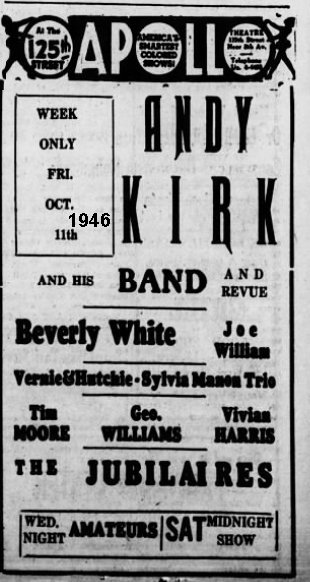
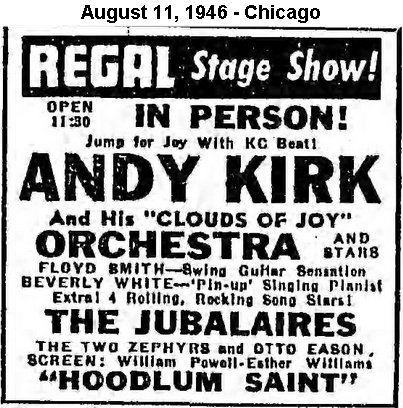

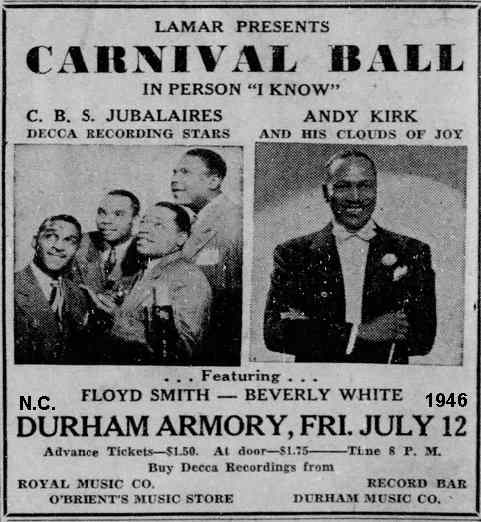 July 12 found them at the Armory in Durham, North Carolina (sure are a lot of armories around), along with the Jubalaires. Both acts would tour together through the end of 1946. On July 28, they were at the Greystone Ballroom in Cincinnati; the Regal Theater in Chicago the week of August 11; and the Apollo Theater the week of October 11.
The February 9, 1947 Austin American got some of it right, when they announced that Kirk would play the Dorie Miller Auditorium on February 11: "Beverly White is the young singing pianist featured with the band. She has worked in Leon and Eddie's, the Onyx Club, and appeared as guest star in many radio programs. [OK so far, but that's the end of the truth.] She was the first Negro artist to play in Carnegie Hall with W. C. Handy's Exhibition of Jazz - she was also the first Negro to sing at the late President Roosevelt's inaugural ball in 1940."
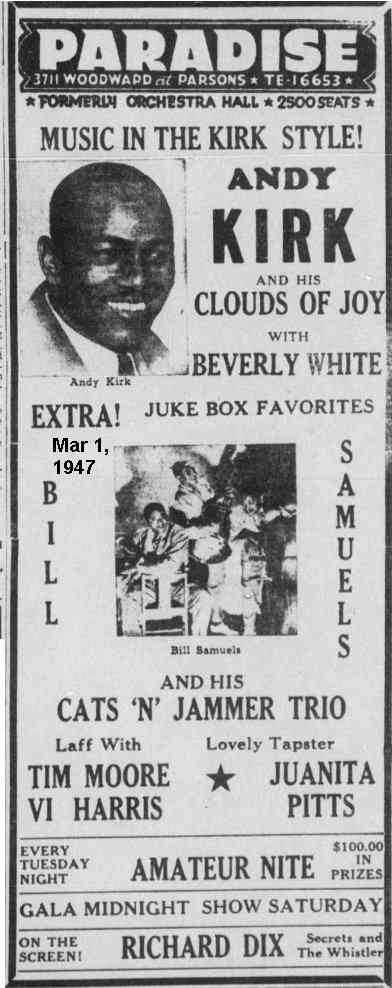
 After that, it was the Yacht Club in Dallas on February 16, before heading up to the Paradise Theater in Detroit for the week of March 1, 1947. Also in the show was Bill Samuels and the Cats 'N Jammer Trio.
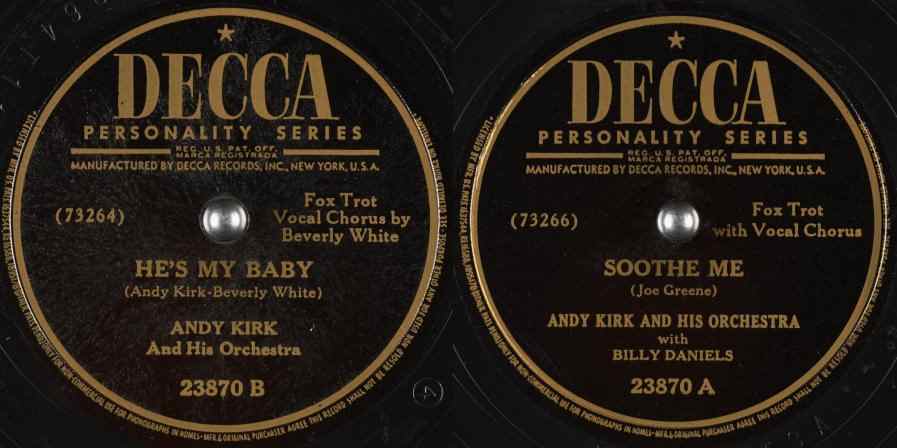 In April 1947, Decca released Beverly's "He's My Baby", with "Soothe Me" (vocal by Billy Daniels) as the flip. Both had been recorded back in January 1946. The record was reviewed in the May 10 Billboard:
No denying that there's honey drippings in the soothing tenor pipes of Billy Daniels, who takes the spotlight for Andy Kirk's spinning of "Soothe Me". Only it's a sultry and sexy blues, and while Kirk lays down a full and solid band background, Daniels is no blues singer. More in keeping with the band's capabilities, and spinning at a faster clip, is the maestro's "He's My Baby". Undoubtedly an old master, since it gives Mary Lou Williams' piano sparkle to send off the spin, the familiar gut box groovings, and the husky chanting of Beverly White. For the hot jazz library because of the "He's My Baby" side. [I don't know what they mean about Mary Lou Williams, one of the great pianists of the era. Piano on that session was played by Hank Jones.]

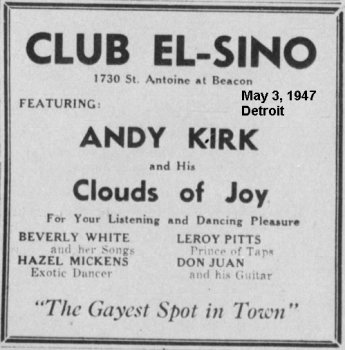 Still in Detroit, they appeared at the El Sino, starting on May 3. But it didn't go smoothly according to the headline in the May 17, 1947 Detroit Tribune: "Andy Kirk Takes Ill In Detroit". He'd been carried out of the club with a severe case of ptomaine (the term that used to indicate food poisoning, but which is no longer used).
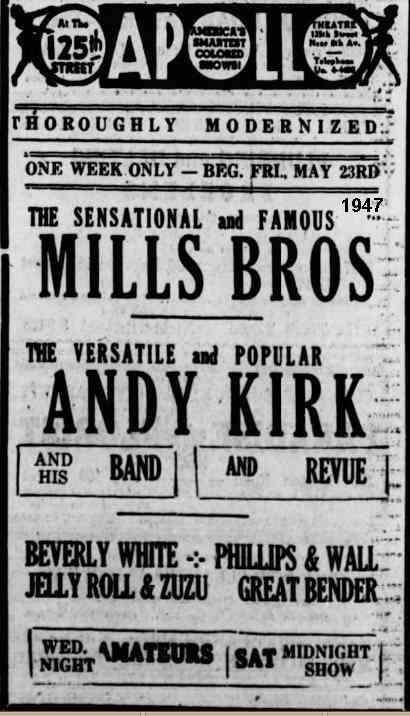 He'd recover in time to begin another trip to the Apollo Theater on May 23, along with the Mills Brothers.
And then, Beverly kind of left Andy Kirk. Since she sometimes appeared with him over the coming months, it's difficult to fathom what really happened.
 A July 11, 1947 ad for the Riviera Cocktail Lounge in St. Louis touts "St. Louis' Own Talented Beverly White - Formerly With Andy Kirk and Other Stars. Playing and Singing the Songs You'll Love" [there's that phrase again]. She was advertised through August 8, when Andy Kirk was there with her for one night. Held over, she was still there on September 7.
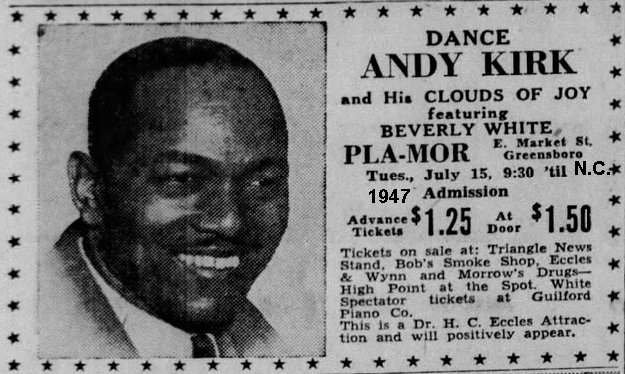 Presumably the ads for Kirk's appearance, with Beverly, at the Pla-Mor (Greensboro, North Carolina) on July 15 were printed before she left, since she was still at the Riviera in St. Louis on that date.
And then, under the heading "Where Do I Even Start?" This was in the August 6 Macon News, titled "Beavery [sic] White Featured With Andy Kirk At City Auditorium":
Beverly White, young singing pianist with the Andy Kirk Band, first saw the light of day in New Orleans in 1917. Got her first opportunity accompanying the great tenor Walter Richardson - in this capacity she traveled and entertained in all the big capitals of Europe as well as in this country and upon her return while working in a night spot was acclaimed by Walter Winchell and other prominent journalists and men of the theater. Since then she has worked in innumerable spots like Leon and Eddie's in New York, the Onyx Club, and other deluxe spots throughout the country - appeared as guest star in many radio programs and had the distinction of being the first colored girl to play in Carnegie Hall with W. C. Handy's Exhibition of Jazz. She is the first colored girl to sing at the late President Roosevelt's inaugural ball in 1940. She has been with Andy Kirk over a year, and is considered a very important feature of the band.
Beverly is proud of the fact that Ethel Waters is her god-mother and feels it has been luck for her.
Beverly's ambition is to follow in the wake of Hazel Scott - do concerts, and play in pictures - she is pretty and talented enough for both. [I must be getting old; I remember when her ambition was to follow in the wake of Florence Mills.]
Other than that she was "Beverly White" and she actually appeared at the two clubs named, absolutely none of that was true. I dug and dug but there was no Beverly or Magnolia White born in 1917 in New Orleans, nor were there ever a George and Bessie White there.
And the malady lingered on with this, from the September 7, 1947 St. Louis Globe-Democrat:
A St. Louis Negro girl is making highly satisfactory sounds with piano and voice these nights at the Club Riviera cocktail lounge. Monicker is Beverly White, and she has quite a background. For a year (1945) she was with the King Cole unit as girl vocalist and took care of the singing for Duke Ellington during 1943, which included a standout engagement at the Zanzibar. She was featured in the "Evolution of Jazz" concert with W. C. Handy at Carnegie Hall and played piano accompaniment for Fats Waller, who deserted his own keyboard for the moment to do straight vocal in the stage play, "Cabin in the Sky". She started her professional music career as accompanist for Walter Richardson, barytone, on a European concert, and as you can see for yourself, she's been going strong ever since.
After all that, there's not much use in telling you that she plays fine piano and sings as right as rain. Nice thing, too, she has a king-size repertoire, well stocked with all the good old tunes of yesteryear, plus a lot of her own original lyrics and music.
You really don't need me to pick this garbage apart again, except that she was never the vocalist with the King Cole Trio, her name was never (except in her own mind) associated with Walter Richardson, and Fats Waller wasn't in either the Broadway or movie version of "Cabin In The Sky".
She seems to have left the Riviera to appear with Andy Kirk again. The November 29, 1947 Pittsburgh Courier said: "Beverly White, the great pianist, walked out of the Riviera Lounge recently after several months' fascinating piano entertainment of customers . . . she gave no particular reason for leaving."
 By the time that was printed, she'd just finished a week (starting November 21) at the Apollo with Andy Kirk (and the Cats & The Fiddle).
The December 6, 1947 Chicago Defender said "Last week, Beverly cut eight sides for Mercury Records and is scheduled to wax at least 20 more before music czar Petrillo's ban goes into effect Jan. 1." Petrillo was the head of the musicians' union and this was the second time he banned union musicians from recording. This strike would last most of 1948 and record companies were frantically doing round-the-clock recording. However, there's no evidence that she ever recorded for Mercury. Did she record with Kirk and, if so, for whom? I have no idea. Kirk certainly made no Decca recordings between December 1946 and May 1949.
They were probably talking about Regent, a Savoy subsidiary, since this was in the December 13 Billboard: "Regent diskery inked a flock of talent, including Dolly Dawn, Jack Birch, the Charles Magnante Trio, chirp Beverly White (formerly with Duke Ellington's ork)...."

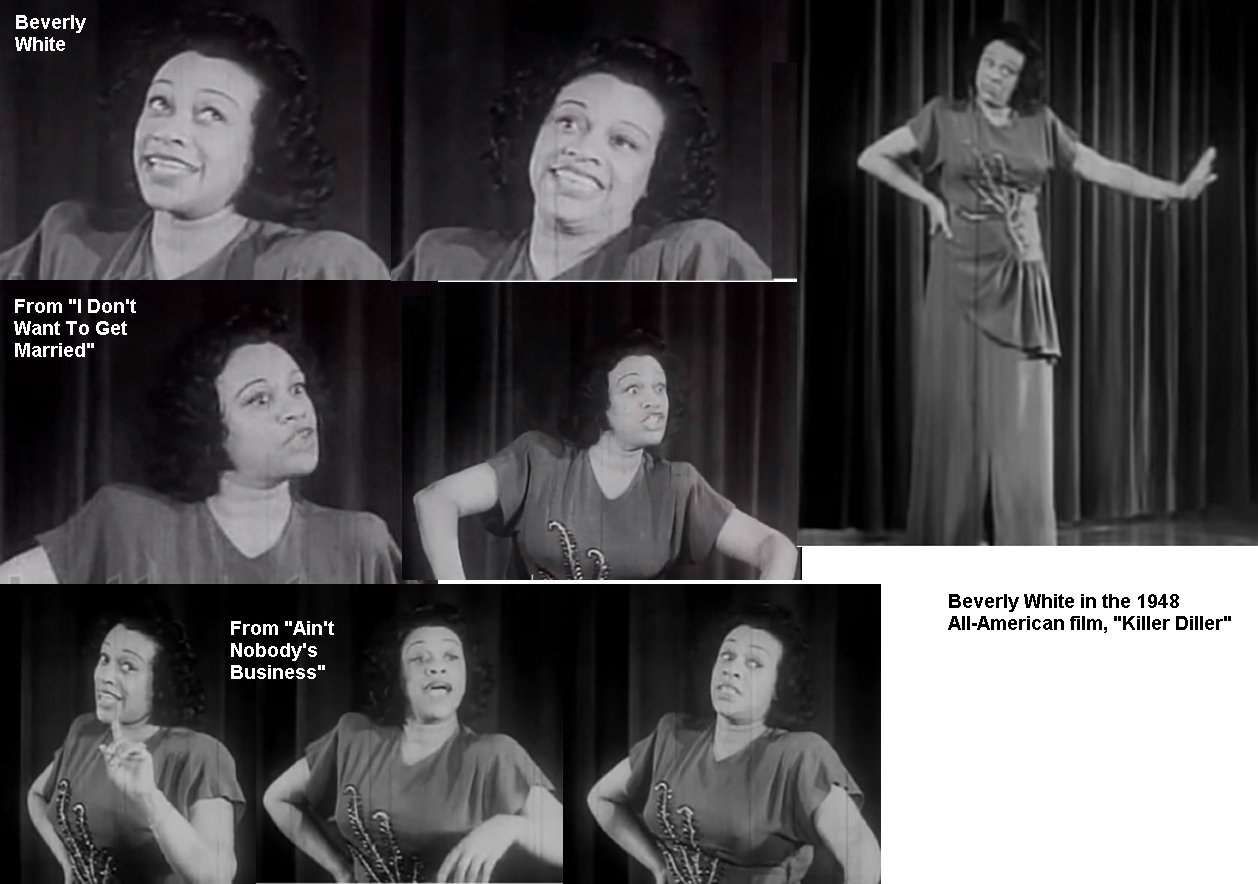 In 1948, Beverly appeared in the All-American film, "Killer Diller". Filmed in New York, it was completed in early January and released in April (first advertised on April 4). It had the Andy Kirk band, the King Cole Trio, Nellie Hill, Jackie "Moms" Mabley, George Wiltshire, Dusty Fletcher, Butterfly McQueen, Freddie Robinson (of Freddie & Flo), and Patterson & Jackson (doing their hilarious "If I Didn't Care" routine). In it, Beverly sang two songs, backed by the Kirk orchestra: "I Don't Want To Get Married" and "Ain't Nobody's Business What I Do". All the acts were in New York in November, so filming probably began then.
 Remember when Beverly "recorded" for Mercury? C'mon, it was only three paragraphs ago. The January 10, 1948 Norfolk, Virginia Journal And Guide had a photo of Beverly, surrounded by a couple of musicians (saxman Ray Abrahams and guitarist Hy White), recording eight sides "on New Year's Eve" for Sterling Records. Once again, they meant Regent. This time, I think I can prove it, so hang on until I get to March.
 In February, Beverly was at the Lenox Lounge in Harlem.
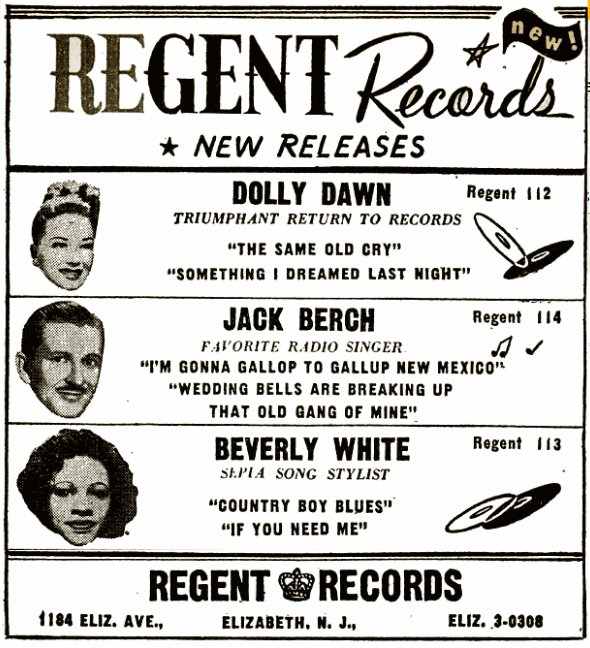 In March 1948, Regent released "If You Need Me", backed with "Country Boy Blues". The New Rochelle (New York) Standard-Star of April 13, talking about "If You Need Me", said:
It is being done by Beverly White and her all-star Jazz Men, featuring the famous Cozy Cole, Hy White, John Simmons, and Sanford Gold. With that combination, the recordings should sell plenty fast.
So, the key there is guitarist Hy White, in both the "Sterling" caption and the Regent write-up. It's hard to imagine how they keep getting this stuff wrong.
The actual label credit went to "Beverly White with All-Star Jazz Men".
 On March 28, 1948, Beverly appeared with Andy Kirk at the Easter Breakfast Dance at the Chestnut Street Hall in Harrisburg, Pennsylvania. Nothing more until August 20, when she opened at the Roma Restaurant and Cocktail Lounge in St. Louis. She seemingly slipped up in the September 10, 1948 St. Louis Argus, which said: "Miss White is proud to be known as a product of St. Louis." Has she abandoned New Orleans? Nah. Then back with Andy Kirk when the band played the Congo Club (Los Angeles) on November 12.
The November 18 Valdosta (Georgia) Daily Times of November 18 said: "Beverly White ... first saw the light of day in New Orleans in 1917." (Told you.)

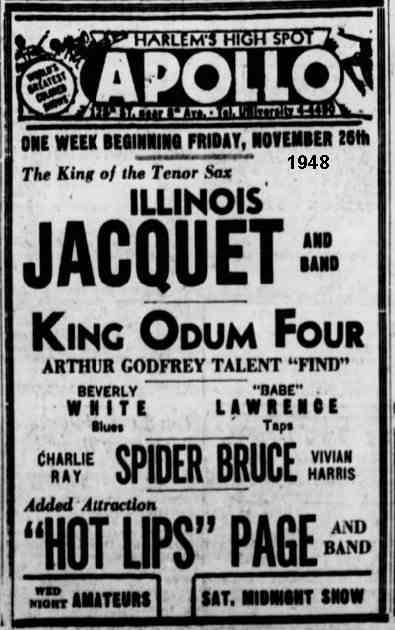 Beverly (by herself) was back at the Apollo Theater the week of November 26, 1948, along with Illinois Jacquet and the King Odom Four. In early January 1949, Beverly played the Barrel (St. Louis). By May, she was back in the cocktail lounge of the Riviera (also St. Louis).

 In March 1950, Beverly had been at the Troost Lounge in Kansas City for over a month, but there weren't any ads. In May, she transferred to the Beaumont Lounge in St. Louis.
Beverly's mother, Bessie White, died on May 31, 1950. The informant on the death certificate was Magnolia B. White, who still gave 3320 Lucas Avenue as her address.
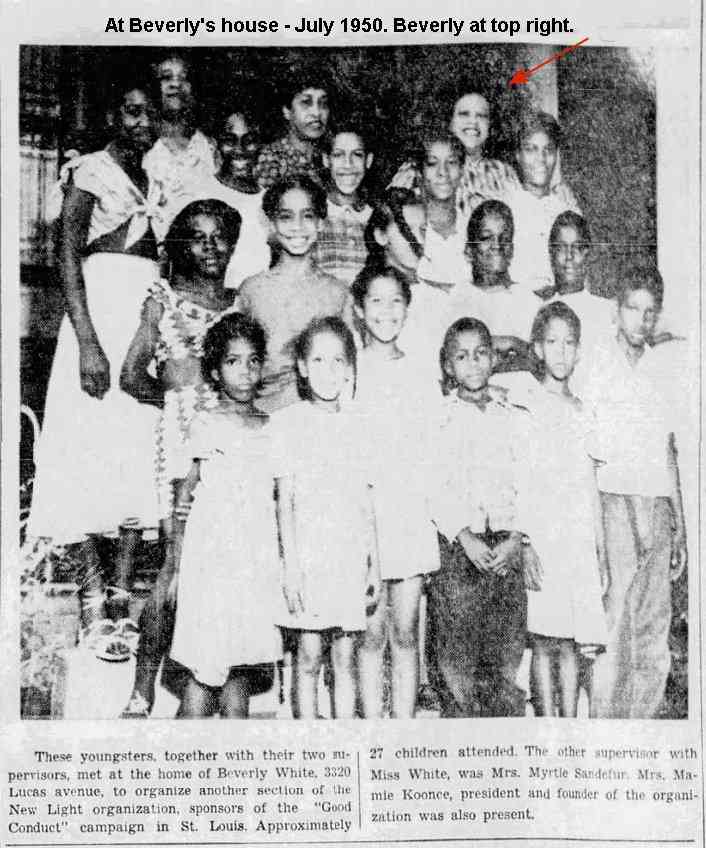
 In July, Beverly was at the Sun Club in St. Louis. The July 14, 1950 St. Louis Argus had a photo of a bunch of children with the title "Organize Another New Light Club". This had to do with St. Louis' "Good Conduct" campaign. They all met "at the home of Beverly White, 3320 Lucas Avenue", and she was also in the photo.
 In August, she was back at Kansas City's Troost Lounge, but there were still no ads. There's a photo of her there with Kansas City star, Julia Lee.
Beverly started 1951 with a stint at the Barrel Bar in St. Louis, although she was only mentioned on January 14. In early March, she was found at the Victorian Room, also in St. Louis, where she was advertised from the 4th through the 14th.
Nothing more for a year, when the June 13, 1952 St. Louis Argus said that "Beverly White, talented pianist and vocalist, also cut four masters for Trumpet Records, which should be released in the near future." Trumpet, owned by Lillian McMurry, was headquartered in Jackson, Mississippi. On June 7, at Premier Radio Enterprises in St. Louis, she recorded "I Waited too Long", "I Don't Care", "Cling To Me Baby", and "When I'm With You". Aside from Beverly White (vocals and piano), there were three studio musicians: William Moore (guitar), Art Schieler (bass), and Robert Heuer (drums).
She was back at the Troost Lounge sometime in March; the title of the July 4, 1952 Kansas City Call article was "Beverly White Goes Into Her Last Sensational Week At Troost Lounge". By now, you should be able to separate most of the wheat from the chaff without my help:
The coming week will complete a limited engagement at Troost Lounge for Beverly White, the sensational pianist and song stylist, who has been giving Kansas City some real musical thrills since Monday.
Beverly comes to Kaycee from the exclusive Victorian Room in St. Louis where she is under a long-term contract. The Troost Lounge engagement is the only outside date she is playing this season.
Her recent record hits have proved favorites with local music fans "Smooth Road" and "Be Anything, Be Mine" have had audiences asking for more. [Or, at least, asking "when did she ever record those???"] A special matinee on Saturday from 3 to 6 will give an opportunity for her fans to hear her. She plays nightly from 9 until 1:30 at the popular Oriental Room.
Recent smash engagements have included the swank Casino in Mexico City, a successful eastern tour and turn away dates at Detroit. Kansas City fans will remember her appearances with Duke Ellington and the King Cole trio.
An accomplished musician, Miss White received her training in Paris where she was discovered by the Duke of Windsor and retained by him for personal appearances. She has also starred in movie shorts, radio, and rave record releases. Versatile, her repertoire includes ballads, blues, classics and novelty numbers with her own exclusive interpretation.
As I've said, there's not a single record of her ever leaving the country.
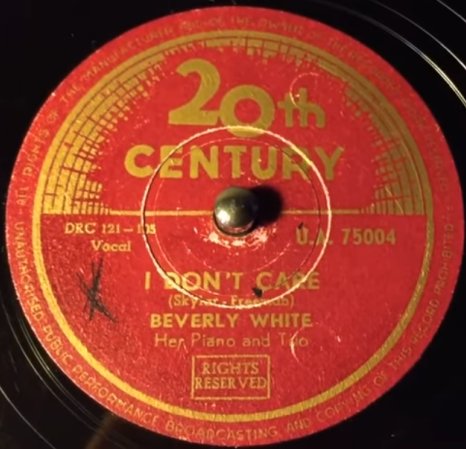
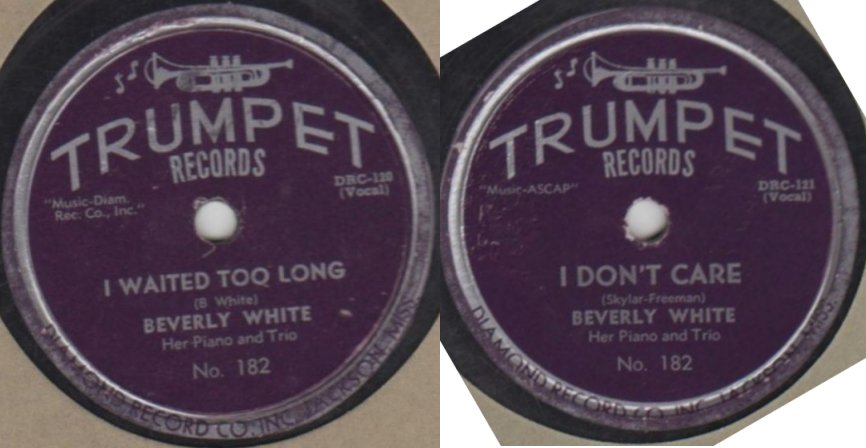 In September 1952, Trumpet released "I Waited Too Long", backed with "I Don't Care". These were credited to "Beverly White & Her Trio". Trumpet had some sort of deal with a European label called 20th Century. At an unknown date (but probably in 1953), they released "I Don't Care" (as Beverly White - Her Piano And Trio). The flip was "Susie", by "Tag" Williams (but probably Clayton Love & His Shufflers), another Trumpet act.
 1953 saw Beverly's last recordings. Done for the local Torch label, they were "Let's Be Sure" and "Cinderella Ella", released in February. Can't say I like either of them. "Let's Be Sure" is almost operatic, with a heavy echo; "Cinderella Ella" has a Dread Chorus.
The April 3, 1953 St. Louis Globe-Democrat said:
My Tin Pan Alley spies tell me there's a new hit record arriving in local music stores today - a rhythm song with a beat that makes you want to get right up and dance. It's "Cinderella Ella", sung by Beverly White and the Three Princes [not mentioned in the credits] on the Torch label. Song was written by Julian Miller, Prom magazine editor, who is our town's only member of ASCAP, national honorary society of America's top song writers.
 Beverly's last trip to the Apollo Theater was the week of June 19, 1953. The star was Pearl Bailey and her husband, drummer Louis Bellson. Also there was Dusty Fletcher, presumably still doing his "Open The Door, Richard" routine. This was the only time that Apollo owner Frank Schiffman commented on Beverly; it was the terse "Fair".
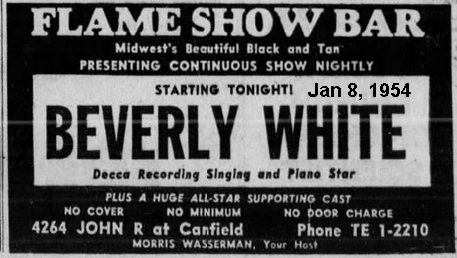
 Nothing more until year-end, when Beverly was at the piano in the Pirate Cove room of the Victorian Club West in St. Louis. Then it was up to Detroit, where she opened, at the Flame Show Bar, on January 8, 1954. She'd be there for most of January, but then disappeared for a year.
There's an ad for Beverly appearing at the Belle-Mar (Syracuse, New York) from March 18, 1955 through mid-April.
The July 8, 1955 "Chick Finney's Blue Notes" column in the St. Louis Argus had this: "Have Beverly White to get in touch with this corner immediately. It's been reported the jazz pianist has recently returned home." His September 2 column said: "According to popular Beverly White, noted recording artist and night club entertainer, her bosom pal, Pearl Bailey, has done it again. She's investing her loot in a string of Nite Spots across the country, which will be named after one of the latest Broadway 'hit' productions." That was pretty useless; what else was Beverly doing in 1955?
 On January 22, 1956, Beverly was one of the acts appearing at the Kiel Opera House in St. Louis for a March Of Dimes benefit. Also there were the Mary Kaye Trio and Tab Smith. The ad said she was currently at the Victorian Club.
The January 29, 1956 St. Louis Globe-Democrat said: "Pianist Beverly White is setting some sort of record at the Victorian Club. She's now in her fourth year there." Sadly, this was another lie. While most Victorian ads didn't mention a performer, in January 1954, it was Lynn Martin and in August 1955, it was Carole Simpson.
And the truth gets another stab in the back, courtesy of the October 20, 1956 St. Louis Globe-Democrat: "Pianist-thrush Beverly White now back at the Victorian Club, may be warbling with a French accent. She just finished an engagement in Paris, France." This puzzling item was in the paper's December 2 edition: "Beverly White, local pianist, has taken over her uncle's spot, the Riviera Cocktail Lounge, 4400 Delmar [actually 4460], and is adding a flock of innovations." The Riviera was owned by Jordan Webster Chambers, a local politician; when he died in 1962, his obituary said he still owned it. I can't find anything that would make him her uncle (although nothing she says surprises me anymore; but the worst is yet to come; stay tuned).
She made it to the January 24, 1957 St. Louis American, in a photo that I can't make out. Doesn't matter anyway; the caption tells us that she was still at the Riviera Lounge and that it was the scene of the Tavern Owners Ball. More important, her table "took top honors in table decorations". Go Beverly!
She was at a Heart Fund show at Kiel Auditorium on April 28, 1957, along with Tony Bennett, Stan Getz, Jimmy Forrest, and the Dozier Boys.
But now, an identity problem. In May 1957, ABC-Paramount released Beverly White's "I Ain't Got Nothing But The Blues". However, this wasn't "our" Beverly, but Josh White's daughter, Beverly White Saunders. She would also have a release on Philips ("Green Corn") in 1962.
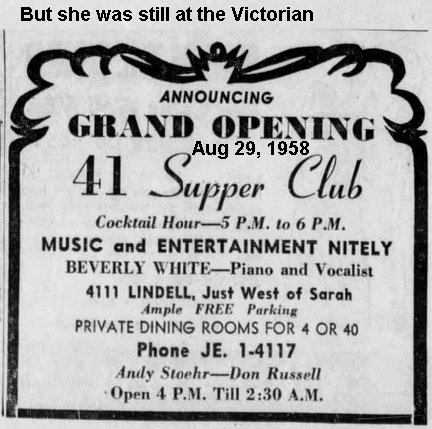 Starting in July 1957 and throughout 1958, Beverly was back at the Victorian Club. While there, she also appeared, at least in late August and early September 1958, at the 41 Supper Club.

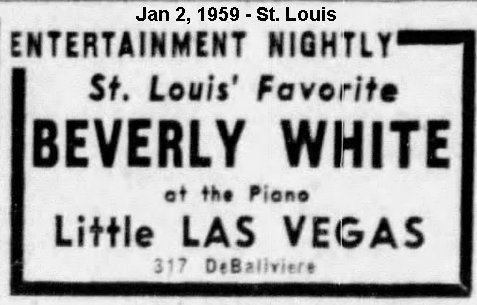 On January 2, 1959, Beverly was advertised at the Little Las Vegas in St. Louis. In late January and early February, the ads were for the piano bar at the Victorian Club. A column in the February 12 St. Louis American said: "Heard Beverly White is 'adding' a new club on the north side, via TV no less . . . Go, gal!" At least we know she was keeping busy, although the only other mention in 1959 was when she was pictured in a September ad for Laurel Springs Whiskey.
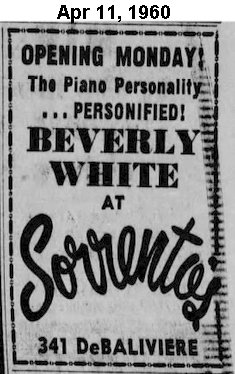 Next, she turned up at Sorrento's (St. Louis) on April 11, 1960. The ad called her "The Piano Personality Personified". By July, she was back at the Victorian Club.
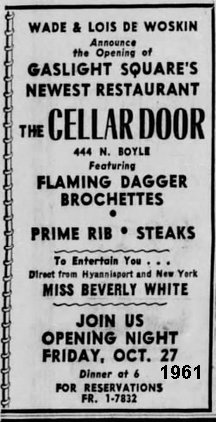 Nothing more until October 27, 1961, when she was at the opening of St. Louis' Cellar Door (featuring flaming dagger brochettes). She was last mentioned there on November 7.
Her only 1962 mention was in the March 23 St. Louis Argus, in a list of "a few local artists that have succeeded in the last 30 years". Also on the list were: Miles Davis, Jimmy Forrest, Ike Turner, Tommy Dean, Chuck Beery [sic], Tab Smith, Albert King, and Floyd Smith.
Nothing at all in 1963 or 1964. Most mentions of "Beverly White" from here on were for Josh White's daughter.
We've seen, up to this point, that Bev had a slight problem with that pesky "truth" thing. However, we can chalk that up to "little white lies" compared to what follows.
Here's someone new on the scene: the February 11, 1965 Wilkes-Barre Times-Leader said: "Art Tatum's big little girl, Mae, at the 88 in Delmonico's Late Edition [the name of a club in Manhattan's Delmonico Hotel]." And the February 12 New York Daily News: "Singer-pianist Mai [the usual spelling] Tatum renewed for four weeks at Hotel Delmonico's Late Edition." Revered jazz pianist Art Tatum had died in November 1956, so never got to see his little girl receive accolades.
Very interesting, but why am I bringing this up? Several March 30, 1965 papers had this:
Some of the best piano in town is being offered these nights by Mai Tatum in the Late Edition Room at the Delmonico. Mai, who used to be known as Baby White and then as Beverly White, is the daughter of the late, great Art Tatum, and she has a lot of Daddy's talent. The night I caught her she told me she was afraid she might not give a top performance. "I got a cramp in my rhythm leg." she told me. Well, I heard her play and, in my opinion, all pianists should go out and get cramps in their rhythm legs.
I believe this, the Biggest Lie, was a reaction to the growing popularity of Josh White's, daughter, Beverly White. Time to go digging. Let's zip forward to March 16, 1972, when "Mai Tatum Plays Big Piano", by Dick Richmond, appeared in the St. Louis Post Dispatch. By now, you can pick apart much of it yourselves.
In 1950, a beautiful young singer named Mai Tatum opened a three-week engagement at the Victorian Club on Washington Boulevard, then one of the most exclusive spots in St. Louis. She stayed 10 years, until the Internal Revenue Service padlocked the doors in 1960 for taxes.
Older and a little heavier, she opened last week for a month-long run at Bebaby whitenedetti's Tumble-In at Boyle Avenue and Lindell Boulevard, performing at the piano bar on Thursday, Friday and Saturday nights.
She is the daughter of the late, great jazz pianist Art Tatum, and if musical genius can rub off, some has brushed onto her. Her voice now is small but pleasant, but she plays big piano and her fingers seem to have a musical memory of their own.
"I didn't make a name for myself with my piano playing," said Miss Tatum, who was the first black female performer to appear in concert at Carnegie Hall. "I started as a singer and even changed my name to Beverly White. I didn't want to trade on my Daddy's fame.
"As a matter of fact, early in my career my piano playing got me fired from the Duke Ellington band. I was Ellington's vocalist," she said, "and we were playing at the Zanzibar Club in New York. I heard this blind singer from Little Rock named Al Hibbler and arranged an audition with Ellington for him.
"Al came to the club and waited around, but Ellington was in no hurry. He spotted Betty Grable and Harry James at one of the tables and went over and chatted with them. I felt sorry for Al just waiting like that and when one of the band members suggested that I play piano for Al to give him his chance, I did.
"Al brought down the house. and was hired, but Ellington wasn't happy with me. He let me know that he was the only piano player in the band. One of the other members of the band spoke up and told Duke he was mad because I played better than he did. A little while later I got a note saying I was fired."
She smiled, recalling the incident. "But I stayed on," she said. "The club owner hired me and I still sang with the band. It didn't seem to bother Ellington. I guess he figured he wasn't paying me, so what the heck. But after that, I gave the piano a wide berth."
Miss Tatum, who has a master's degree from the Juilliard School of Music, is writing an autobiography, which she's calling "20 Years Before the Masses."
"I've known so many performers personally," she said, "and when I read some of the junk that's written about them, it makes me mad. I want to put a lot of things straight." [Oh, the hypocrisy!]
She sang with a number of big bands and was in the original cast of "Cabin in the Sky." It was Nat King Cole and Macdonald Carey, two of her father's biggest fans, who prevailed upon her to retake the family name and resume her piano playing.
When asked to play like her father, she replies that the best she can do is mimic him. But then, that's good enough.
Oh, my; oh, my. Let's start with this: we've already seen that Beverly was born in late 1910 (remember, she was 9 in the 1920 census). How about Art Tatum? He was born October 13, 1909. In later years, "Mai Tatum" appeared in the St. Louis City Directory with a birthday of November 17, 1920 (that's where I got the November 17 from in her birthdate; it's reasonable that she kept that). Art Tatum would have been 11 on that date. Remember, Beverly was singing in a club in Saratoga, New York in July 1932. A November 1920 birth date would have made her 11; far too young to be allowed in a club that wanted to keep its liquor license.
In 1994, James Lester published a book called "Too Marvelous for Words: The Life and Genius of Art Tatum". Of course, he learned of her story, and he started investigating. He had Juilliard check their records and no one named "Mai Tatum" or "Beverly White" had ever attended, let alone received a Master's degree. Al Hibbler, himself (who came from Mississippi, not Arkansas), refuted her story about how Ellington hired him. Lester checked with the St. Louis musicians' union and found that she (as Beverly White) had refused to give them a birth date.
Nat King Cole had conveniently died the month before this story was published, so he couldn't be asked about it. I have no idea how actor Macdonald Carey entered into it. Of course, we know she was all over the place between 1950 and 1960 and didn't spend 10 years at the Victorian Club, at which she briefly appeared in March 1951, not 1950. Has anyone out there read her autobiography? Didn't think so; no book with that title was ever published (although, I have to admit, I like the title a lot). It probably would have spent months at the top of the best-selling fiction lists.
She said she didn't make a name for herself with her piano playing, although that's exactly what she did. She was always known as a singer/pianist and played special duets with Claude Hopkins.
When you lie and lie and believe everything you say is true, you'd make a great politician. Remember: be careful when you begin to believe your own press releases.

 January 4, 1966 found Mai at Firmature's Trentino Restaurant and Cocktail Lounge in Omaha, Nebraska. [I'll refer to her as Mai from now on.] The ads were full of her lies (and her photo in most 1966 ads was from 1945). By April 8, she'd switched to Omaha's Bombay Bar, in the Sheraton Fontenelle, and was advertised until July 6 (with the same old photo). October 3 found her at the Stage Door, in Des Moines, Iowa. Then, it was up to the Captain's Lounge in La Crosse, Wisconsin in mid-October, followed by the Simon Bar in Madison, Wisconsin (whose ads finally used a current photo) from late November to the end of the year.
Oy. The December 28, 1966 Capital Times (Madison, Wisconsin) said: "Pianist Mai Tatum has been signed to an 'unlimited contract' at the Simon House. She plans to take a few days off after New Year's for a visit to her Omaha, Neb. home, then back to the keyboard here." Should I bother to mention that there's no trace of her living in Omaha?
A February 23, 1967 article in the Capital Times said that she'd signed a year's contract with the Simon House. Maybe, but there was only a single ad for her that year (March 10). However, that article added a lot to her mythos. Some excerpts:
She now claimed she'd played for Princess Grace of Monaco, along with President Roosevelt. She'd been with Duke Ellington for three years (she originally said two years, although in fact it was around two months).
"... in Denver, Colo., Eleanor Roosevelt requested Miss Tatum to play 'Going Home', one of the late president's favorite songs."
And it rolls on:
"During Robert Kennedy's campaign for senator in New York, Miss Tatum toured New York schools with Sammy Davis, Jr, Carol 'Hello Dolly' Channing, Sonny Fox, and Kennedy."
On April 23, she was part of a program given by the Madison musicians local. I've no idea where she was the rest of 1967, although it was probably the Simon House.
A strange legal notice in the January 11, 1968 Madison Wisconsin State Journal (repeated on January 18 and 25). Two people named Borcherding and two named Colletti were suing Mai Tatum, Castle & Doyle, Struck & Irwin Fuel Company, the Pioneer Improvement Company, and the First Wisconsin National Bank. Unfortunately, the legal notice didn't say what it was all about.
At some point in 1968, Mai was at the Club Pigalle in the Hotel Jefferson (Peoria, Illinois).
In December, there were ads for the Mai Tatum Duo at the Flamingo Supper Club in Omaha. Don't even bother to ask who the other member of the duo was. (My best guess: she played twin pianos with Beverly White.)
She was still there in March 1969, but there had been no further mention of a "duo". On April 17, 1969 the Omaha World-Herald reported that:
An M-G-M recording crew from Chicago made a tape of pianist Mai Tatum at work in the Tiki Lounge at the Flamingo pub last week.
At the director's request, Mai played numbers identified with her father, the late Art Tatum.
The result will be a record called "Tatum Plays Tatum".
I'm still waiting.
The Flamingo ads stopped on June 14 and there's no further trace of her that year.
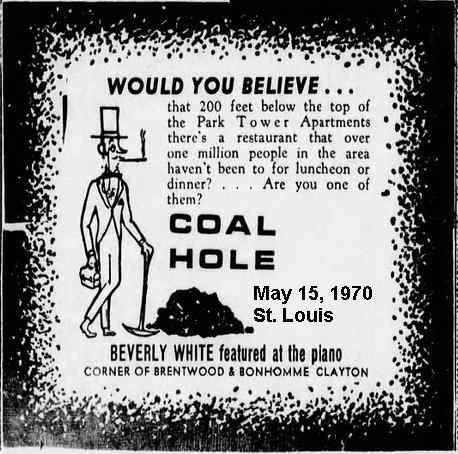
 In 1970, she returned to Missouri and opened, on January 6, at the Coal Hole in Clayton, a suburb of St. Louis. There were only two Coal Hole ads for her, but strangely, their May 15 ad called her Beverly White.
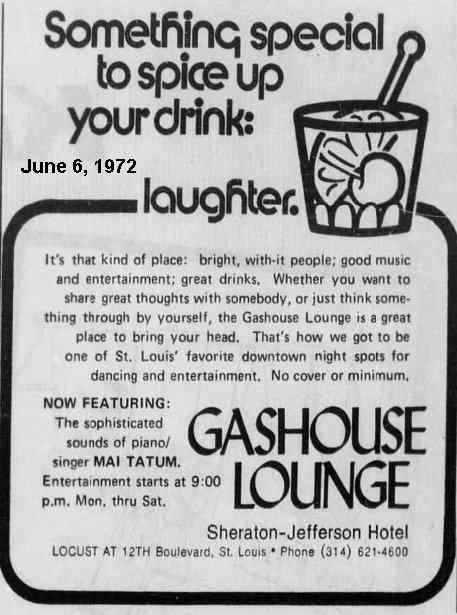 Nothing at all in 1971, but in June 1972, there were a couple of ads for Mai at the Gashouse Lounge in St. Louis.
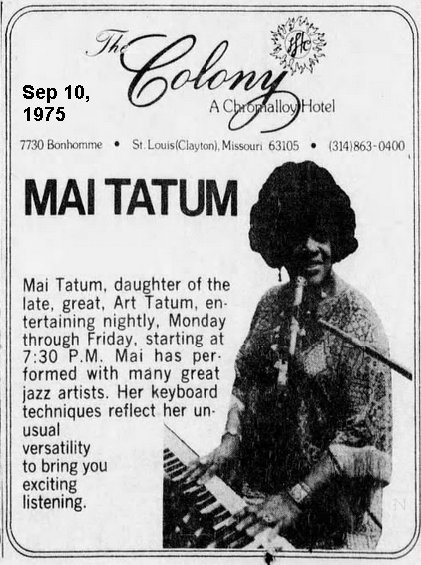 Then, two more years of silence, until she appears at the Colony Hotel, in Clayton, starting in mid-September 1975; ads ran through June 1976.
Nothing in 1977, but in August 1978 she was at the Copperfield Lounge in St. Louis' Lenox Hotel, although there were no ads. She was still there in March 1979, but in July of that year, she was entertaining at a place called Siegfried IV. Then, in August, it was the Portico on weekdays, as well as Siegfried IV on Fridays.
Nothing at all in 1980, but in February 1981, it was Hannigan's, Tuesdays through Saturdays. She continued there through 1984.
1985 was another blank year, but in January 1986, she started appearing on the Goldenrod Showboat (entertainment cruises on the Mississippi) every Friday and Saturday night through the end of the year. December 25, 1986 was the last mention ever of Mai Tatum.
Beverly White, as Mai Tatum, died, in St. Louis, on February 4, 1989. Her birthday, on the death record, was given as November 17, 1920, which I mentioned before (and have, hopefully, thoroughly debunked). As popular as she was in St. Louis, there was no mention of her passing under either name.
This is the point where I usually give a conclusion, but in this case, it's hard to know what to say. It seems like every time Beverly White talked about herself, there were lies involved. It's hard to imagine why she felt so insecure that she had to constantly re-invent herself. I have to admit, though, if you'd asked me to write a fictional biography, I couldn't have done better.
DECCA (Claude Hopkins And His Orchestra - vocal by Baby White)
1153 Sunday / Swingin' Down The Lane - 3/37
1286 June Night / [Church Street Sobbin' Blues - Claude Hopkins] - ca 5/37
1316 Honey / My Kinda Love (One Way To Paradise) - ca 6/37
BEACON (Beverly White & Her Blues Chasers)
111 Don't Stop Now! / My Baby Comes First With Me - 3/43
112 Hot Bread / If Things Don't Get Better (I'm Gonna Make A Change) - 4/43
JOE DAVIS (Beverly White & Her Blues Chasers - reissues)
7111 Don't Stop Now! / Hot Bread - 8/45
7112 My Baby Comes First With Me / If Things Don't Get Better (I'm Gonna Make A Change) - ca 8/45
DECCA (Andy Kirk Ork Voc By Beverly White)
23870 He's My Baby / [Soothe Me - vocal by Billy Daniels] - ca 4/47
REGENT (Beverly White; subsidiary of Savoy)
113 If You Need Me / Country Boy Blues - 3/48
MOVIE - "Killer Diller" - 1948
I Don't Want To Get Married
Ain't Nobody's Business What I Do
TRUMPET (Beverly White & Her Trio)
182 I Waited Too Long / I Don't Care - ca 9/52
TRUMPET UNRELEASED
Cling To Me Baby (recorded June 7, 1952)
When I'm With You (recorded June 7, 1952)
20th CENTURY (Beverly White - Her Piano And Trio; European pressing)
75004 I Don't Care / [Susie - "Tag" Williams] - 53?
TORCH (Beverly White; a St. Louis label)
2010 Let's Be Sure / Cinderella Ella - 2/53
The following two records are by Josh White's daughter, Beverly White Saunders:
ABC-PARAMOUNT (Beverly White)
9823 I Ain't Got Nothing But The Blues / It's You - 5/57
PHILIPS (Beverly White)
40012 Green Corn / I'll Walk The Rest Of The Way - 7/62